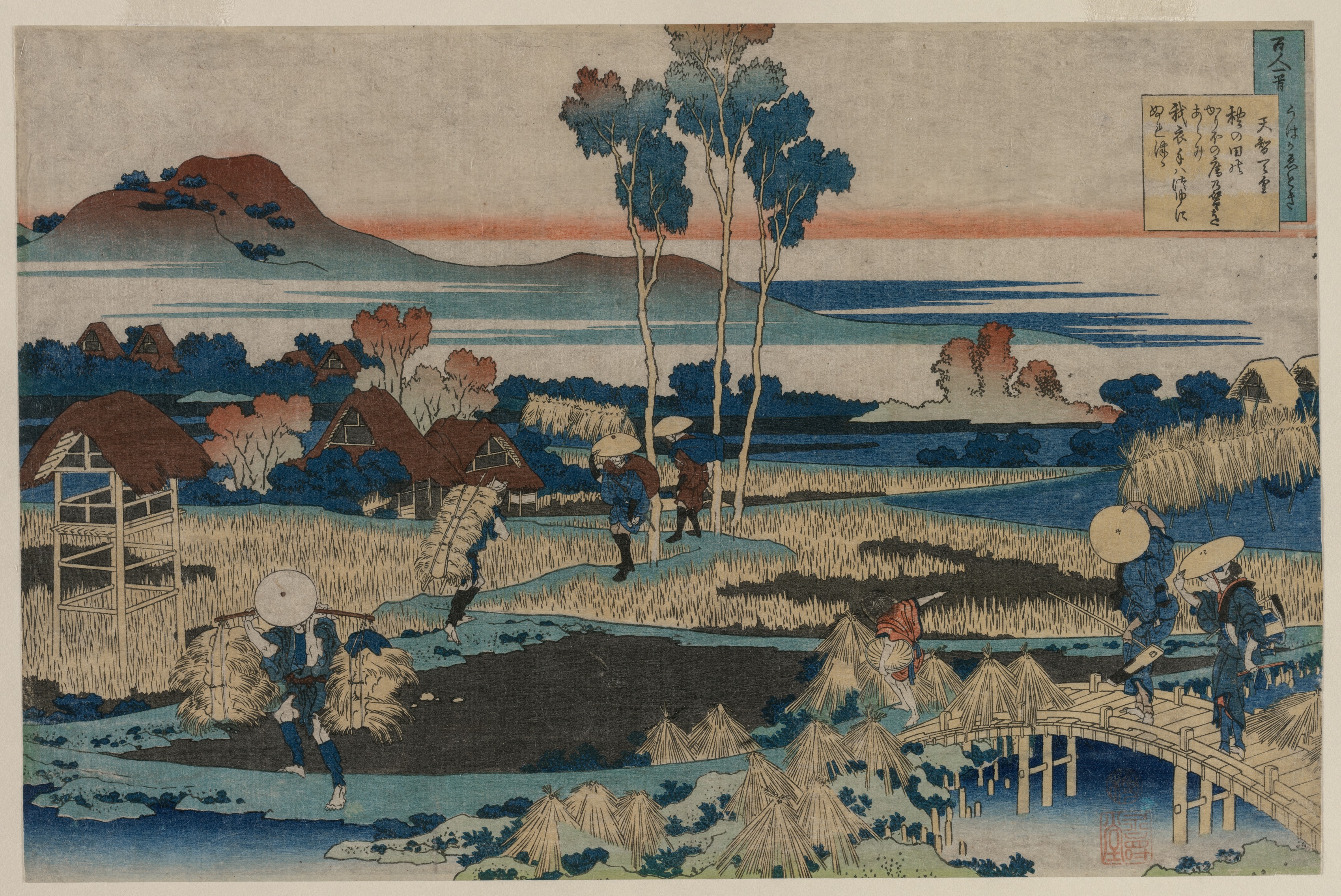
Poem by Emperor Tenchi, from the series One Hundred Poems by One Hundred Poets Explained by the Nurse
Woodblock print depicting a rural Japanese landscape. The scene features a body of water with a mountain range in the background. The sky above is a mix of gray and pink hues. In the foreground, several people are shown carrying large bundles of straw or thatch on their backs. Some individuals are crossing a bridge, while others are walking along a path. The people are dressed in traditional Japanese clothing. The image includes several trees and bushes with varying shades of green, orange, and brown leaves. The print features a color palette of blue, beige, brown, and orange. A small inset in the top-right corner contains Japanese text on a yellow background with a blue border. The overall composition shows a serene and peaceful rural scene.
Artwork details
- Dimensions:
- 900 × 601 px
- Museum record:
- View original
You May Also Like

Poem by Tenchi Tennō, from the series One Hundred Poems Explained by the Nurse (Hyakunin isshu uba ga etoki)

Tenji Tenno (The Emperor Tenji), first poet in the series One Hundred Poems by One Hundred Poets Explained by the Nurse

Lower Meguro (Shimo Meguro), from the series "Thirty-six Views of Mount Fuji (Fugaku sanjurokkei)"

Viewing Maple Trees

Poem by Sarumaru Dayu, from the series "One Hundred Poems Explained by the Nurse (Hyakunin isshu uba ga etoki)"

Okabe: Utsu Mountain (Okabe, Utsu no yama), from the series "Fifty-three Stations of the Tokaido Road (Tokaido gojusan tsugi no uchi)," also known as the Hoeido Tokaido

Evening Moon at Izumizaki (Izumizaki yagetsu), from the series "Eight Views of the Ryukyu Islands (Ryukyu hakkei)"

Okabe: Utsu Mountain (Okabe, Utsu no yama), from the series "Fifty-three Stations of the Tokaido Road (Tokaido gojusan tsugi no uchi)," also known as the Hoeido Tokaido

Lower Meguro (Shimo Meguro), from the series Thirty-six Views of Mount Fuji (Fugaku sanjūrokkei)

Poem by Sarumaru Dayū, from the series One Hundred Poems Explained by the Nurse (Hyakunin isshu uba ga etoki)

Yui: The Yui River (Yui, Yuigawa), from the series "Fifty-three Stations of the Tokaido (Tokaido gojusan tsugi)," also known as the Tokaido with Poem (Kyoka iri Tokaido)

Bamboo Grove at Kume Village (Kumemura no chikuri), from the series “Eight Views of Ryukyu Islands (Ryukyu hakkei)”

Tama River in Musashi Province (Musashi Tamagawa), from the series "Thirty-six Views of Mount Fuji (Fuji sanjurokkei)"

Odawara: The Sakawa River (Odawara, Sakawagawa), from the series "Fifty-three Stations of the Tokaido Road (Tokaido gojusan tsugi no uchi)," also known as the Hoeido Tokaido

Banana Garden at Nakashima (Nakashima shoen), from the series "Eight Views of the Ryukyu Islands (Ryukyu hakkei)"

Harumichi no Tsuraki, from the series "A True Mirror of Japanese and Chinese Poems (Shiika shashin kyo)"

Lower Meguro (Shimo Meguro), from the series Thirty-six Views of Mount Fuji (Fugaku sanjūrokkei)

Descending Geese at Haneda (Haneda no rakugan), from the series "Eight Views in the Environs of Edo (Edo kinko hakkei no uchi)"

Kakegawa: Crossing the Forty-eight Rapids on the Akiba Road (Kakegawa, Akiba michi shijuhachi segoe), no. 27 from the series "Famous Sights of the Fifty-three Stations (Gojusan tsugi meisho zue)," also known as the Vertical Tokaido

Tama River in Musashi Province (Musashi Tamagawa), from the series "Thirty-six Views of Mount Fuji (Fuji sanjurokkei)"

The Village of Yase (Yase no sato), from the series "Famous Places in Kyoto (Kyoto meisho no uchi)"

Futakawa: Sarugababa Plateau (Futakawa, Sarugababa), from the series "Fifty-three Stations of the Tokaido (Tokaido gojusan tsugi no uchi)," also known as the Hoeido Tokaido

Bamboo Grove at Kume Village (Kumemura no chikuri), from the series “Eight Views of Ryukyu Islands (Ryukyu hakkei)”

Numazu: Twilight (Numazu, tasogare zu), from the series "Fifty-three Stations of the Tokaido Road (Tokaido gojusan tsugi no uchi)," also known as the Hoeido Tokaido