
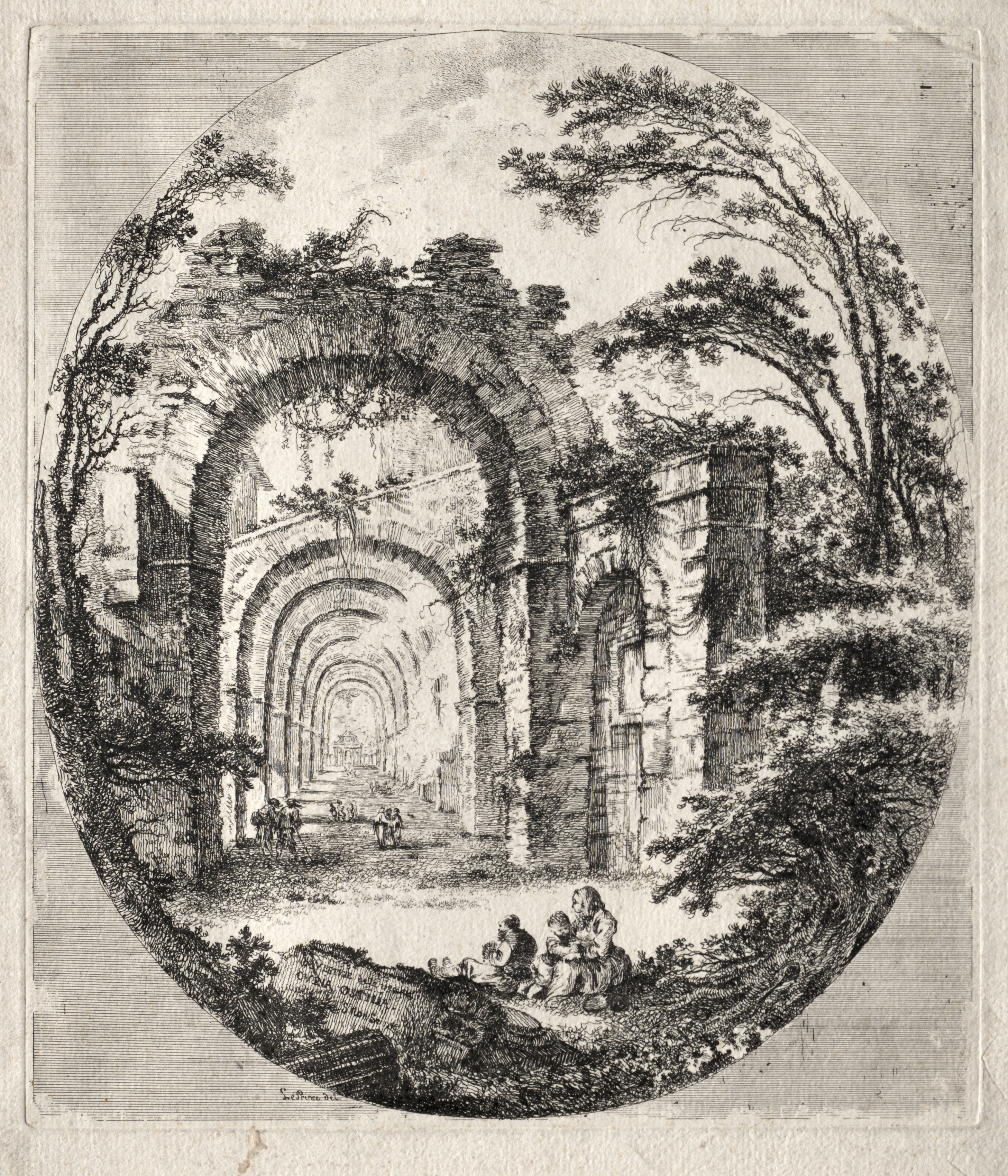
The image depicts a circular illustration by Jean-Claude-Richard de Saint-Non, titled "Ancient Ruins". The illustration is in black and white and shows a ruined structure with multiple archways. The archways are rounded and decrease in size as they recede into the distance. The structure appears to be made of stone and is overgrown with trees and bushes. In the foreground, there are three people sitting on a rocky outcropping. Behind them, to the left, are two people and a horse. The sky above is cloudy. The illustration is surrounded by a border with a textured appearance. The circular illustration is set against a rectangular background with a lighter color and horizontal lines. The image has a worn and aged appearance.
Artwork details
- Dimensions:
- 765 × 893 px
- Museum record:
- View original
You May Also Like

Part of the Old Appian Way

Ancient Ruins: Ancient Aqueduct

The Statue in Front of Ruins

Stairs in an Italian Garden

The Arch at Rimini built by Augustus, plate 17 from Some Views of Triumphal Arches and other monuments
![Ruins of the Xystus [a long open portico used for athletic exercises], the central hall of the Antonine Baths [The Baths of Caracalla], from Views of Rome](/api/image?url=https%3A%2F%2Fwww.artic.edu%2Fiiif%2F2%2Feba5f92e-ff3b-2f33-6c2f-1a901e175dfd%2Ffull%2F843%2C%2F0%2Fdefault.jpg&w=1536&q=75)
Ruins of the Xystus [a long open portico used for athletic exercises], the central hall of the Antonine Baths [The Baths of Caracalla], from Views of Rome

Views of Rome: The Aquaduct of Nero

Views of Rome: Rovine del Sisto o sia della gran sala delle Terme Antoniniane

Views of Rome: The Arch or Titus

View of the upper storey of the Cages for Wild Animals built by the Emperor Domitian, associated with the Flavian Amphitheater and commonly called the Curia Hostilia, from Views of Rome

Forum of Augustus, plate 15 from Some Views of Triumphal Arches and other monuments

From Treatise on Etching

Liber Studiorum: Plate 35, Wenlock Priory, Salop
![Ruins of the Xystus [a long open portico used for athletic exercises], the central hall of the Antonine Baths [The Baths of Caracalla], from Views of Rome](/api/image?url=https%3A%2F%2Fwww.artic.edu%2Fiiif%2F2%2F07dbbda9-035d-8035-4718-eb14a75c5d21%2Ffull%2F843%2C%2F0%2Fdefault.jpg&w=1536&q=75)
Ruins of the Xystus [a long open portico used for athletic exercises], the central hall of the Antonine Baths [The Baths of Caracalla], from Views of Rome

Another view of the Temple of the Sibyl in Tivoli, from Views of Rome

Interior view of the Flavian Amphitheater, called the Colosseum, from Views of Rome

Traité de La Gravure a l’eau forte: Plate 2

Traité de La Gravure a l’eau forte

A Palace with an Arched Bridge (A Roman Villa)

Remains of a room belonging to the Praetorian Fort at Hadrian's Villa, Tivoli, from Views of Rome

Veduta dell'Arco di Gallieno

Notable Buildings of the Middle Ages in Germany: Ruins of the Church of the Virgin with the Tomb of Genevieve and Siegfried, Count Palatine of the Rhine, in the Moselle Valley near Andernack

The Tunnel in the Park

Arch of Drusus at the Porta S. Sebastiano in Rome, plate 8 from Some Views of Triumphal Arches and other monuments