
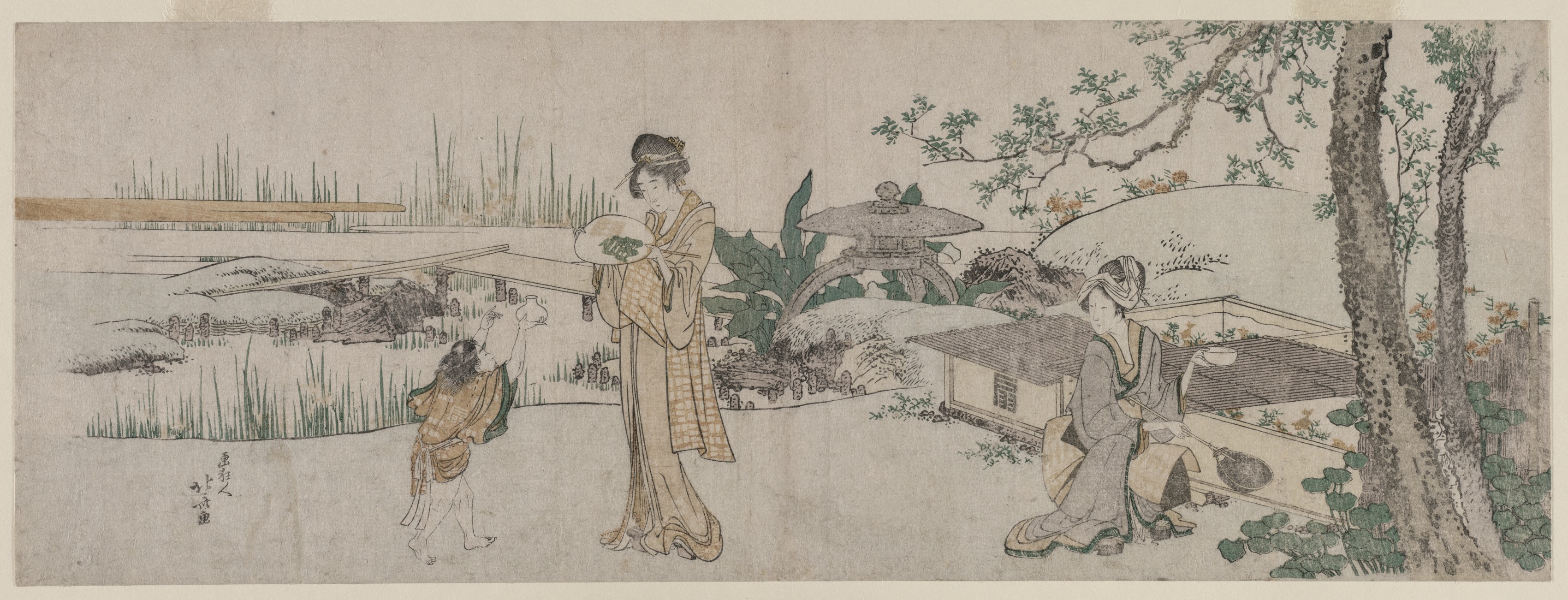
The image depicts a traditional Japanese scene. Two women and a child are standing beside a goldfish tank. The woman on the left is tall and wears a long, light-colored kimono. She holds a tray. The woman on the right kneels. A child stands on the left. Traditional Japanese buildings and a pagoda-style stone lantern are in the background. A tree trunk is on the right. Reeds and grasses line a body of water on the left. The color palette is muted. The style is ukiyo-e.
Artwork details
- Dimensions:
- 900 × 344 px
- Museum record:
- View original
You May Also Like

Goldfish vendor

Boy releasing a kite

Gathering spring greens, from the album "Fuji in Spring (Haru no Fuji)"

Bush Clover (Hagi), from an untitled series of Flowers

Goldfish farm

The Marsh Where the Snipe Takes Flight (Shigi tatsu sawa), from the series "Three Evening Poems (Sanseki no uchi)"

Women and children out for a picnic

Gathering spring flowers

Two Ladies in Foreground of Landscape

Tsukasa and Other Courtesans of the Ogiya Watching the Autumn Moon Rise Over Rice Fields from a Balcony in the Yoshiwara

Women Chasing Crickets on an Autumn Moor

Parody of the play "Musume Dojoji"

Women Viewing Cherry Blossoms at Asukayama

Wakana, Part 1 (Wakana, jo), from the series "A Fashionable Parody of the Tale of Genji (Furyu yatsushi Genji)"

Kameido Tenjin Shrine, from vol. 1 of the illustrated book "Fine Views of the Eastern Capital at a Glance (Toto shokei ichiran)"

Ono no Komachi Visiting Kiyomizu Temple, from the series The Fashionable Seven Komachi (Furyu nana Komachi)

A Wayside Scene (Oji)

Yasuhide, from the series "Six Immortal Poets (Rokkasen)"

Women on the Veranda Looking at a Girl Picking Flower

Flower Viewing

On the footbridge

"So": A Coquettish Woman, from the series "Tales of Ise in Fashionable Brocade Pictures (Furyu nishiki-e Ise monogatari)"

Ladies at Shichirigahama

The Actors Arashi Sangoro II as Minamoto no Yoritomo (right), Segawa Kikunojo II as Yuki Onna (center), and Ichimura Uzaemon IX as Kajiwara Genta no Kagetoki, in the Play Myoto-giku Izu no Kisewata, Performed at the Ichimura Theater in the Eleventh Month, 1770