
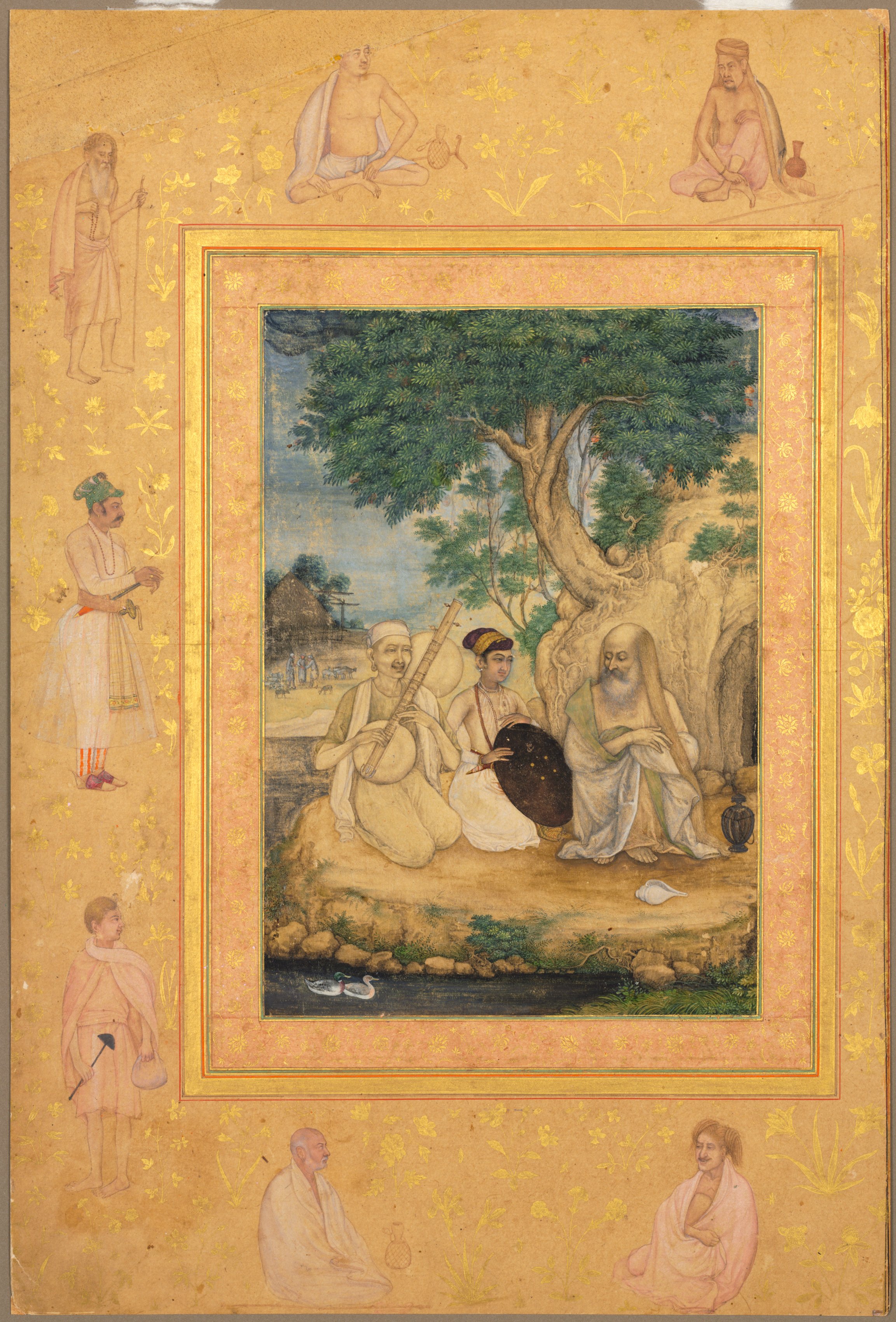
The image depicts a painting of Prince and ascetics. The painting is rectangular with a thick gold border. Inside the border, a central scene shows a prince and ascetics sitting under a tree. The prince wears a white outfit and a turban. Three ascetics sit to his right; one plays a stringed instrument, one plays a drum, and the third sits with his hands folded. The background of the central scene includes a blue sky, a tree, and a body of water with a swan. The gold border is decorated with a floral pattern and features eight smaller illustrations of people in various poses. The people in the border are dressed as ascetics, wearing simple white robes. The background of the painting is gold with a floral pattern. The painting style is Indian, with intricate details and vibrant colors. The artist's style suggests the work is from the Mughal Empire.
Artwork details
- Dimensions:
- 605 × 893 px
- Museum record:
- View original
You May Also Like

European Costume Scene

Nobleman Visiting Saint at his Shrine

Bhairava Raga

The unfaithful wife explaining away the presence of the dough elephant, from a Tuti-nama (Tales of a Parrot): Eighth Night

Mary ascends the stairs to the temple, from a Mirror of Holiness (Mir’at al-quds) of Father Jerome Xavier

Grotesque Dancers Performing

Harem night-bathing scene, from the Late Shah Jahan Album (recto)

Ascetic Princess with Snakes in a Wilderness: Asavari Ragini, from a Ragamala

Kanhara Ragini: Song of Inspiration to Krishna for Killing the Elephant Demon, from the Ragamala Series

The origin of music from a fabulous bird of India which had seven holes in its beak, from a Tuti-nama (Tales of a Parrot): Fourteenth Night

Shri Rama Putra Raga: Page from the Dispersed "Boston" Ragamala Series (Garland of Musical Modes)

Illustration from a Ragamala Series (Garland of Musical Modes)

Portrait of Sardar Singh (Son of Savant Singh, 1730–68)

Maharaja Anup Singh of Bikaner (reigned 1669–98) Receives a Courtier

Circumcision ceremony for Akbar’s sons, painting 126 from an Akbar-nama (Book of Akbar) of Abu’l Fazl (Indian, 1551–1602)

The Brahman, unable to select from the four gifts of the king of the Ocean seeks the Raja’s advice, from a Tuti-nama (Tales of a Parrot): Eleventh Night
![Bahram Gur Visits the Princess of India in the Black Pavilion (recto): Illustration and Text, Persian Verses, from a manuscript of the Khamsa of Nizami, Haft Paykar [Seven Portraits]](/api/image?url=https%3A%2F%2Fopenaccess-cdn.clevelandart.org%2F1944.486.a%2F1944.486.a_web.jpg&w=1536&q=75)
Bahram Gur Visits the Princess of India in the Black Pavilion (recto): Illustration and Text, Persian Verses, from a manuscript of the Khamsa of Nizami, Haft Paykar [Seven Portraits]

A House Burgled at Night

A dancing dervish and three musicians, from a Divan (Collected Poems) of Urfi (Persian, 1555–1591)

Vabhruvahana Approaches Arjuna, page from the Khan Khanan's Razm-nama

The two cooks, who attempt to seduce the warrior’s loyal wife, are trapped by her in a cellar, from a Tuti-nama (Tales of a Parrot): Fourth Night

The street cleaner, on his way to meet King Bhojaraja, sleeps under a tree where four thieves disguised as fellow travelers deprive him of a priceless pearl, from a Tuti-nama (Tales of a Parrot): Twelfth Night

The Brahman’s wife who killed a peacock and ate its gallbladder on the physician’s advice, from a Tuti-nama (Tales of a Parrot): Nineteenth Night

The game of wolf-running in Tabriz, from an Akbar-nama (Book of Akbar)