
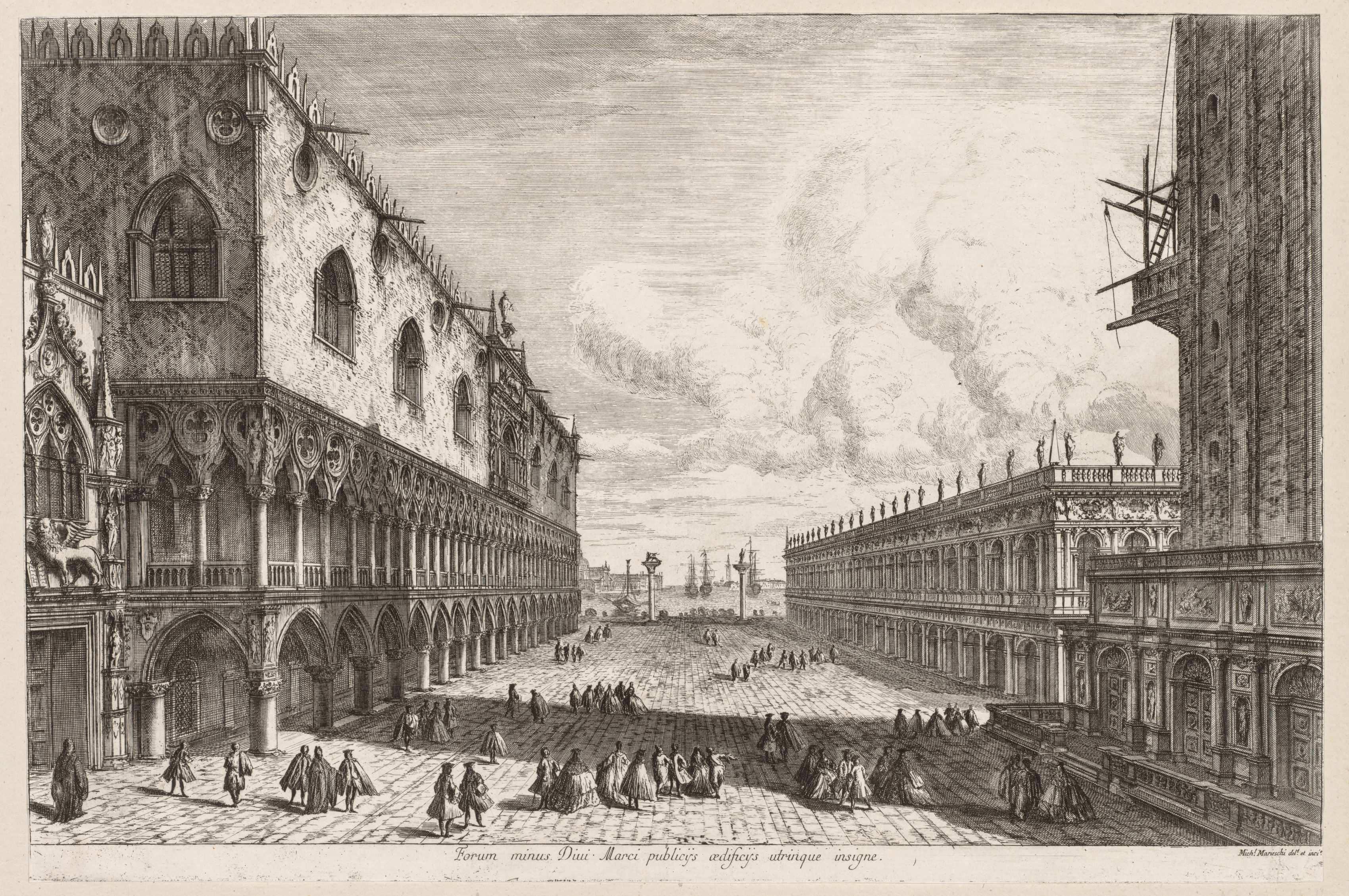
The image is a black-and-white drawing of a large square with buildings on either side. The buildings are multi-story and ornate, with many arches and columns. The building on the left has a balcony on the second floor, and a row of arches on the first floor. The building on the right is similar but appears to be more worn. The square is paved with stone tiles and filled with people dressed in 18th-century clothing. In the background, there is a body of water with boats and a cloudy sky. The overall atmosphere suggests a busy and vibrant scene in a historic city, likely Venice, given the title "Views of Venice". The image is titled "The Piazzetta" and attributed to Michele Marieschi.
Artwork details
- Dimensions:
- 900 × 598 px
- Museum record:
- View original
You May Also Like

Views: The Stone of Proclamation at Venice

La Piera del Bando. V.

Views of Venice: The Molo and S. M. Della Salute

Views: The Library, Venice

Views of Venice: Piazzetta S. Basso

Views of Venice: Campo S. S. Giovanni e Paolo

Views: The Procurator's Palace and the Church of St. Géminien, Venice

Le Procuratie niove e S. Ziminian V.

La libreria. V.

Views of Venice: Piazzo S. Marco
![Cut-away view of the interior of the Basilica of S. Paolo fuori delle Mura [St. Paul outside the Walls], from Views of Rome](/api/image?url=https%3A%2F%2Fwww.artic.edu%2Fiiif%2F2%2F1be129d9-2c48-d708-c5cc-3abc419a1af0%2Ffull%2F843%2C%2F0%2Fdefault.jpg&w=1536&q=75)
Cut-away view of the interior of the Basilica of S. Paolo fuori delle Mura [St. Paul outside the Walls], from Views of Rome
![S. Giovanni in Laterano from "Prospectus Locurum Urbis Romae Insign[ium]"](/api/image?url=https%3A%2F%2Fopenaccess-cdn.clevelandart.org%2F1991.64.8%2F1991.64.8_web.jpg&w=1536&q=75)
S. Giovanni in Laterano from "Prospectus Locurum Urbis Romae Insign[ium]"

Le Preson. V.

Views of Venice: The Regatta

Views: The Prison, Venice

Views of Venice: The Courtyard of the Ducal Palace

View of the Palazzo della Consulta on the Quirinal housing the Papal Secretariat, from Views of Rome

View along the Via del Corso of the Palazzo dell' Accademia established by Louis XIV, King of France for French students of Painting, Sculpture and Architecture, from Views of Rome

View of the Remains of the Forum of Nerva, from Views of Rome
![View of the Basilica of S. Paolo fuori delle Mura [St. Paul outside the Walls], built by Constantine the Great, from Views of Rome](/api/image?url=https%3A%2F%2Fwww.artic.edu%2Fiiif%2F2%2Faed673b9-117c-08a7-8aa2-39f447c929ea%2Ffull%2F843%2C%2F0%2Fdefault.jpg&w=1536&q=75)
View of the Basilica of S. Paolo fuori delle Mura [St. Paul outside the Walls], built by Constantine the Great, from Views of Rome

View of the Fountainhead of the Acqua Felice, from Views of Rome

View of the Palazzo di Montecitorio, from Views of Rome

View of the Palazzo di Montecitorio, from Views of Rome

View of the Piazza di Spagna, from Views of Rome