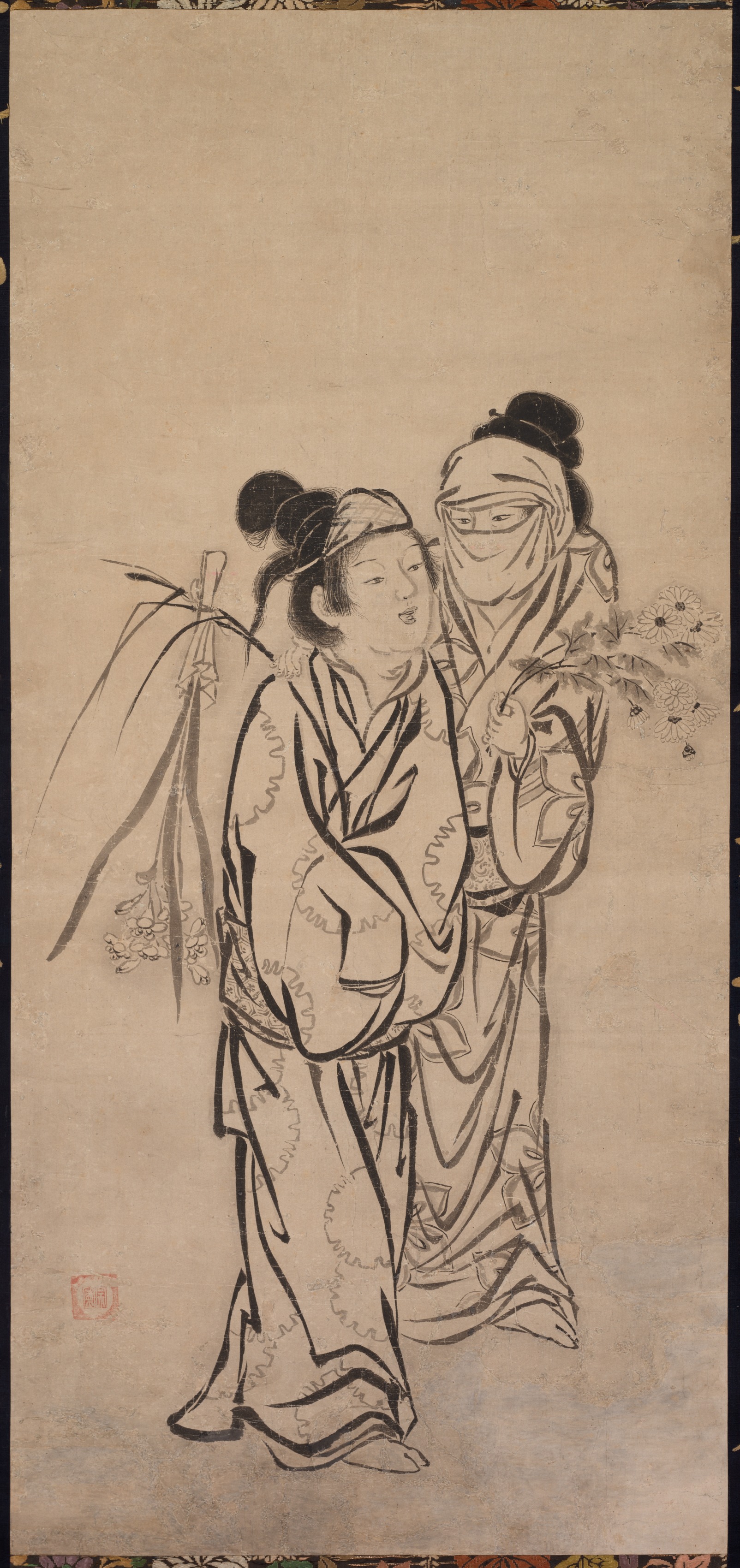
A scroll painting of a couple. The woman on the right wears a head covering and holds a bunch of flowers. The man on the left holds a closed umbrella. The figures are rendered in black and white. The background of the painting is beige colored paper. The woman wears a kimono and has her hair bunned up on top of her head. The man also has his hair bunned up on top of his head and also wears a kimono. The painting depicts the couple standing. A red seal stamp appears on the bottom left side.
Artwork details
- Dimensions:
- 425 × 900 px
- Museum record:
- View original
You May Also Like

Dubbelportret van Iwai Kumesaburo en Iwai Kiyotaro

Doeken spannen

Koharu and Jihei, from the series "Fashionable Patterns in Utamaro Style (Ryuko moyo Utamaro-gata)"

A Woman and Baby

The Actors Segawa Kikunojo III (right) as Ochiyo, and Bando Mitsugoro I (left) as the Greengrocer Hambei, in the Play Kabuki no Hana Bandai Soga, Performed at the Ichimura Theater in the Fourth Month, 1781

The Actors Ichimura Uzaemon VIII as Taira no Koremochi and Arashi Koroku I as Makomo no Mae in "Shusse Momijigari," performed at the Ichimura Theater in the eleventh month, 1747

Courtesan and Attendant

Een gedicht schrijvend

The Actor Nakamura Nakazo I as Prince Takahiro in the Play Date Nishiki Tsui no Yumitori, Performed at the Morita Theater in the Eleventh Month, 1778

The Actors Ichikawa Komazo I (L) and Nakamura Matsue I (R)

Woman Representing Good Fortune

Sanokawa Mangiku, Nakamura Gentaro en Takashima Onoe

Actor as a Standing Beauty

Twee vrouwen en een klein kind: de vijfde maand.

Japanse vrouwen

Women Cutting Branches of Bush Clover; The Noji Tama River in Omi Province, from an untitled series of the Six Tama Rivers

Scene from a Drama: Matsumoto Koshiro I and Two Other Actors

The Lovers Umegawa and Chubei

Okita and Ofuji

Kintoki en Yamauba

Drawing Intended as Design for an Actor Print

The Courtesans Karagoto and Nishikido of Chojiya

Morning of Iris, from the series "Five Festivals in the Pleasure Quarters (Hanakuruwa gosechi no asobi)"

Gyokkashi Eimo before Executing Calligraphy (Gyokkashi no sekisho)