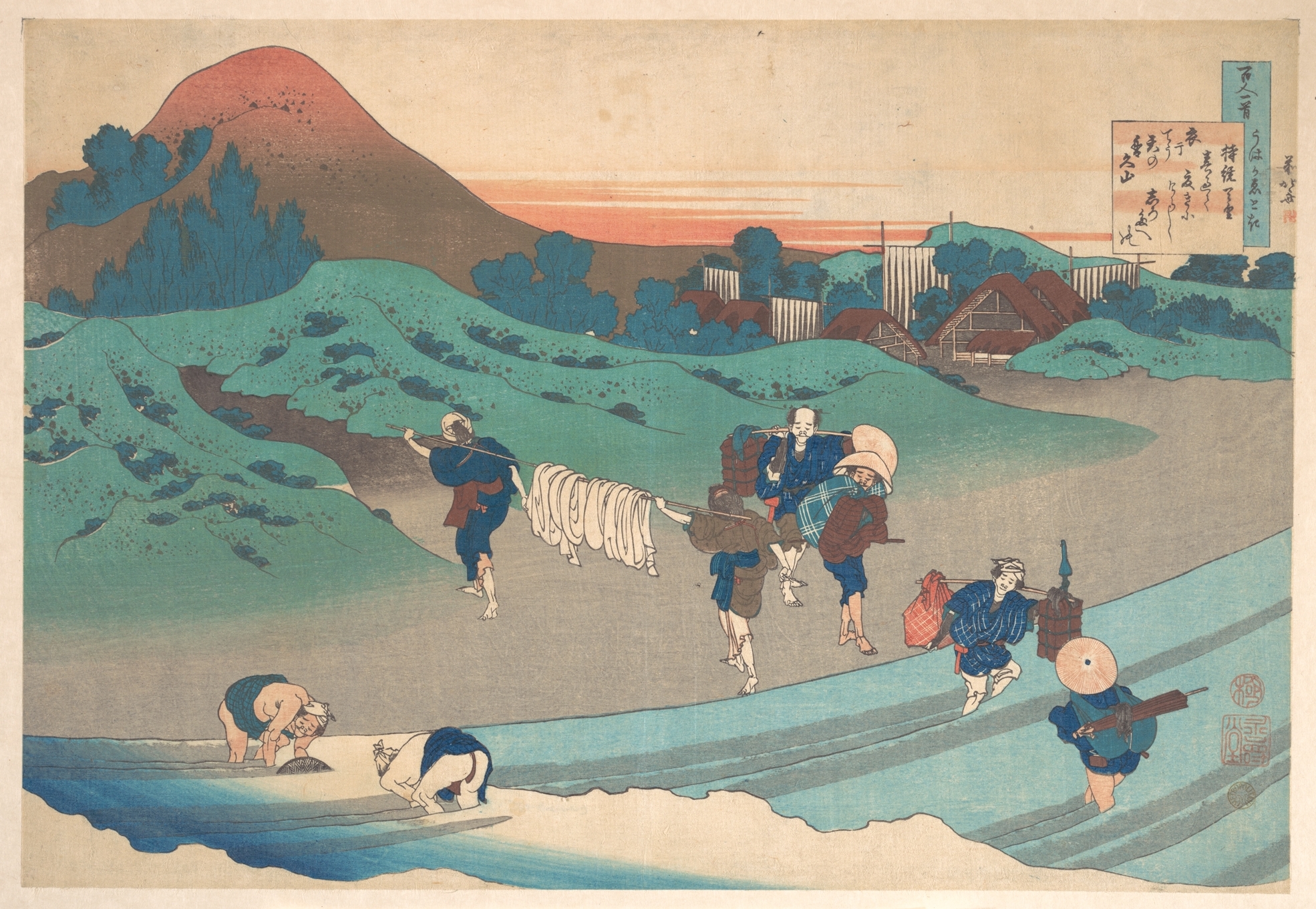
Poem by Jitō Tenno (Empress Jitō), from the series One Hundred Poems Explained by the Nurse (Hyakunin isshu uba ga etoki)
A Japanese woodblock print depicting a serene landscape with people crossing a shallow river. In the foreground, two men wade through the river; one bends down to dip his arm into the water, while the other walks towards the right. On the riverbank, a person carries a large round object on their head and holds a stick. Further back, three people walk along the path; one leads an ox with a load on its back, another carries a bundle on their back and a third person walks beside them. The background features rolling green hills, trees, and buildings. A mountain is visible on the left side, and the sky above shows a sunset or sunrise with hues of orange and pink. The print features a color palette of blue, green, brown, and orange. Japanese characters are visible in the top-right corner.
Artwork details
- Date:
- 1839
- Medium:
- Woodblock print; ink and color on paper
- Culture:
- Japan
- Dimensions:
- 599 × 414 px
- Museum record:
- View original
You May Also Like

Empress Jito (Jito Tenno) from the series "One Hundred Poems as Explained by the Wet Nurse (Hyakunin isshu uba ga etoki)"

Poem by Jitō Tenno (Empress Jitō), from the series One Hundred Poems Explained by the Nurse (Hyakunin isshu uba ga etoki)

Poem by Sangi Hitoshi (Minamoto no Hitoshi), from the series One Hundred Poems Explained by the Nurse (Hyakunin isshu uba ga etoki)

Poem by Dainagon Tsunenobu (Minamoto no Tsunenobu, Katsura no Dainagon), from the series One Hundred Poems Explained by the Nurse (Hyakunin isshu uba ga etoki)

Poem by Sarumaru Dayu, from the series "One Hundred Poems Explained by the Nurse (Hyakunin isshu uba ga etoki)"

Ejiri in Suruga Province (Sunshū Ejiri), from the series Thirty-six Views of Mount Fuji (Fugaku sanjūrokkei)

Dainagon Tsunenobufrom the series One Hundred Poems Explained by the Nurse (Hyakunin isshu uba ga etoki)

Saka no Shita

Ejiri in Suruga Province (Sunshu Ejiri), from the series "Thirty-six Views of Mount Fuji (Fugaku sanjurokkei)"

Nakahara in Sagami Province (Soshu Nakahara), from the series "Thirty-six Views of Mount Fuji (Fugaku sanjurokkei)"

Shiba Zōjōji Sannai no Zu

Poem by Ariwara no Narihira, from the series "One Hundred Poems Explained by the Nurse (Hyakunin isshu uba ga etoki)"

Ejiri in Suruga Province (Sunshu Ejiri), from the series "Thirty-six Views of Mount Fuji (Fugaku sanjurokkei)"

Hara: Mount Fuji in the Morning (Hara, Asa no Fuji), from the series Fifty-Three Stations of the Tōkaidō Road (Tōkaidō gojūsan tsugi), also known as the First Tōkaidō or Great Tōkaidō

Poem by Sarumaru Dayū, from the series One Hundred Poems Explained by the Nurse (Hyakunin isshu uba ga etoki)

Enoshima

Beauties Harvesting Bracken, from the series Gekkō’s Miscellaney

Kakegawa, Akihasan Empo

Fukui Bridge in Echizen Province (Echizen Fukui no hashi), from the series Remarkable Views of Bridges in Various Provinces (Shokoku meikyō kiran)

Kyoto: The Great Bridge at Sanjo (Kyo, Sanjo Ohashi zu), from the series "Fifty-three Stations of the Tokaido (Tokaido gojusan tsugi)," also known as the Tokaido with Poem (Kyoka iri Tokaido)

Poem by Ariwara no Narihira, from the series One Hundred Poems Explained by the Nurse (Hyakunin isshu uba ga etoki)

Ariwara no Narihirafrom the series One Hundred Poems Explained by the Nurse (Hyakunin isshu uba ga etoki)

Sakanoshita—No. 49, from the series "Fifty-three Stations of the Tokaido (Tokaido gojusan tsugi)," also known as the Reisho Tokaido

Fujikawa—No. 38, from the series "Fifty-three Stations of the Tokaido (Tokaido gojusan tsugi)," also known as the Reisho Tokaido


