
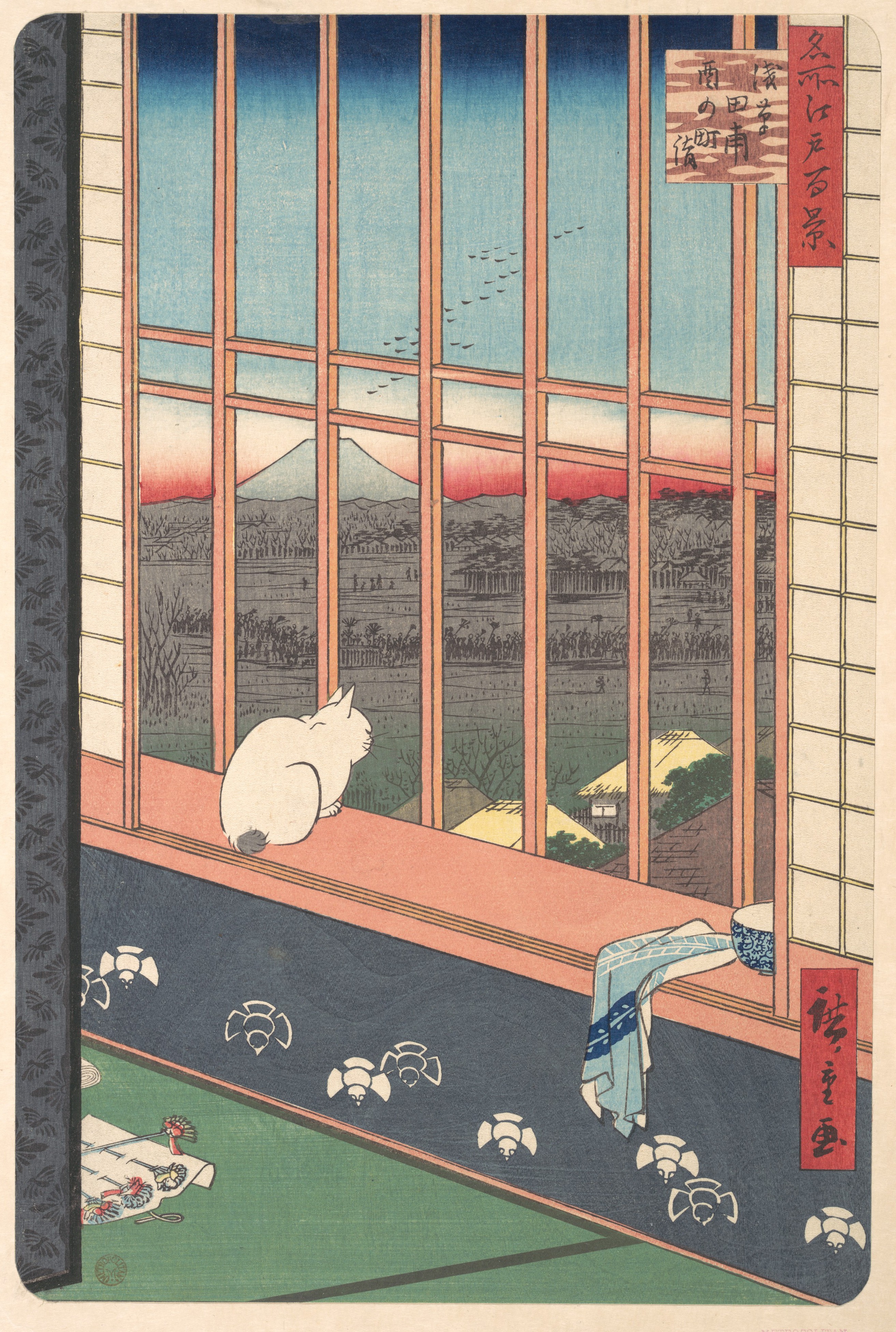
Revelers Returned from the Tori no Machi Festival at Asakusa, from the series One Hundred Famous Views of Edo
A white cat sits on a ledge looking outside through a large multi-paned window. The window has a view of a mountain in the distance with a pink and blue sky. There are buildings and vegetation in the midground. The bottom of the wall outside the window is dark blue with white designs. A blue garment hangs off the ledge. The floor is green with a piece of white fabric on it. The wall to the right of the window is beige and has two vertical red banners with black Japanese writing. There is a small rectangular beige label with Japanese writing in the top-right corner of the image.
Artwork details
- Date:
- 1857
- Medium:
- Woodblock print; ink and color on paper
- Culture:
- Japan
- Dimensions:
- 420 × 624 px
- Museum record:
- View original
You May Also Like

Asakusa Rice Fields and Torinomachi Festival (Asakusa tanbo Torinomachi mode), from the series "One Hundred Famous Views of Edo (Meisho Edo hyakkei)"

Asakusa Rice Fields and Torinomachi Festival (Asakusa tanbo Torinomachi mode), from the series "One Hundred Famous Views of Edo (Meisho Edo hyakkei)"

Asakusa Rice Fields and Torinomachi Festival (Asakusa tanbo Torinomachi mode), from the series "One Hundred Famous Views of Edo (Meisho Edo hyakkei)"

Young Lady in Summer Attire

Bikuni Bridge in Snow (Bikunibashi setchu), from the series "One Hundred Famous Views of Edo (Meisho Edo hyakkei)"

Samurai Admiring Pine-Tree and Plum Blossoms
![Minakuchi, from the series "Fifty-three Stations [of the Tokaido] (Gojusan tsugi)," also known as the Figure Tokaido (Jinbutsu Tokaido)](/api/image?url=https%3A%2F%2Fwww.artic.edu%2Fiiif%2F2%2Fbe209000-019e-3503-c446-3ceec812a0f5%2Ffull%2F843%2C%2F0%2Fdefault.jpg&w=1536&q=75)
Minakuchi, from the series "Fifty-three Stations [of the Tokaido] (Gojusan tsugi)," also known as the Figure Tokaido (Jinbutsu Tokaido)

Mount Kano in Kazusa Province (Kazusa Rokusozan), from the series "Thirty-six Views of Mount Fuji (Fuji sanjurokkei)"

Interior of a Palace with Noblemen Conversing

Entrance to the Gankirō Tea House in the Miyozaki District, Yokohama, Bushu

Otsu: Distant View of Otsu and the Lake from the Kannon Hall of Mii Temple (Otsu, Miidera Kannondo yori Otsu no machi kosui chobo), no. 54 from the series "Famous Sights of the Fifty-three Stations (Gojusan tsugi meisho zue)," also known as the Vertical Tokaido

Hibiya and Soto-Sakurada from Yamashita-cho (Yamashita-cho Hibiya Soto-Sakurada), from the series "One Hundred Famous Views of Edo (Meisho Edo hyakkei)"

Mout Fuji Seen from the Left on the Tokaido (Tokaido hidari Fuji), from the series "Thirty-six Views of Mount Fuji (Fuji sanjurokkei)"

Poem by Sanjō-in, from the series One Hundred Poems Explained by the Nurse (Hyakunin isshu uba ga etoki)

Poem by Emperor Sanjo, from the series One Hundred Poems by One Hundred Poets Explained by an Old Nurse

Puppies in the Snow

Kanda Temple Snow

Monkey Bridge

Drum Bridge and Yuhi Hill at Meguro (Meguro Taikobashi Yuhi-no-oka), from the series "One Hundred Famous Views of Edo (Meisho Edo hyakkei)"

Mout Fuji Seen from the Left on the Tokaido (Tokaido hidari Fuji), from the series "Thirty-six Views of Mount Fuji (Fuji sanjurokkei)"

Seki: Junction of the Pilgrim's Road to Ise Shrine (Seki, Sangudo oiwake), no. 48 from the series "Famous Sights of the Fifty-three Stations (Gojusan tsugi meisho zue)," also known as the Vertical Tokaido

Sei Shonagon, from the series "A True Mirror of Japanese and Chinese Poems (Shiika shashin kyo)"
![Shono, from the series "Fifty-three Stations [of the Tokaido] (Gojusan tsugi)," also known as the Figure Tokaido (Jinbutsu Tokaido)](/api/image?url=https%3A%2F%2Fwww.artic.edu%2Fiiif%2F2%2F1136d146-e271-10dc-db25-3589da53ab45%2Ffull%2F843%2C%2F0%2Fdefault.jpg&w=1536&q=75)
Shono, from the series "Fifty-three Stations [of the Tokaido] (Gojusan tsugi)," also known as the Figure Tokaido (Jinbutsu Tokaido)

Hilltop View from Yushima Tenjin Shrine (Yushima Tenjin sakaue tenbo), from the series "One Hundred Famous Views of Edo (Meisho Edo hyakkei)"


