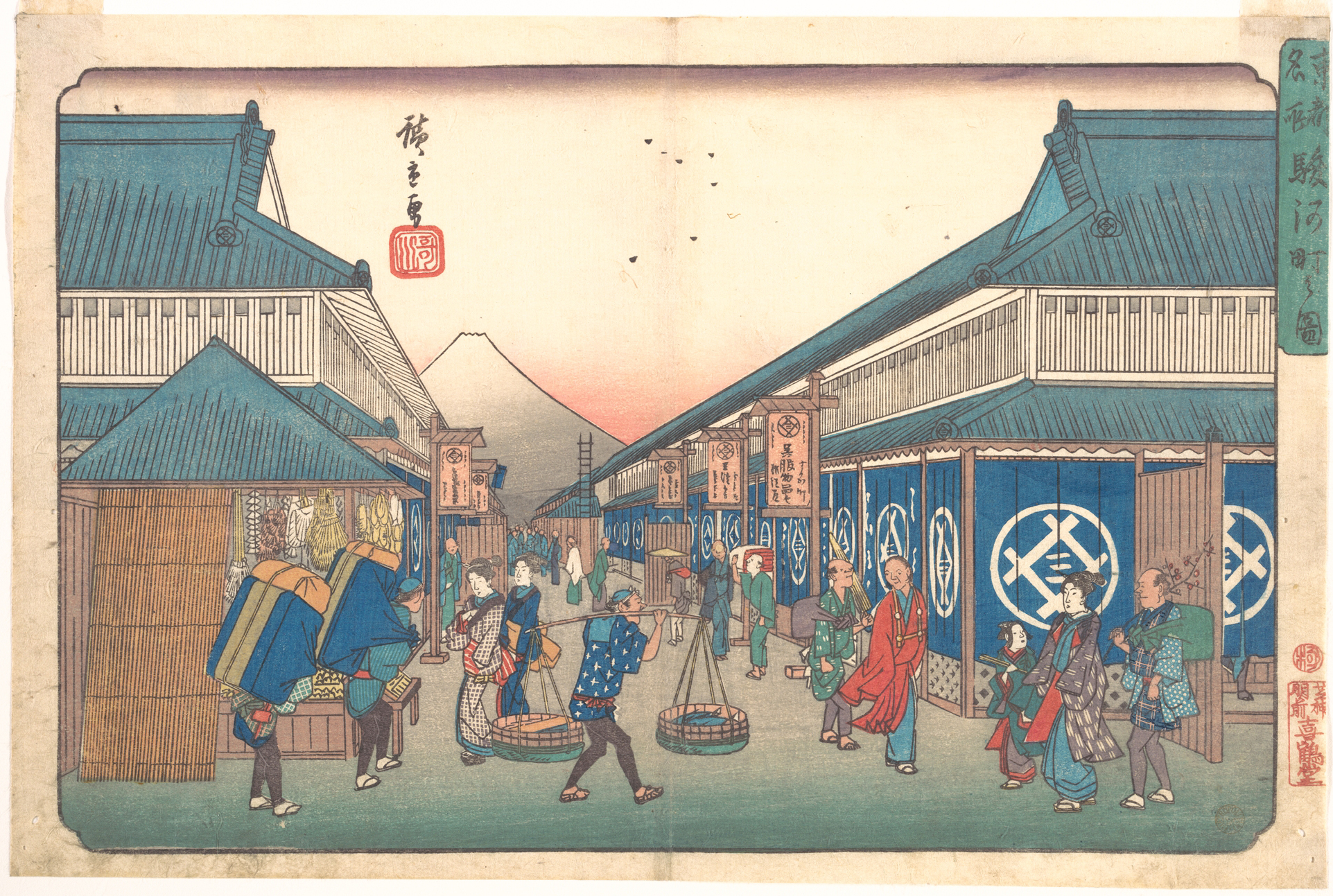
The image depicts a traditional Japanese woodblock print titled "Suruga Street" by Utagawa Hiroshige. The scene shows a street with blue-roofed buildings on both sides and people walking on the street. The buildings have white walls and blue tile roofs. The building on the left appears to be a wooden structure with a protruding overhang and a vendor selling things. The building on the right has blue shutters with white circular designs. There are people dressed in traditional Japanese clothing, including kimonos, walking on the street. Some people are carrying baskets or other items. In the background, there are mountains and a pinkish-gray sky with birds flying. The overall color palette is muted, with shades of blue, green, and beige dominating the scene. The image has a beige border around it. The artwork captures a serene and peaceful atmosphere of a traditional Japanese street scene.
Artwork details
- Date:
- ca. 1836
- Medium:
- Woodblock print; ink and color on paper
- Culture:
- Japan
- Dimensions:
- 599 × 403 px
- Museum record:
- View original
You May Also Like

View of Surugacho (Surugacho no zu), from the series "Famous Places in the Eastern Capital (Toto meisho)"

Shiba Shinmeisha Uchi (Shatetsu-ro)

Shimbashi no Zu

Narumi, from the series The Fifty-three Stations of the Tōkaidō Road

Narumi: Shops Selling the Famous Tie-dyed Fabric (Narumi, meisan shibori mise)—No. 41, from the series "Fifty-three Stations of the Tokaido (Tokaido gojusan tsugi)," also known as the Reisho Tokaido

Willow Tree at the Gate of the Shimabara Pleasure Quarrter (Shimabara deguchi no yanagi), from the series "Famous Places in Kyoto (Kyoto meisho no uchi)"

Narumi

東海道五十三次 府中 二丁町廓之図

Wisteria in Full Bloom in the Precincts of the Kameido Tenmangu Shrine (Kameido Tenmangu keidai fuji hanazakari no zu), from the series "Newly Selected Famous Places in Edo (Shinsen Edo meisho)"

Daisenji Mae (Tagawaya)

Night View of Saruwaka-machi (Saruwaka-machi yoru no kei), from the series "One Hundred Famous Views of Edo (Meisho Edo hyakkei)"

Goyu: Women Stopping Travelers (Goyu tabibito tomeru onna), from the series “Fifty-three stations of the Tokaido (Tokaido gojusan tsugi no uchi)," also known as the Hoeido Tokaido

Fujisawa—No. 7, from the series "Fifty-three Stations of the Tokaido (Tokaido gojusan tsugi)," also known as the Reisho Tokaido

Shinagawa: Sunrise (Shinagawa, hinode), from the series "Fifty-three Stations of the Tokaido Road (Tokaido gojusan tsugi no uchi)," also known as the Hoeido Tokaido

Kameido Uramon (Tama-ya)

Narumi, from the series "Fifty-three Stations of the Tokaido (Tokaido gojusan tsugi)," also known as the Tokaido with Poem (Kyoka iri Tokaido)

Goyu, Tabibito Ryujo

Tea house in Hakusen district

Shinagawa: Departure of the Daimyo (Shinagawa, shoko detachi), from the series "Fifty-three Stations of the Tokaido Road (Tokaido gojusan tsugi no uchi)," also known as the Hoeido Tokaido

Shitaya Hirokoji, from the series “One Hundred Famous Views of Edo (Meisho Edo hyakkei)”

Mimeguri no Kei (Toyoha-ya)

Sumidagawa Hashiba Watashi Zu (Yanagiya)

The Umegawa at Ryogoku Yanagibashi

Chiryūshuku, from the series The Fifty-three Stations of the Tōkaidō Road


