
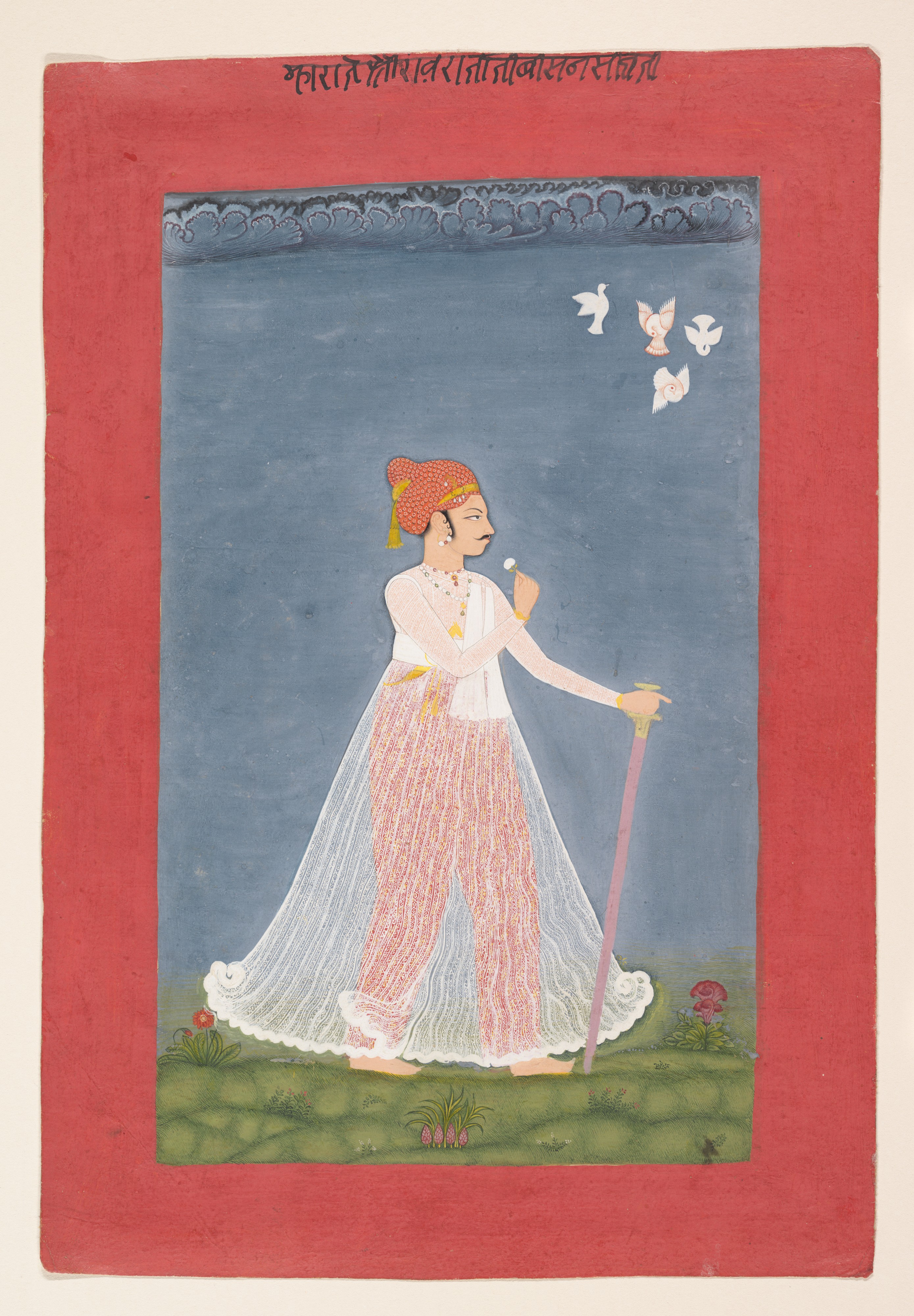
Bishen Singh as a Young Man
The painting depicts a man standing on grass with his right arm outstretched and his left hand holding what appears to be a flute to his mouth. He wears a white long-sleeved shirt, a long pink and white striped dhoti, and a red turban adorned with gold accents. A red sash wraps around his waist. The man holds a pink cane with a gold star on top in his right hand. Three white doves fly above him to the right. The background features a blue sky and a red border surrounds the painting. Black text is written in a foreign script at the top of the painting. The man's attire and the style of the painting suggest it is titled "Bishen Singh as a Young Man" by an unknown artist.
Artwork details
- Date:
- ca. 1780
- Medium:
- Ink and opaque watercolor on paper
- Culture:
- India (Rajasthan, Uniara)
- Dimensions:
- 434 × 625 px
- Museum record:
- View original
You May Also Like

Two Court Ladies with Fireworks

Royal Woman Holding a Flower

Shah Jahan holding a spinel and a long Deccan sword, from the Late Shah Jahan Album

Portrait of Maharaja Rai Singh of Bikaner (reigned 1574–1612)

The Heroine Who Waits Anxiously for Her Absent Lover: Utka Nayika

Princess Smoking a Hookah (as Salabhanjika)

The Heroine Who Waits Anxiously for Her Absent Lover (Utka Nayika)

Lovers Embracing (Raga Malkaus)

A Heroine Waiting for Her Paramour: Vasakasajja Nayika, from a Nurpur Rasikapriya

The Morning Toilette

The Heroine Who Waits Anxiously for Her Absent Lover: Utka Nayika

Portrait of Raja Ram Singh of Amber (r. 1667-1688) with a Deccan Sword (recto)

Lovers on a Terrace: Ramakali Ragini of Hindol, from a Bundi Ragamala

Portrait of Raja Jagat Singh of Nurpur (reigned 1618–46)

Woman Addressing a Peacock: Gujari Ragini of Megh, from a Ragamala

Kakubha Ragini

A woman with attendant and a pair of deer: probably Gujari Ragini of Dipak

Yusuf and Zulaykha meeting

Lover's Tryst

The Timid Bride

Aurangzeb

An African Lyre Player (recto)

Desvarati Ragini: Folio from a ragamala series (Garland of Musical Modes)

The origin of music from a fabulous bird of India which had seven holes in its beak, from a Tuti-nama (Tales of a Parrot): Fourteenth Night