
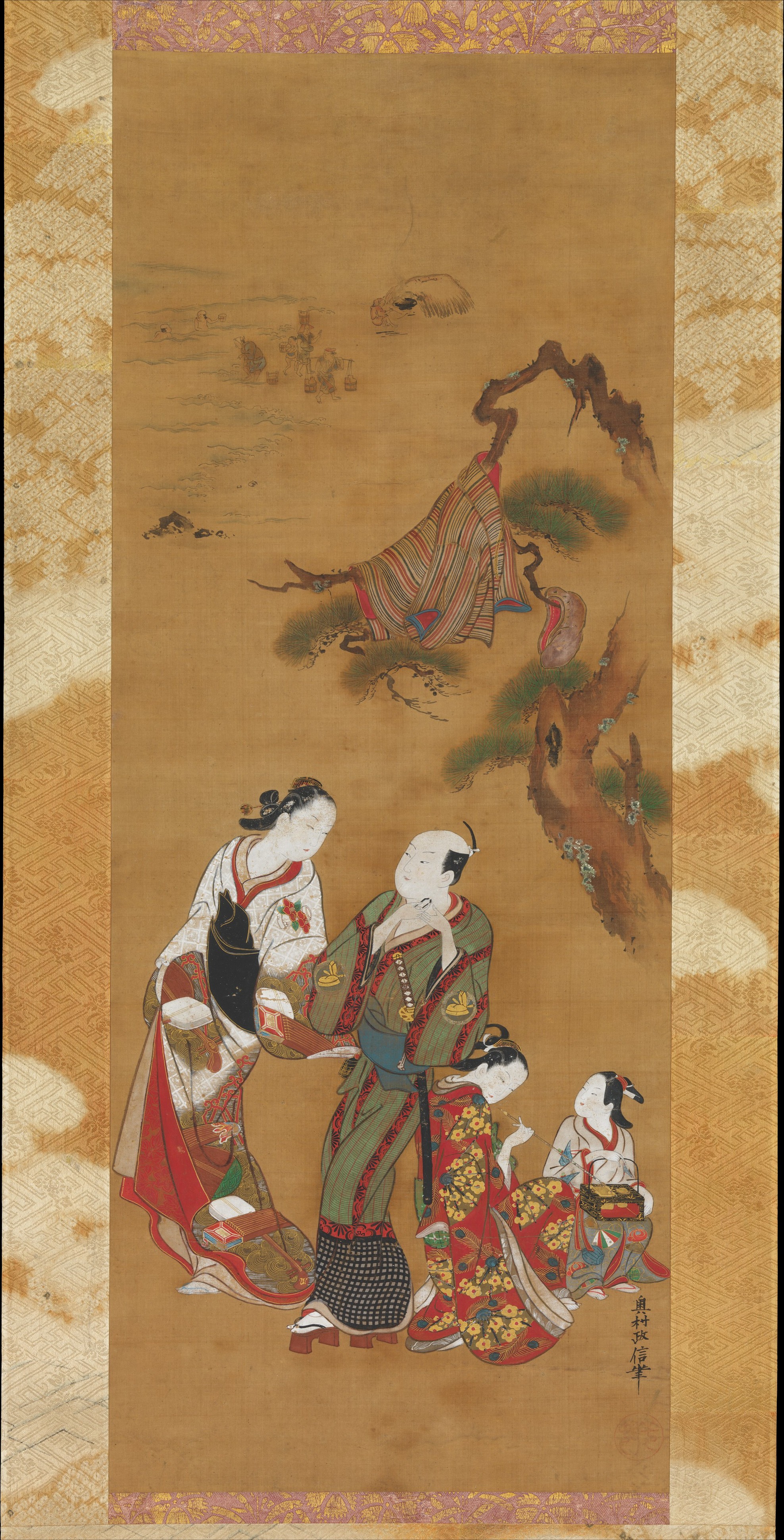
Vertical Japanese-style painting on brown background. A man and two women are standing. The man wears a green kimono with red trim and yellow and red designs. The woman on the left wears a white kimono with red lining and a black obi. The woman on the right wears a kimono with a red and gold floral pattern. All have white face makeup and black hair. The woman on the right holds a fan. A tree branch with green leaves extends from the right. Border has gold, beige, and pink pattern.
Artwork details
- Date:
- 18th century
- Medium:
- Hanging scroll; ink and color on silk
- Culture:
- Japan
- Dimensions:
- 318 × 624 px
- Museum record:
- View original
You May Also Like

Queen Mother of the West

Courtesan and her Attendants under a Willow Tree

Travelers on the Tokaido

Painting the Eyes on a Snow Rabbit

The Ide Jewel River in Yamashiro Province (Yamashiro Ide no Tamagawa), from an untitled series of Six Jewel Rivers

Beauties and Young Gallants

Street Scene in the New Year Season

Woman under a Willow Tree

Women Viewing Cherry Blossoms

Women Chasing Crickets on an Autumn Moor

Yamashiro Province from the series Fashionable Six Jewel Rivers (Furyu Mu Tamagawa)

Puppeteer with Puppet

Women and Children on the Banks of a Stream

Fashionable Six Immortal Poets (Furyu rokkasen)

Scene from a Drama

Fairy and Crane

The Actors Ichikawa Komazo II as Minamoto no Yorimasa (right), Matsumoto Koshiro II as Osada no Taro Kagemune Disguised as Yatsurugi Zaemon (center), and Ichikawa Danzo III as I no Hayata Tadazumi (left), In the Play Nue no Mori Ichiyo no Mato, Performed at the Nakamura Theater in the Eleventh Month, 1770

Yugao, from the series "Fifty-four Chapters of the Tale of Genji (Genji monogatari gojuyonjo)"

The Third Month (Yayoi), from the series "Popular Versions of Immortal Poets in Four Seasons (Fuzoku shiki kasen)"

Three Great Wise Men of the Han Dynasty


"Na": Nunobiki Waterfall, from the series "Tales of Ise in Fashionable Brocade Pictures (Furyu nishiki-e Ise monogatari)"

Girls Gathering Shells on the Sea-shore

History of Kamakura: Poem-bridge of Egara Tenjin Shrine


