
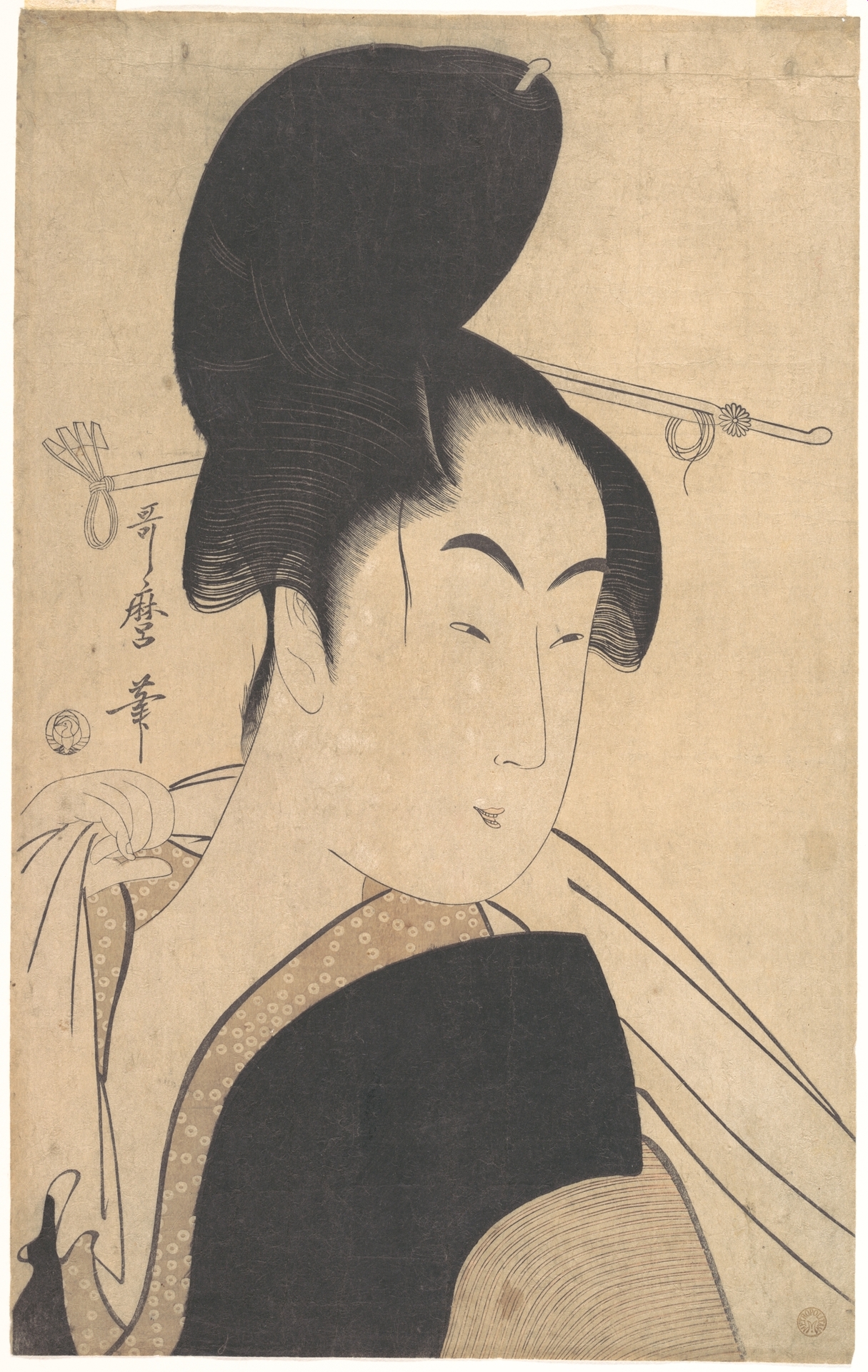
The image depicts a Japanese woodblock print of a woman's upper body. The woman's head and shoulders are shown. Her head is tilted slightly to the right. She has black hair styled in an updo, with a long pin protruding from the back. A portion of her forehead is shaved. She wears a kimono with a black and beige pattern. The kimono has a round neckline and a black collar. Her left shoulder is visible. The background of the print is a light brown color. There is Japanese writing on the left side. The overall style of the print is traditional Japanese ukiyo-e.
Artwork details
- Date:
- ca. 1795
- Medium:
- Woodblock print; ink and color on paper
- Culture:
- Japan
- Dimensions:
- 395 × 624 px
- Museum record:
- View original
You May Also Like

Ha... of the Southern Station (Nan'eki ha-jirushi)

Portrait of a Courtesan Holding a Pipe (from the series The Six Immortal Poets in Modern Dress)

Karatsuchi of the Echizenya

Kisegawa of the Matsubaya, from the series "Comparing the Charms of Five Beauties (Gonin bijin aikyo kurabe)"

An Elegant Series of Amulet Paintings (Furyu nanatsume e awase): Rabbit and Cock

Geisha Style (geisha fū) from the series Guide to Contemporary Styles (Tōsei fūzoku tsū)

“Hanamurasaki of the Tamaya,” from the series Seven Komachi of the Pleasure Quarters (Seirō Nana Komachi)

Woman Relaxing after Her Bath

Three Beauties of Our Time (Tosei san bijin)

Takashima Ohisa, from the series "Renowned Beauties Likened to the Six Immortal Poets (Komei bijin rokkasen)"

The actor Matsumoto Yonesaburo as Shinobu in the guise of the courtesan Kewaizaka no Shosho

Woman Holding a Round Fan

Tomimoto Toyohina, from the series "Famous Beauties of Edo (Edo komei bijin)"

The Courtesan Konosumi, from the series Beauties of the Southern Quarter (Nangoku bijin awase)

Portrait of Toyozumi of Chojiya House, Writing a Letter

Large Head and Bust Portrait of the Oiran Hanaogi of Ogiya.

Tatsumi Roko, from the series “Renowned Beauties Likened to the Six Immortal Poets" ("Komei bijin rokkasen")

Mirror, from the series “Eight Views of Tea-stalls in Celebrated Places" ("Meisho koshikake hakkei")

A Beauty

A Selection of Six Flowers - A Parody Rokkasen (Yatsushi rokkasen): Bishop Henjo

Wakamurasaki of the Kadotamaya

Woman of the Yoshiwara

Reflective Love, from the series "Anthology of Poems: The Love Section (Kasen koi no bu) (Mono-omou koi)"

A Young Woman Reading A Letter


