
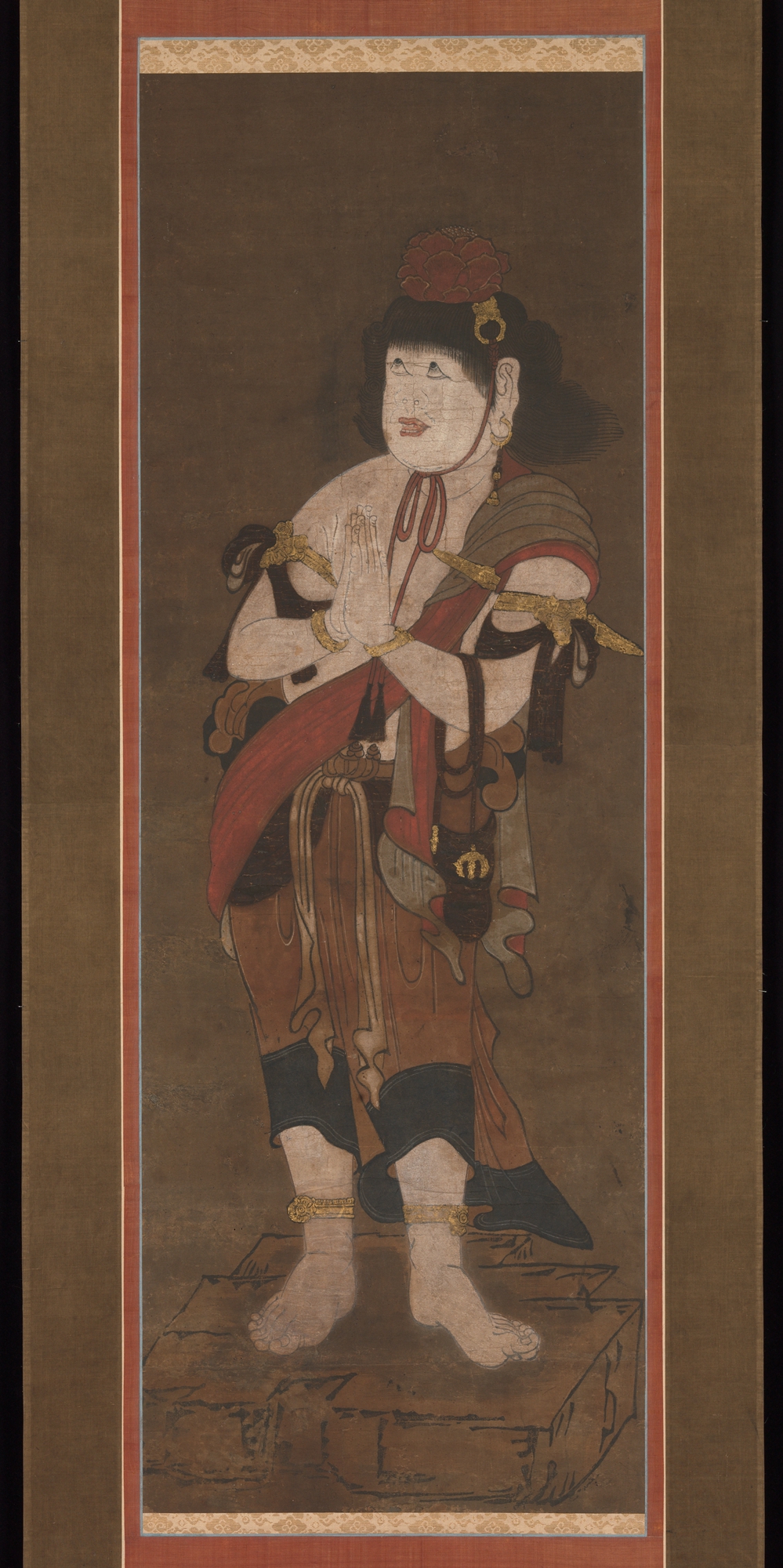
The image depicts a Japanese-style painting of Fudō Myōō, the Immovable Wisdom King. Fudō Myōō stands centrally, barefoot on a stone block, with his arms crossed over his chest, each hand gripping a cord. He wears a red headpiece and has black hair. His upper body is bare, with a red cloth draped over his left shoulder and around his waist. He has a necklace and various bracelets and ankle rings. Two attendants are positioned on either side, though they are not fully visible. The background of the painting is dark brown with a red and beige border. The painting style appears traditional Japanese, created by Ryūshū Shūtaku, also known as Myōtaku.
Artwork details
- Date:
- 14th century
- Medium:
- One of a triptych of hanging scrolls; hand-colored woodblock print on paper
- Culture:
- Japan
- Dimensions:
- 312 × 625 px
- Museum record:
- View original
You May Also Like

Fudō Myōō and Two Attendants

Buddha Amitabha Descending from His Pure Land

Fudō Myōō and Two Attendants

The Second Nakamura Juzo as a Yakko

Standing Ksitigarbha

Buddha Amitabha Descending from his Pure Land

The Bodhisattva Monju (Manjushri) with Five Topknots

One of the Twelve Celestial Guardians

One of the Twelve Celestial Guardians

A Mughal Prince, Perhaps Danyal, Holding a Sprig of Flowers

Otani Hiroji III as a Samurai Standing Beside a Stream

Monju as a Child (Chigo Monju)

Welcoming Descent of Amida Buddha

Ōtsu-e of Shōmen Kongōyasha (Vajrayaksha)

Kshitigarbha

Prince Shōtoku at Age Sixteen

Banner with Bodhisattva, possibly Mahamayuri

Kongara-doji

Monju with Five Hair Knots

Folio from a Manuscript of the Ashtasahasrika Prajnaparamita (Perfection of Wisdom)

The First Bando Mitsugoro as an Unarmed Man

Sri Nathaji

Painting from a Kalpa-sutra: Indra Praises the Embryo of Mahavira in the Womb of the Brahman Woman Devananda

Marshal Wang


