
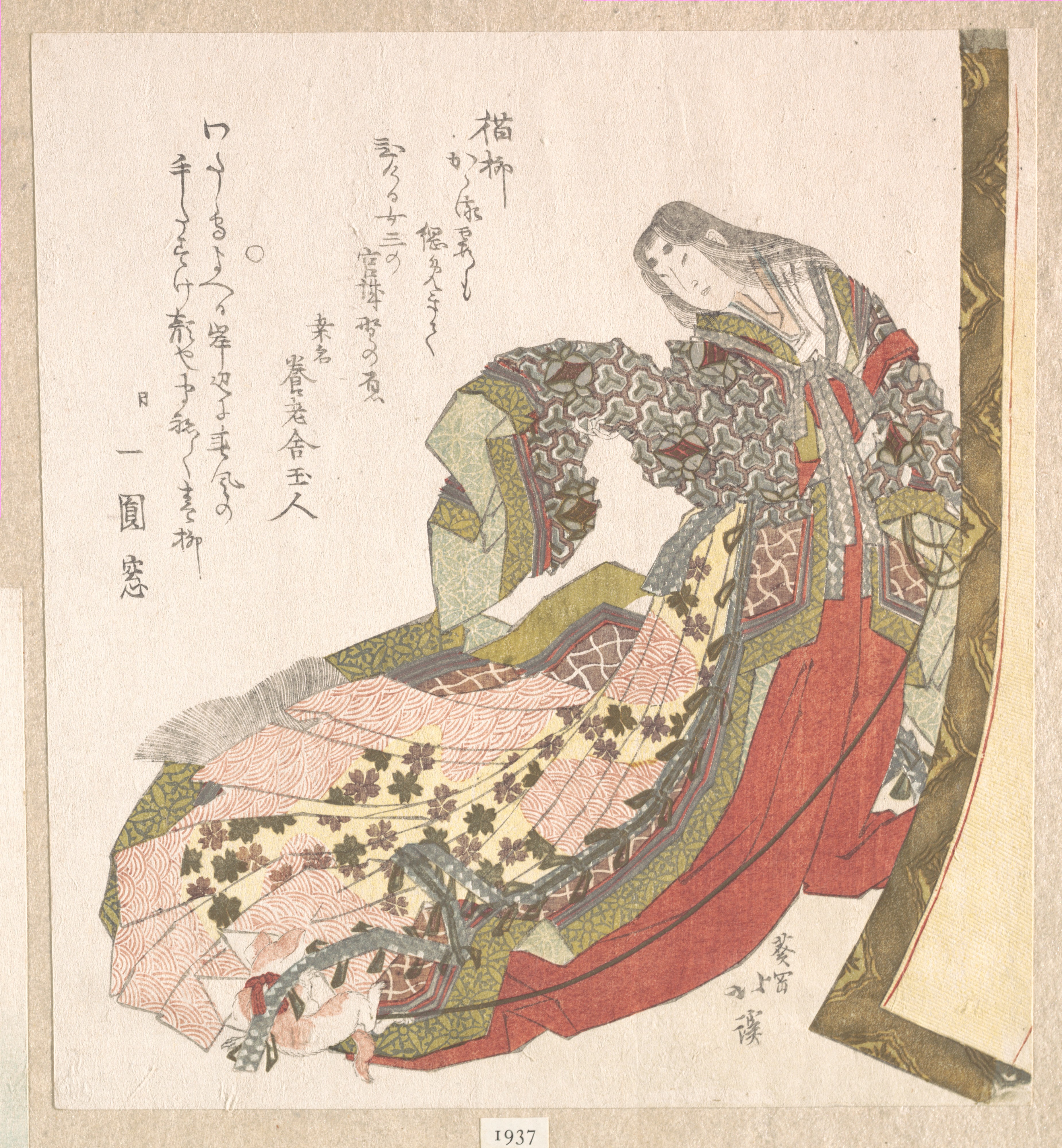
A woman wearing a traditional Japanese kimono, with a red under-kimono visible at the bottom, and a long outer kimono with a green and gold border, and a pink, green and gold patterned body with cherry blossoms; she wears a matching obi with similar designs; she has a long black hairpiece on top of her head with long strands of hair on either side of her head; she holds a large round fan decorated with similar designs; she has a white background behind her with Japanese writing on the left; the image has a thick beige border, and a small white square in the bottom center with the number 1937.
Artwork details
- Medium:
- Woodblock print (surimono); ink and color on paper
- Culture:
- Japan
- Dimensions:
- 578 × 625 px
- Museum record:
- View original
You May Also Like

Scene from the Noh Dance "Shojo"

Hananoto of the Ebiya in Kyōmachi 1-chome, from the series Songs of the Four Seasons in the Pleasure Quarters

Young Court Lady

Snake (Mi), from the series "Parody of the Twelve Signs of the Zodiac (Mitate juni shi)"

Courtesan Reading Beside a Potted Plum Tree, from the series Seven Courtesans Compared to Daoist Immortals

Lady Murasaki Sets a Bird Free from a Cage

Princess Fujitsubo in Court Costume with a Fan

Two Courtesans

Sotoori-hime (early 5th century), One of the Three Gods of Poetry From the Spring Rain Collection (Harusame shū), vol. 1

Dancer in Momijigari, from an untitled series of nerimono festival dancers

Woman and Youth on a Verandah

Nobleman Receiving a Kyoka (Humorous Poem) from Shibanoya Sanyo, a Master of Kyoka

Courtesan and New Year Decoration

Court lady standing amidst pines

Courtesan

Ushiwaka-maru in Armor

Courtesan Reading a Letter

Man and Woman in Court Costume

Two Courtesans, One Playing a Koto (Harp) and The Other Reading a Letter

Beauties and Young Gallants

Court Lady with a Fan—a Cherry-Tree in Bloom

The Courtesan Hana-ogi of Ogiya as the Sennin Tekkai (from the series Eight Immortals of Sensuality)


Courtesan Going to Bed, from the series "Ten Types of Beauties in Pictures (Jittai e-fuzoku)"


