
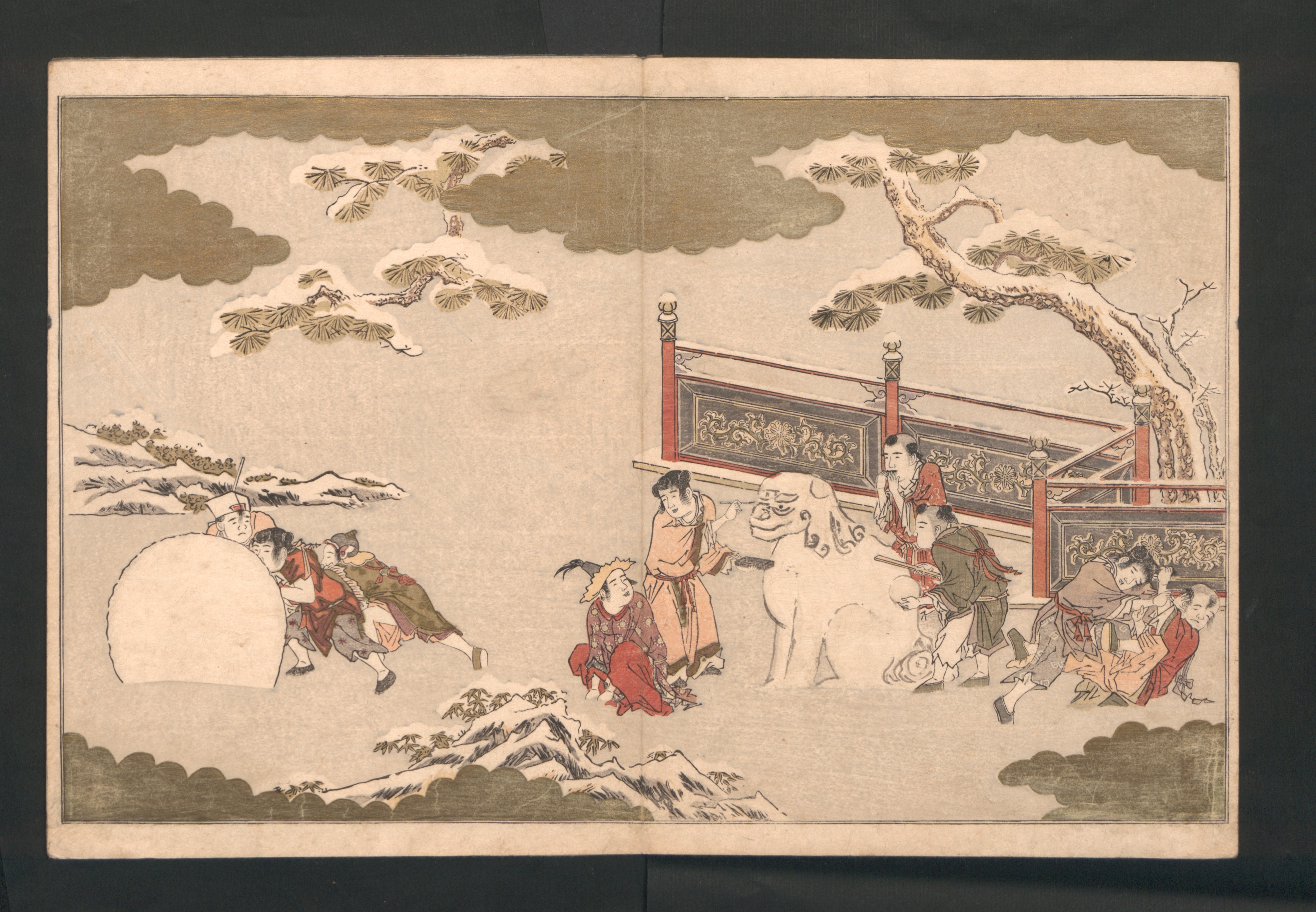
The image depicts a traditional Japanese woodblock print. The scene shows people in traditional Japanese clothing walking around. One person rides a white horse. There are trees and a fence in the background. The print features muted colors, including shades of beige, gray, and red. The composition includes two large sections divided down the middle. Several people are on the left and right sides, with one central figure. The sky has clouds and mountains are visible. Pine trees are also present. The artist's signature is visible but not legible. The title of the work is "The Silver World" or "Gin sekai" in Japanese. The overall style suggests an 18th or 19th-century Japanese artwork.
Artwork details
- Date:
- preface dated 1790
- Medium:
- Polychrome woodblock printed book; ink and color on paper
- Culture:
- Japan
- Dimensions:
- 599 × 415 px
- Museum record:
- View original
You May Also Like

Moon-Mad Monk (Kyōgetsubō) 狂月坊

Rain of the Fifth Month (Samidare)

Landscape with Man on Horseback

Picture Book on the Music of the Pine Trees (Ehon matsu no shirabe) 絵本松のしらべ

Winter Scene from the Romance of the Three Kingdoms

Enjoying the Cool in a Garden

Joyous Banquet of Guo Ziyi (곽분양행락도)

Flower Viewing

Travelers on the Tokaido

Famous Views of Ōmi

Hodogaya on the Tōkaidō (Tōkaidō Hodogaya), from the series Thirty-six Views of Mount Fuji (Fugaku sanjūrokkei)

Crossing the Bridge at Sano

Family Training

Night Watchmen Under Maple Tree

Sekiya Village on the Sumida River (Sumidagawa Sekiya no sato), from the series Thirty-six Views of Mount Fuji (Fugaku sanjūrokkei)

Poem by Abe no Nakamaro, from the series One Hundred Poems Explained by the Nurse (Hyakunin isshu uba ga etoki)

Scenes from the Tale of Genji

Picture of Minamoto no Yoritomo's Hunt on the Slopes of Mount Fuji

Chiyoda Castle (Album of Men)

Hakuba no Sechie

The Top of Mount Fuji

Ichikawa Norinosuke and Ichikawa Yonejuro as Morihachi and Yonehachi, Two Comedians

Asakayama Hanami

Performance of a Trained Monkey, from an illustrated poetry anthology entitled "The Young God Ebisu (Waka Ebisu)"


