
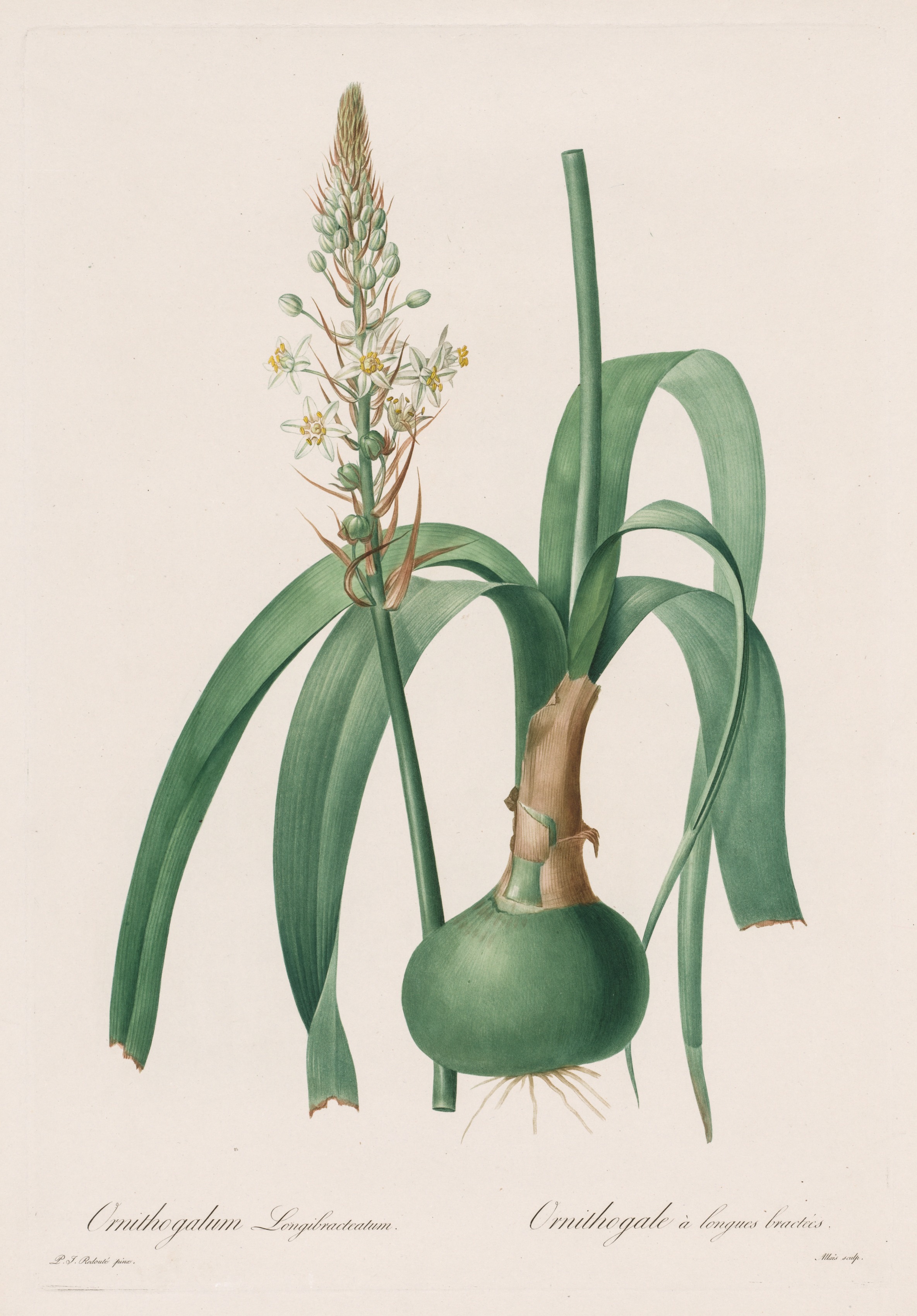
The image shows a green plant with a large bulbous base and long, thin leaves extending from it. The bulb is positioned centrally and has a light brown, woody section at the top. Several long, thin, green leaves emerge from the top of the bulb, some of which curve downward. A tall stem with small white flowers and yellow centers rises from the center of the bulb. The background of the image is a light beige color. At the bottom of the image, there is cursive text in a foreign language, likely Latin, which appears to be the plant's name.
Artwork details
- Dimensions:
- 627 × 900 px
- Museum record:
- View original
You May Also Like

Les Liliacées: Amaryllis Lutes

Les Liliacées: Limodorum purpureum

Les Liliacées: Tradescantia discolor

Plantae Selectae: No. 52 - Ixia

Plantae Selectae: No. 37 - Yucca

Gold-banded Iris

Aloes

Plantae Selectae: No. 39 - Lilio-Gladiolus

The Temple of Flora, or Garden of Nature: The Nodding Renealmia

The Temple of the Flora: American Bog Plants

Les Liliacées: Crocus Sativus

Polyanthus or Cluster Narcissus (Botanical: Narcissus tazetta)

The American Cowslip, Plate 26

The Botanical Magazine or Flower Garden Displayed: Garden Hyacinth

Les Liliacées: Kaempferia longa

Lillium Pomponium (Turban Lily), plate 7 from Les Liliacées

Choix des plus belles fleurs...plus beaux fruits: Figue Violette

Flore des Jardiniers, Amateurs et Manufacturiers: Polyanthus or Cluster Narcissus

The Botanical Magazine or Flower Garden Displayed: The Mountain Lake Lily

Crown Imperial Fritillary

Double Narcissus and Single Narcissus, folio 26 (recto), from Florilegium (A Book of Flower Studies)

Les Liliacées: Scilla amaena
![The Botanical Magazine or Flower Garden Displayed: Plate 933, Protea mucronifolia. Dagger-Leaved Protea. [Protea odorata]](/api/image?url=https%3A%2F%2Fopenaccess-cdn.clevelandart.org%2F2005.336%2F2005.336_web.jpg&w=1536&q=75)
The Botanical Magazine or Flower Garden Displayed: Plate 933, Protea mucronifolia. Dagger-Leaved Protea. [Protea odorata]

Voyage aux Régions équinoxiales du nouveau continent, fait dans les années 1709 à 1804: Monographie des melastomacées: No. 15