
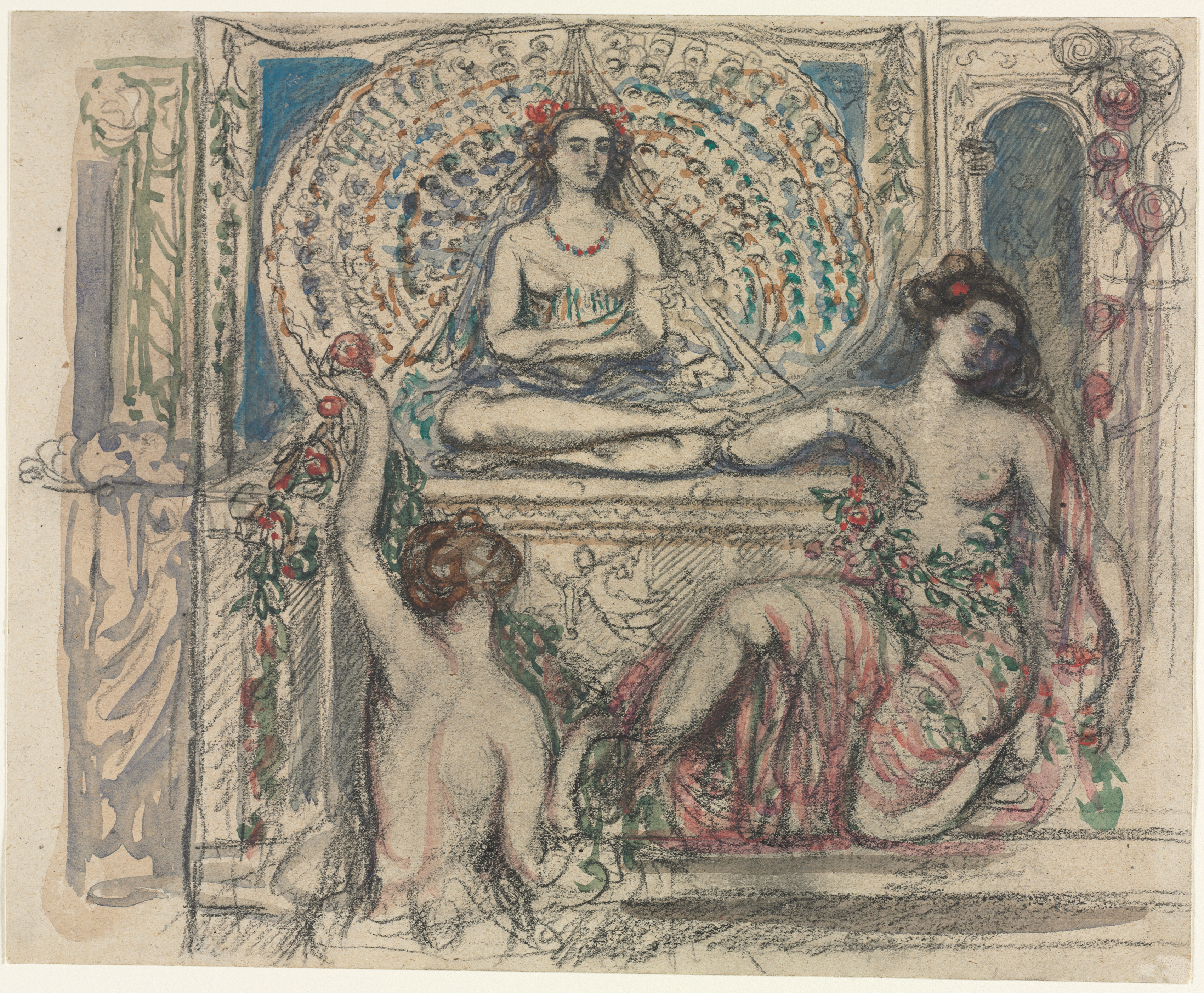
The artwork, "The Throne of the Peacock" by Charles Conder, features a drawing of three figures. The central figure sits cross-legged on a throne, with a peacock's tail behind. The figure has long hair and minimal clothing, with a necklace and headpiece adorned with red flowers. The figure is fair-skinned. In front of and to the left of the throne, a smaller figure with short brown hair reaches up, holding flowers. To the right of the throne, another figure with long dark hair, a pink and white dress with green and red flowers and bare shoulders, sits. The background includes architectural elements such as columns with floral designs and an archway. The overall style is impressionistic with detailed line work and muted colors. The color palette includes shades of pink, green, blue, and red on a primarily beige background.
Artwork details
- Dimensions:
- 1083 × 893 px
- Museum record:
- View original
You May Also Like

Invocation to the Divinities who preside over Agriculture from Virgil's "Georgics"

Two Bathers under a Tree at the Water's Edge

Olympia

The Family (In Memory of a Summer in the White Mountains)

Ornament with Naked Couple
![The Soul Hovering Over the Body [from Marriage of Heaven and Hell," plate 14]](/api/image?url=https%3A%2F%2Fapi.nga.gov%2Fiiif%2F503d8aad-69f1-4b47-b675-922ebabfd18a%2Ffull%2F!843%2C843%2F0%2Fdefault.jpg&w=1536&q=75)
The Soul Hovering Over the Body [from Marriage of Heaven and Hell," plate 14]

Male Nude Seated and Standing

Bacchanal, The Game of Leap Frog

Mercury Orders Calypso to Allow Ulysses Depart

Expulsion from Paradise

Te arii vahine—opoi (Woman with Mangos—Tired), from the Suite of Late Wood-Block Prints

Virtus Combusta: An Allegory of Virtue

The Nymphs

The Two Bathers

The Entombment

St. Jerome in Penitence

Nude Man and Woman

Two Standing Tahitian Women

Two Women Bathing

Jupiter and Antiope

Cecrops' Daughters Uncover Erichthonius (recto); A Battle Scene (verso)

The Marital Bliss of Nala and Damayanti: Folio from a Nala-Damayanti Series

Music

Woman (The Sphinx)