
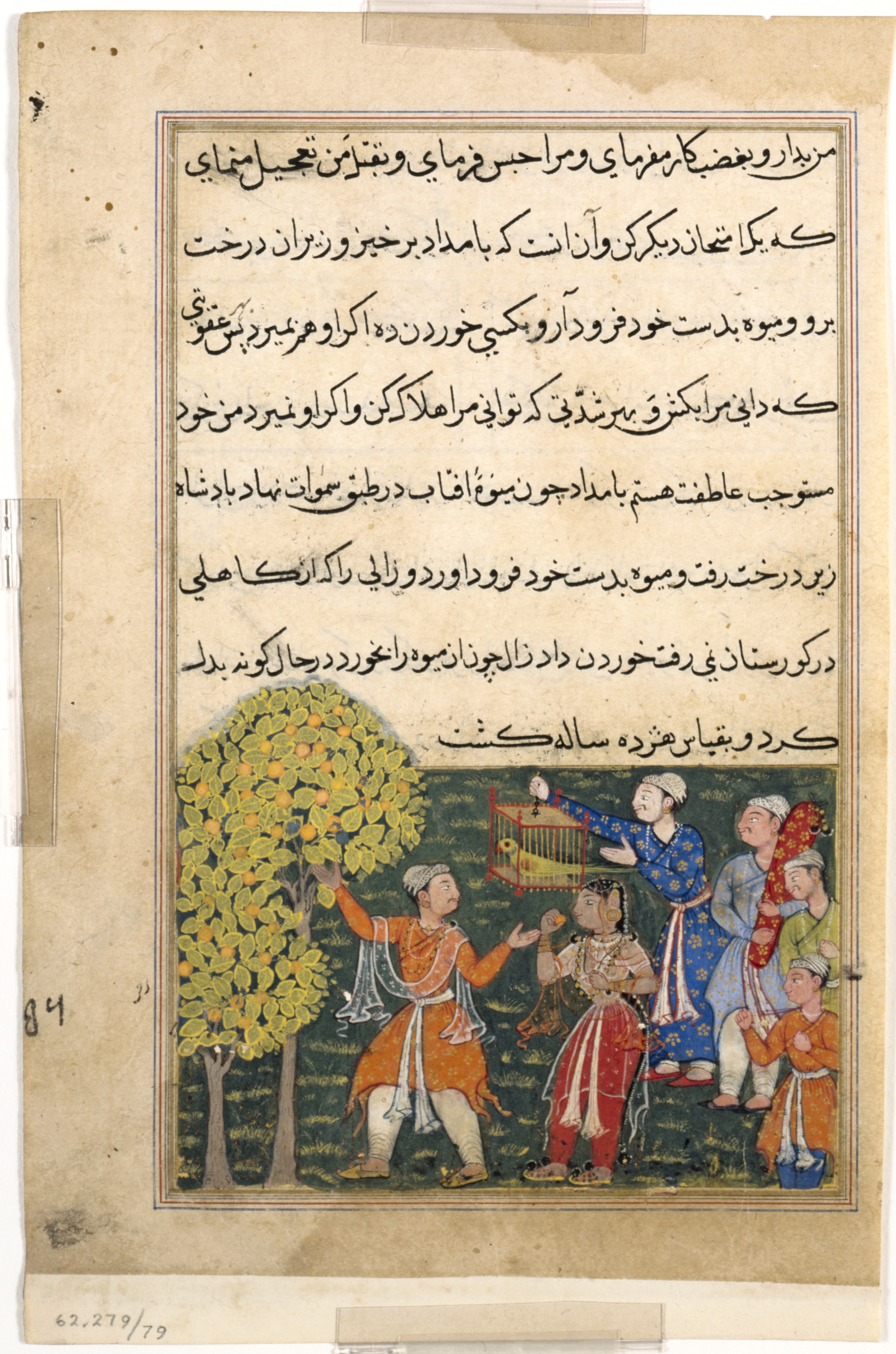
The king plucks fruit from the Tree of Life with his own hands and feeds it to a lady, from a Tuti-nama (Tales of a Parrot): Ninth Night
A man in a blue robe and white turban reaches for a piece of fruit on a tree with his right hand. He stands on the right side of a tree. A man to his left, wearing an orange robe and white turban, holds the tree's branches with his left hand. The tree has yellow-green leaves and orange fruit. The man in blue stands on a grassy area with three people. A man sits on a low platform. A woman wearing a pink robe sits on the grass. A man wearing orange stands on the right. The man in orange holds a blue vessel. A large block of black text in a foreign language is above the people. The image has a yellow-brown background with darker spots and a thin black border.
Artwork details
- Dimensions:
- 591 × 893 px
- Museum record:
- View original
You May Also Like

The young prince is crowned and the wicked handmaiden is executed, from a Tuti-nama (Tales of a Parrot): Eighth Night

The unfaithful wife explaining away the presence of the dough elephant, from a Tuti-nama (Tales of a Parrot): Eighth Night

The prince, once reprieved, is returned to the palace of execution a second time on the plea of the king’s handmaiden, from a Tuti-nama (Tales of a Parrot): Eighth Night

The lover’s son makes an elephant of the pastry dough carried by the unfaithful wife and puts it in her basket, from a Tuti-nama (Tales of a Parrot): Eighth Night

King Bahram, who has married Khassa’s daughter, has her tied to a camel to be abandoned in the desert as a result of false accusations made by Khulasa, from a Tuti-nama (Tales of a Parrot): Fifty-first Night

Vabhruvahana Approaches Arjuna, page from the Khan Khanan's Razm-nama

The merchant’s daughter gives birth to a son as a result of eating out of the box. The clever child recognizes the false gems from true, from a Tuti-nama (Tales of a Parrot): Twenty-third Night

The sentinel in the employ of the Shah of Tabaristan prepares to sacrifice his son to the ghost of the Shah’s soul, from a Tuti-nama (Tales of a Parrot): Second Night

The king’s handmaiden takes the prince away to the harem, from a Tuti-nama (Tales of a Parrot): Eighth Night

The parrot addresses Khujasta at the beginning of the forty-seventh night, from a Tuti-nama (Tales of a Parrot): Forty-seventh Night

The prince, with the help of Mukhlis who changes into a frog, recovers the ring lost in the sea, and returns it to the king, from a Tuti-nama (Tales of a Parrot): Eighteenth Night

The parrot brings a fruit from the Tree of Life to the king of Syria, from a Tuti-nama (Tales of a Parrot): Ninth Night

The eldest brother explains the reason for his youthful appearance, from a Tuti-nama (Tales of a Parrot): Forty-ninth Night

The bird of seven colors brings a sable to the pious man, from a Tuti-nama (Tales of a Parrot): Fifty-second Night

Shahr-Arai and her husband adopt her lover as a brother in the family, from a Tuti-nama (Tales of a Parrot): Fortieth Night

The hunter offers the mother parrot to the king of Kamarupa, from a Tuti-nama (Tales of a Parrot): Fifth Night

The monk returns the magic parrot to its rightful owner, the merchant, from a Tuti-nama (Tales of a Parrot): Tenth Night

The Brahman gambler sees the daughter of the king of the jinns in a pit together with an old man and a cauldron of boiling oil, from a Tuti-nama (Tales of a Parrot: Seventh Night)

The goldsmith judged; the bear cubs trained by the carpenter as though they were his sons, from a Tuti-nama (Tales of a Parrot): Third Night

The young prince is presented to the king, his father, by his teacher, but refuses to speak, from a Tuti-nama (Tales of a Parrot): Eighth Night

The third suitor strikes the devotee’s daughter and thus restores her to life, from a Tuti-nama (Tales of a Parrot): Twentieth Night

The prince rejects the amorous advances of the king’s handmaiden, from a Tuti-nama (Tales of a Parrot): Eighth Night

Three suitors fight amongst themselves for the hand of the devotee’s daughter, from a Tuti-nama (Tales of a Parrot): Twentieth Night

Page of disasters, from the Tarikh-i Alfi (History of a Thousand Years)