
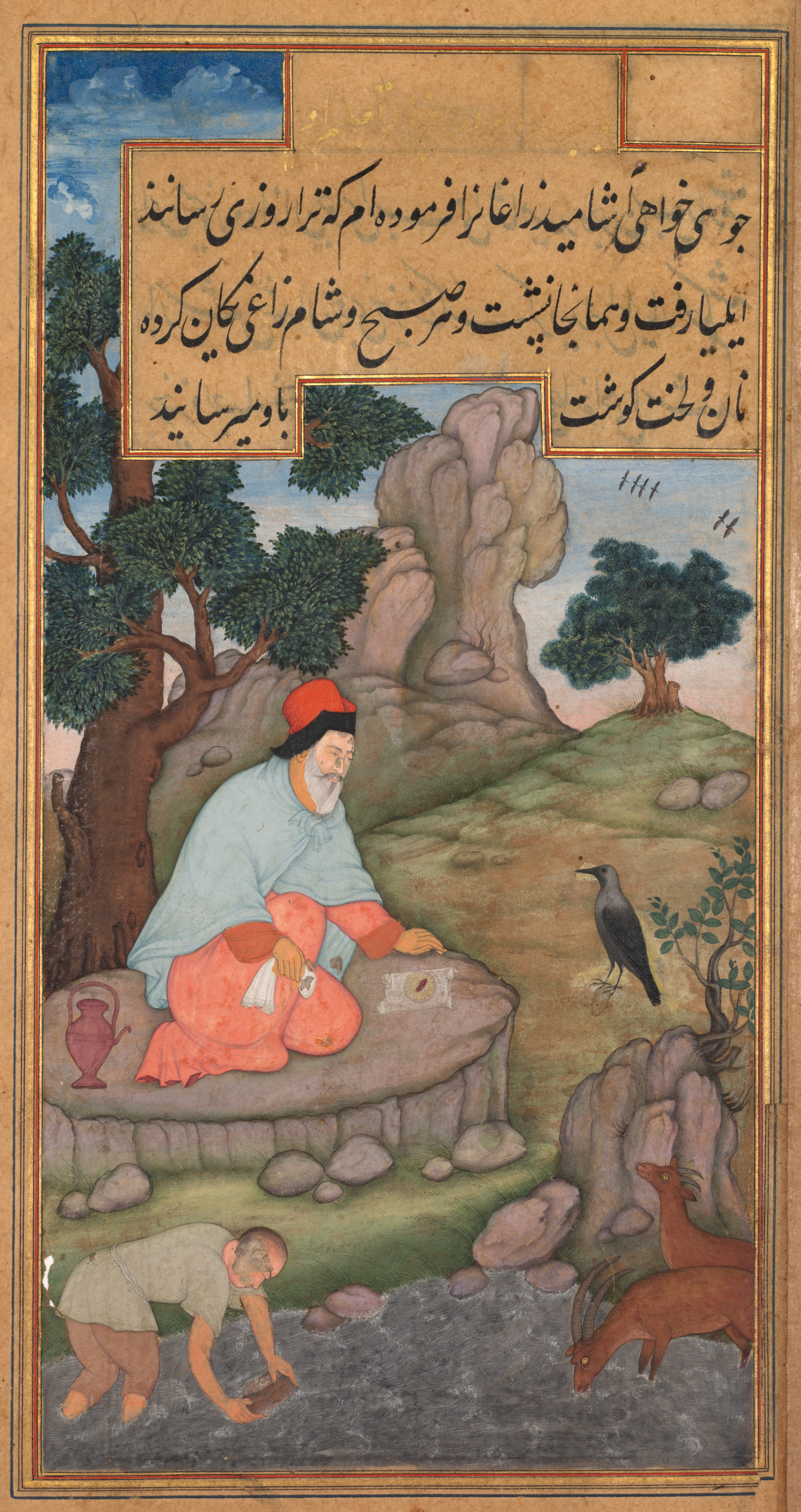
A raven brings food to Elijah (folio 72 recto), from a Mirror of Holiness (Mir’at al-quds) of Father Jerome Xavier,
The image depicts an illustration of a man sitting on a stone, with a raven standing to his right. He wears a red and black hat and a blue robe with red pants. A small table in front of him holds a plate and a cup. The man sits on a raised stone surface. In the foreground, a person bends over, and two deer drink from a stream. The background features trees, rocks, and a blue sky with clouds. Black text in a foreign language, likely Arabic or Persian, is written in the top portion of the image. The overall scene is framed by a gold border.
Artwork details
- Dimensions:
- 477 × 900 px
- Museum record:
- View original
You May Also Like

The Raja of Ujjain, who is traveling in the guise of a yogi, meets two brothers who ask him to equitably partition their father’s possession, from a Tuti-nama (Tales of a Parrot): Forty-sixth Night

Moses praying to end the serpents’ attack on the Israelites (folio 63 verso), from a Mirror of Holiness (Mir’at al-quds) of Father Jerome Xavier

The suitors take the devotee’s daughter out of her tomb after breaking it open, when the physician discovers she is still alive, from a Tuti-nama (Tales of a Parrot): Twentieth Night

The emir slays the snake after giving it shelter, from a Tuti-nama (Tales of a Parrot): Forty-fifth Night

Shah Tahmasp I (1514–1576) Seated in a Landscape

The unfaithful wife explaining away the presence of the dough elephant, from a Tuti-nama (Tales of a Parrot): Eighth Night

Portrait of a kneeling holy man, from the Prince Salim Album

The four destitute friends go to a wise man who gives each one of them a magic shell to be placed on top of the turban, from a Tuti-nama (Tales of a Parrot): Forty-seventh Night

The young man of Baghdad solicits advice from a friend as his slave girl, who is adept at music, awaits, from a Tuti-nama (Tales of a Parrot): Forty-eighth Night

The fourth man digs at the spot where he dropped the shell, expecting jewels, but discovering mere iron, from a Tuti-nama (Tales of a Parrot): Forty-seventh Night

Latif, who has murdered his brother, falsely accuses Khurshid of the deed, from a Tuti-nama (Tales of a Parrot): Thirty-second Night

Kaiwan, Latif, and Sharif arrive at a house of worship, where they seek help from Khurshid who has become a mystical healer, from a Tuti-Nama (Tales of a Parrot): Thirty-second Night

An Episode from the Story of the Sasanian King Khusrau and His Beloved Shirin, from a Khamsa (Quintet) of Nizami (1141–1209) (verso)

Raja Dilip Singh of Guler on a dais

Kabir and Two Followers on a Terrace (recto)

The prince, a son of the ruler of Sistan, enters the service of a snake, from a Tuti-nama (Tales of a Parrot): Thirty-seventh Night

The bag of gold which he received for the slave girl being stolen in a mosque, the young man of Baghdad tears his cloths and is about to fling himself into the Tigris, from a Tuti-nama (Tales of a Parrot): Forty-eighth Night

The Brahman’s wife who killed a peacock and ate its gallbladder on the physician’s advice, from a Tuti-nama (Tales of a Parrot): Nineteenth Night

Jesus on Mount Tabor, near Nazareth where he Chooses Twelve of his Followers and Calls them Apostles (folio 87 verso), from a Mirror of Holiness (Mir’at al-quds) of Father Jerome Xavier

Vabhruvahana Approaches Arjuna, page from the Khan Khanan's Razm-nama
![Bahram Gur Visits the Princess of India in the Black Pavilion (recto): Illustration and Text, Persian Verses, from a manuscript of the Khamsa of Nizami, Haft Paykar [Seven Portraits]](/api/image?url=https%3A%2F%2Fopenaccess-cdn.clevelandart.org%2F1944.486.a%2F1944.486.a_web.jpg&w=1536&q=75)
Bahram Gur Visits the Princess of India in the Black Pavilion (recto): Illustration and Text, Persian Verses, from a manuscript of the Khamsa of Nizami, Haft Paykar [Seven Portraits]

Mahrusa’s marriage to the prefect of the city, from a Tuti-nama (Tales of a Parrot): Thirty-sixth Night

The Parrot Addresses Khujasta at the Beginning of the Eighth Night, from a Tuti-nama (Tales of a Parrot)

The origin of music from a fabulous bird of India which had seven holes in its beak, from a Tuti-nama (Tales of a Parrot): Fourteenth Night