
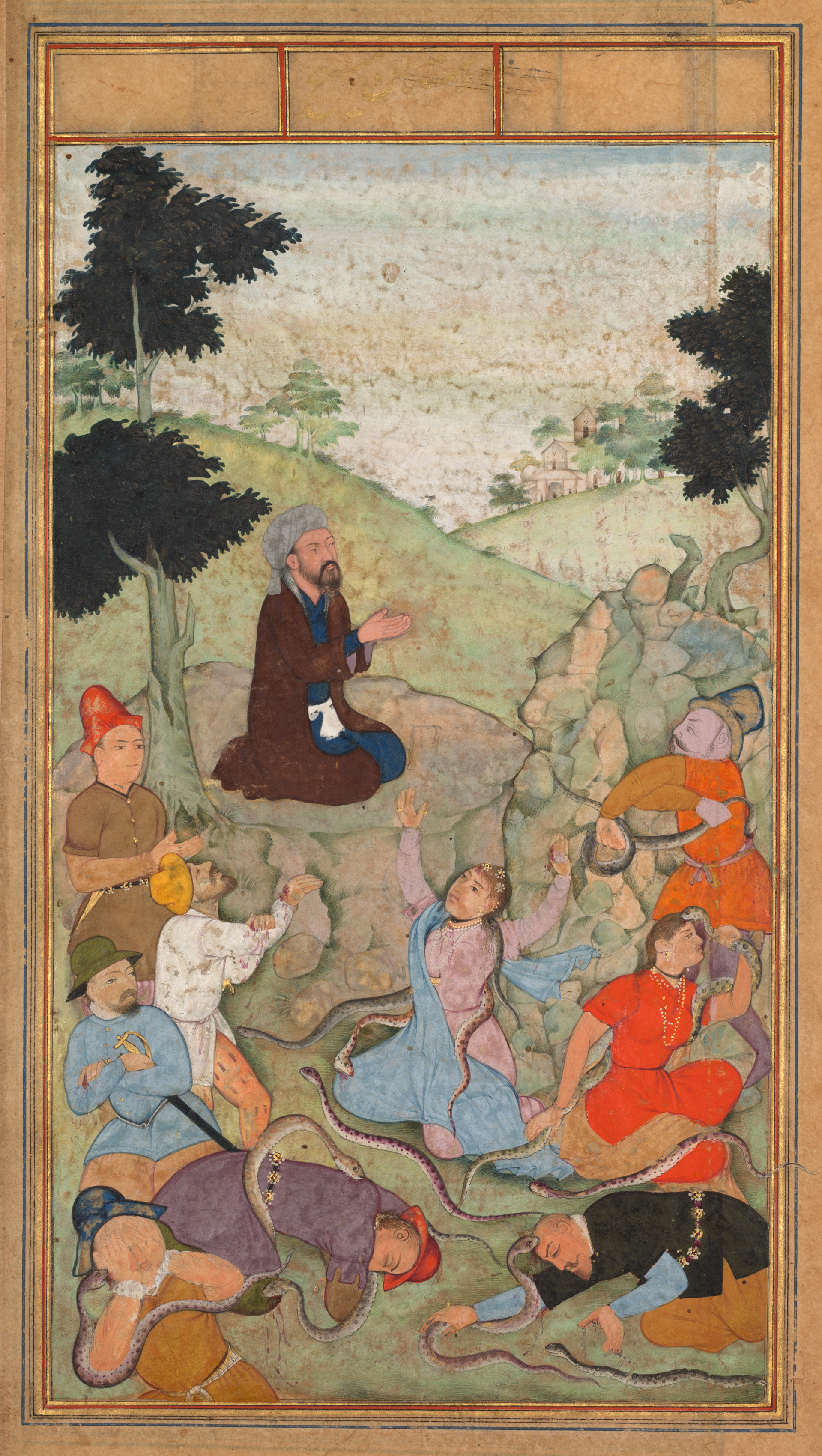
Moses praying to end the serpents’ attack on the Israelites (folio 63 verso), from a Mirror of Holiness (Mir’at al-quds) of Father Jerome Xavier
A painting depicts a man sitting on a rock with hands outstretched in prayer. He wears brown robes with a long grey beard and hair. Eight people are below him, facing him with hands raised. Some wear turbans; one man on the bottom right is red with snakes on his body and another man on the bottom left with snakes wrapped around his body lying on the ground. Trees and rocks are behind the figures; a green hillside and buildings are in the background. The painting has a tan border with gold, blue, and red lines.
Artwork details
- Dimensions:
- 508 × 900 px
- Museum record:
- View original
You May Also Like

A feast for Babur hosted by his half-brother Jahangir Mirza in Ghazni in May 1505, from a Babur-nama (Memoirs of Babur)

The game of wolf-running in Tabriz, from an Akbar-nama (Book of Akbar)

The Raja of Ujjain, who is traveling in the guise of a yogi, meets two brothers who ask him to equitably partition their father’s possession, from a Tuti-nama (Tales of a Parrot): Forty-sixth Night

Jesus on Mount Tabor, near Nazareth where he Chooses Twelve of his Followers and Calls them Apostles (folio 87 verso), from a Mirror of Holiness (Mir’at al-quds) of Father Jerome Xavier

Khosrow and Shirin in a Garden, a Scene from the Khamsa of Nizami

Babur receives booty and Humayun’s salute after the victory over Sultan Ibrahim in 1526, from an Akbar-nama (Book of Akbar) of Abu’l Fazl (Indian, 1551–1602)

Grotesque Dancers Performing

Salome Receiving John the Baptist’s Head on a Platter (folio 112 verso), from a Mirror of Holiness (Mir’at al-quds) of Father Jerome Xavier

Timur distributes gifts from his grandson, the Prince of Multan, from a Zafar-nama (Book of Victories)

Yusuf and Zulaykha (recto); Illustration and Text (Persian Verses) in an Anthology with some verses from Haft Awrang (Seven Thrones) of Jami; The Fifth Throne

Mary and Joseph Travel to Bethlehem (folio 24 verso), from a Mirror of Holiness (Mir’at al-quds) of Father Jerome Xavier

The infant son of the king of Isfahan responds to music, from a Tuti-nama (Tales of a Parrot): Thirteenth Night

Jesus being portrayed by King Abgar’s painter (folio 143 recto), from a Mirror of Holiness (Mir’at al-quds) of Father Jerome Xavier

Vabhruvahana Approaches Arjuna, page from the Khan Khanan's Razm-nama

The young man of Baghdad joins the Hashimi’s boat as a sailor to find his slave-girl on board, from a Tuti-nama (Tales of a Parrot): Forty-eighth Night
![Bahram Gur Visits the Princess of India in the Black Pavilion (recto): Illustration and Text, Persian Verses, from a manuscript of the Khamsa of Nizami, Haft Paykar [Seven Portraits]](/api/image?url=https%3A%2F%2Fopenaccess-cdn.clevelandart.org%2F1944.486.a%2F1944.486.a_web.jpg&w=1536&q=75)
Bahram Gur Visits the Princess of India in the Black Pavilion (recto): Illustration and Text, Persian Verses, from a manuscript of the Khamsa of Nizami, Haft Paykar [Seven Portraits]

An Episode from the Story of the Sasanian King Khusrau and His Beloved Shirin, from a Khamsa (Quintet) of Nizami (1141–1209) (verso)

The vizier dissuades the king of Bahilistan from executing the dervish who asks for his daughter’s hand in marriage, from a Tuti-nama (Tales of a Parrot): Seventh Night

Royal Reception in a Landscape, left folio from the double frontispiece of a Shahnama (Book of Kings) of Firdausi (Persian, about 940–1019 or 1025)

Royal Reception in a Landscape, left folio from the double frontispiece of a Shahnama (Book of Kings) of Firdausi (Persian, about 940–1019 or 1025)

Mahrusa’s marriage to the prefect of the city, from a Tuti-nama (Tales of a Parrot): Thirty-sixth Night

Hulagu Khan giving a feast and dispensing favor upon the amirs and princes, from a Chingiz-nama (Book of Chingiz Khan) of the Jami al-tavarikh (Compendium of Chronicles)

Folios A and B from the "Five Treasures" (Panj Ganj) of Jami

Zulaykha in her palace and as an old woman with Joseph, from a Panj Ganj (Five Treasures) of Abd al-Rahman Jami (Persian, 1414–1492); verso from a Panj Ganj of Abd al-Rahman Jami (Persian, 1414–1492), with two masnavis: Yusuf va Zulaykha (Joseph and Zulaykha) and Khirad-nama-i Iskandari (Alexander’s Book of Wisdom)