
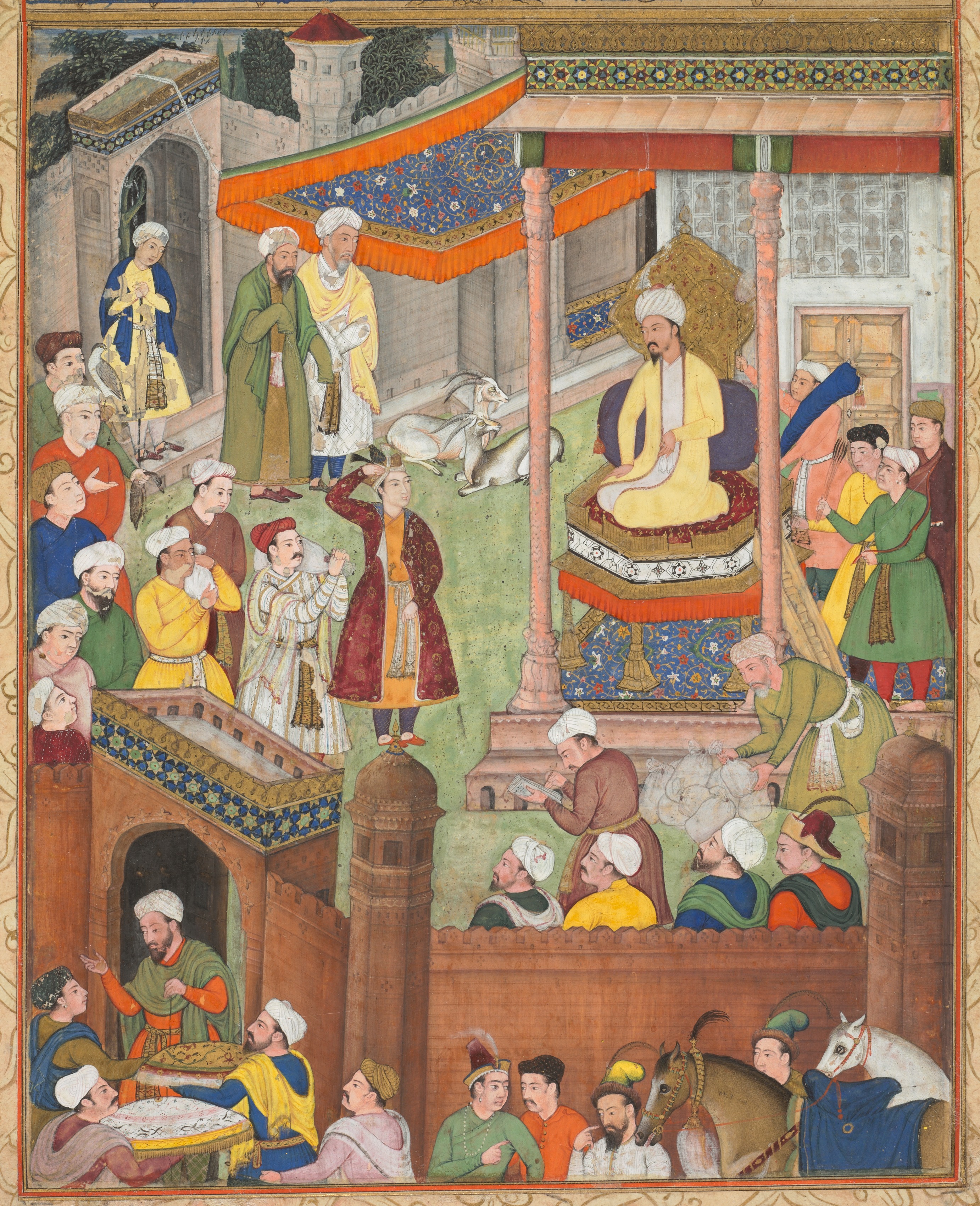
Babur receives booty and Humayun’s salute after the victory over Sultan Ibrahim in 1526, from an Akbar-nama (Book of Akbar) of Abu’l Fazl (Indian, 1551–1602)
Man sitting on a throne-like seat under a canopy, wearing yellow garments and a white turban. He sits on a raised platform surrounded by pillars. People around him wear colorful traditional clothing, some with turbans and others with various hats. A man in a red and orange robe touches his forehead. A group of men gathered around a table below. Some hold horses. Intricately designed buildings and walls are in the background. A blue and orange patterned fabric is on the left. People on balconies and an archway are on the left. A white horse with a decorated saddle is on the left side. A red and gold patterned border surrounds the image.
Artwork details
- Dimensions:
- 732 × 900 px
- Museum record:
- View original
You May Also Like

A feast for Babur hosted by his half-brother Jahangir Mirza in Ghazni in May 1505, from a Babur-nama (Memoirs of Babur)

Preparation for the marriage of Mahmuda to the Young Vizier, from a Tuti-nama (Tales of a Parrot): Thirty-third Night

Timur distributes gifts from his grandson, the Prince of Multan, from a Zafar-nama (Book of Victories)

John the Baptist recognizes Christ by the appearance of a dove (folio 50 verso), from a Mirror of Holiness (Mir’at al-quds) of Father Jerome Xavier

Yusuf and Zulaykha (recto); Illustration and Text (Persian Verses) in an Anthology with some verses from Haft Awrang (Seven Thrones) of Jami; The Fifth Throne

The merchant returns bringing a young slave who is really the son of the princess of Rum, now married to the king, from a Tuti-nama (Tales of a Parrot): Fiftieth Night

Simeon Kneels in Front of Mary and Jesus after Recognizing Them (folio 40 recto), from a Mirror of Holiness (Mir’at al-quds) of Father Jerome Xavier

The three young men present themselves as suitors for the hand of Zuhra, the daughter of the merchant of Kabul, from a Tuti-nama (Tales of a Parrot): Thirty-fourth Night

The vizier dissuades the king of Bahilistan from executing the dervish who asks for his daughter’s hand in marriage, from a Tuti-nama (Tales of a Parrot): Seventh Night

Zulaykha in her palace and as an elderly woman with Joseph (recto), from a Panj Ganj (Five Treasures) of Abd al- Rahman Jami (Persian, 1414–1492)

Folios A and B from the "Five Treasures" (Panj Ganj) of Jami

Zulaykha in her palace and as an old woman with Joseph, from a Panj Ganj (Five Treasures) of Abd al-Rahman Jami (Persian, 1414–1492); verso from a Panj Ganj of Abd al-Rahman Jami (Persian, 1414–1492), with two masnavis: Yusuf va Zulaykha (Joseph and Zulaykha) and Khirad-nama-i Iskandari (Alexander’s Book of Wisdom)

The Young Emperor Akbar Arrests the Insolent Shah Abu’l-Maali, Page from a Manuscript of the Akbarnama

Kaiwan, Latif, and Sharif arrive at a house of worship, where they seek help from Khurshid who has become a mystical healer, from a Tuti-Nama (Tales of a Parrot): Thirty-second Night

The rejuvenated old man and the daughter of the king of the jinns take leave of the King of Kings, from a Tuti-nama (Tales of a Parrot): Seventh Night

King Luhrasp Ascends the Throne: a Processon Arrives at Court (recto); the Story of King Luhrasp (verso) from a Shahnama (Book of Kings) of Firdausi (940-1019 or 1025)

King Luhrasp Ascends the Throne: a Processon Arrives at Court, recto of the left folio of a double-page composition from a Shahnama (Book of Kings) of Firdausi (940-1019 or 1025)

Salome Receiving John the Baptist’s Head on a Platter (folio 112 verso), from a Mirror of Holiness (Mir’at al-quds) of Father Jerome Xavier

Circumcision ceremony for Akbar’s sons, painting 126 from an Akbar-nama (Book of Akbar) of Abu’l Fazl (Indian, 1551–1602)

The young prince recounts his experiences to his father, the king, from a Tuti-nama (Tales of a Parrot): Eighth Night

Jesus writes on the ground (folio 130 verso), from a Mirror of Holiness (Mir’at al-quds) of Father Jerome Xavier

Page from a Manuscript of Kulliyat (Complete Works) by Sa'di

Hulagu Khan giving a feast and dispensing favor upon the amirs and princes, from a Chingiz-nama (Book of Chingiz Khan) of the Jami al-tavarikh (Compendium of Chronicles)

Shispul Arguing with Rukmini's Father, Bhishmaka, page from a Rukmini Mangal series