
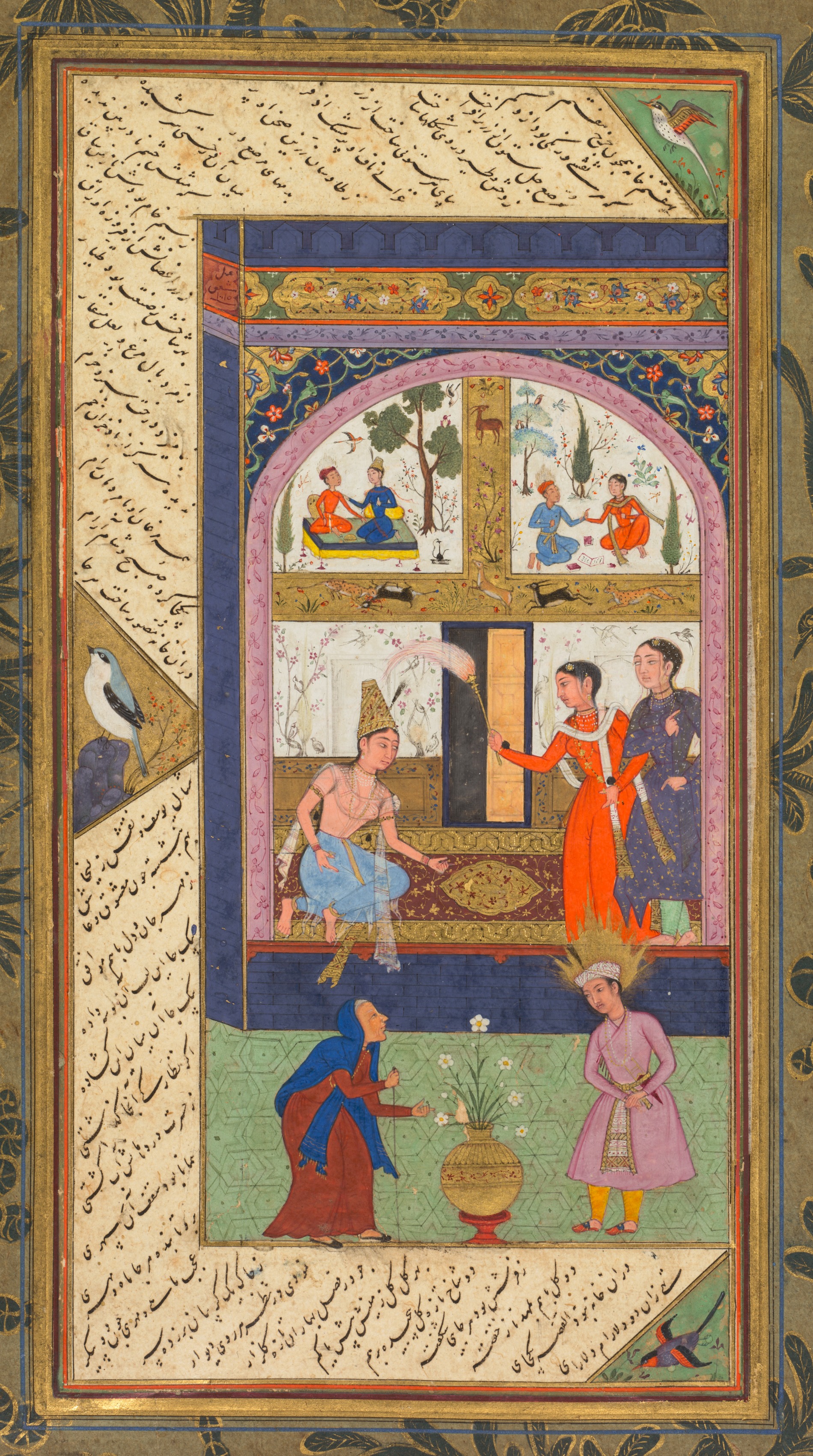
The image depicts a colorful illustration within an ornate gold frame, featuring multiple scenes. The main scene shows a man seated on a rug in a blue and gold room, wearing a gold headdress and blue pants; he appears to be shirtless. To his right, another man in an orange robe and white collar gestures toward the seated man, accompanied by a third man in a blue robe. A fourth man in a pink robe and gold headdress stands to the right. In the bottom left, a man in a red robe and blue sash interacts with a potted plant. The scene is divided into sections by archways and borders, with intricate designs and patterns throughout. The top section features two smaller scenes: one with two men seated under a tree and another with two people and a deer. The background of the main scene is green, while the border contains black script on a beige background and a brown outer border with leaf patterns. The overall composition suggests a narrative or allegorical theme.
Artwork details
- Dimensions:
- 503 × 900 px
- Museum record:
- View original
You May Also Like

Zulaykha in her palace and as an old woman with Joseph, from a Panj Ganj (Five Treasures) of Abd al-Rahman Jami (Persian, 1414–1492); verso from a Panj Ganj of Abd al-Rahman Jami (Persian, 1414–1492), with two masnavis: Yusuf va Zulaykha (Joseph and Zulaykha) and Khirad-nama-i Iskandari (Alexander’s Book of Wisdom)

Zulaykha in her palace and as an elderly woman with Joseph (recto), from a Panj Ganj (Five Treasures) of Abd al- Rahman Jami (Persian, 1414–1492)

The rejuvenated old man and the daughter of the king of the jinns take leave of the King of Kings, from a Tuti-nama (Tales of a Parrot): Seventh Night

Preparation for the marriage of Mahmuda to the Young Vizier, from a Tuti-nama (Tales of a Parrot): Thirty-third Night

Bahram Visits the White Domed Pavilion on Friday (recto)

The young prince recounts his experiences to his father, the king, from a Tuti-nama (Tales of a Parrot): Eighth Night

Yusuf and Zulaykha (recto); Illustration and Text (Persian Verses) in an Anthology with some verses from Haft Awrang (Seven Thrones) of Jami; The Fifth Throne

The magician, disguised as a Brahman, visits the king of Babylon, from a Tuti-nama (Tales of a Parrot): Thirty-fifth Night

The merchant’s clerk replaces the sugar purchased by the philandering wife with gravel, from a Tuti-nama (Tales of a Parrot): Eighth Night

The vizier dissuades the king of Bahilistan from executing the dervish who asks for his daughter’s hand in marriage, from a Tuti-nama (Tales of a Parrot): Seventh Night

Kaiwan, Latif, and Sharif arrive at a house of worship, where they seek help from Khurshid who has become a mystical healer, from a Tuti-Nama (Tales of a Parrot): Thirty-second Night

Grotesque Dancers Performing

The merchant returns bringing a young slave who is really the son of the princess of Rum, now married to the king, from a Tuti-nama (Tales of a Parrot): Fiftieth Night

Bahram Visits the White Domed Pavilion on Friday, illustrated with text in Khamsa of Nizami (verso), from a Haft Paykar (Seven Portraits) of Nizami

The young prince is crowned and the wicked handmaiden is executed, from a Tuti-nama (Tales of a Parrot): Eighth Night

The three young men present themselves as suitors for the hand of Zuhra, the daughter of the merchant of Kabul, from a Tuti-nama (Tales of a Parrot): Thirty-fourth Night

A Royal Picnic on a Terrace

The dervish brings the King of Kings before the king of Bahilistan, from a Tuti-nama (Tales of a Parrot): Seventh Night

Mahrusa’s marriage to the prefect of the city, from a Tuti-nama (Tales of a Parrot): Thirty-sixth Night

Royal Reception in a Landscape, right folio from a double-page frontispiece of a Shahnama (Book of Kings) of Firdausi (940–1019 or 1025)

The hunter offers the mother parrot to the king of Kamarupa, from a Tuti-nama (Tales of a Parrot): Fifth Night

King Bhojaraja tries in vain to ascertain the whereabouts of the pearl from the four travelling companions, from a Tuti-nama (Tales of a Parrot): Twelfth Night

The king of the Ocean, having assumed human form, arrives at the court of the Raja, from a Tuti-nama (Tales of a Parrot): Eleventh Night

Babur receives booty and Humayun’s salute after the victory over Sultan Ibrahim in 1526, from an Akbar-nama (Book of Akbar) of Abu’l Fazl (Indian, 1551–1602)