
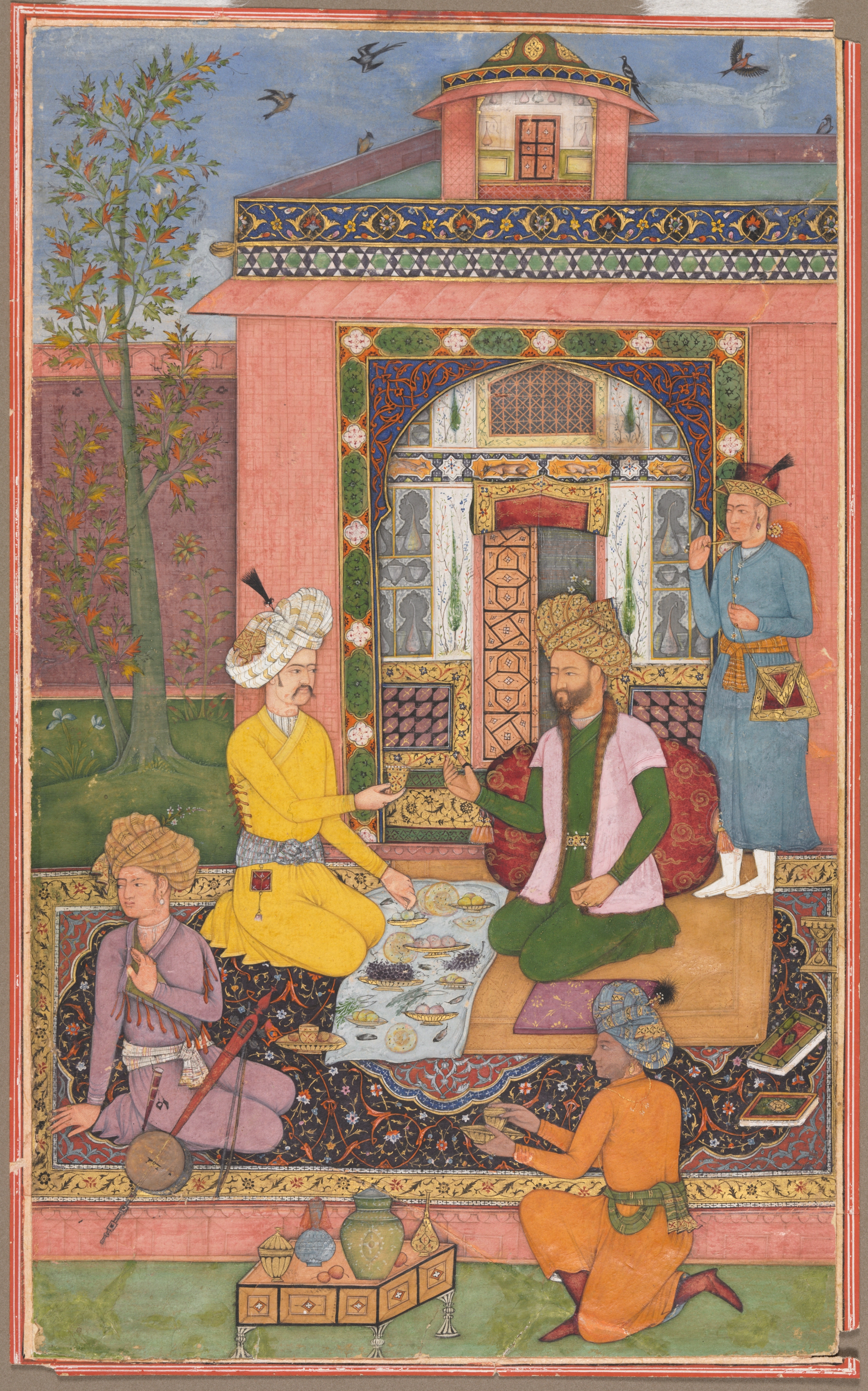
The image depicts A Royal Picnic on a Terrace by Muhammad Ali. The scene shows four men and a servant, sitting and standing on a terrace. The terrace has a pink wall with a large arched window and doorway, decorated with intricate designs in blue, green, gold, and white. The men wear traditional clothing, including long-sleeved shirts, pants, and turbans. The man on the left sits cross-legged on a patterned rug, wearing a yellow outfit and white turban. The man on the right sits cross-legged on a cushion, wearing a green outfit and pink shawl. The man on the far right stands wearing a blue outfit and holding a staff. The man on the bottom right kneels on one knee, wearing an orange outfit. The man on the bottom left sits cross-legged, wearing a purple outfit. A tree with sparse leaves is on the left. The sky is blue with birds flying. The men appear to be eating from a spread on a tablecloth. A small table with objects sits in front of the kneeling man.
Artwork details
- Dimensions:
- 557 × 893 px
- Museum record:
- View original
You May Also Like

Shispul Arguing with Rukmini's Father, Bhishmaka, page from a Rukmini Mangal series

The parrot laughs on hearing the Raja of Ujjain’s wife admire her beauty in a mirror, from a Tuti-nama (Tales of a Parrot: Forty-sixth Night

The court of the Raja of Ujjain, from a Tuti-nama (Tales of a Parrot): Forty-sixth Night

Timur distributes gifts from his grandson, the Prince of Multan, from a Zafar-nama (Book of Victories)

The three young men present themselves as suitors for the hand of Zuhra, the daughter of the merchant of Kabul, from a Tuti-nama (Tales of a Parrot): Thirty-fourth Night

Folios A and B from the "Five Treasures" (Panj Ganj) of Jami

Zulaykha in her palace and as an old woman with Joseph, from a Panj Ganj (Five Treasures) of Abd al-Rahman Jami (Persian, 1414–1492); verso from a Panj Ganj of Abd al-Rahman Jami (Persian, 1414–1492), with two masnavis: Yusuf va Zulaykha (Joseph and Zulaykha) and Khirad-nama-i Iskandari (Alexander’s Book of Wisdom)

Kaiwan, Latif, and Sharif arrive at a house of worship, where they seek help from Khurshid who has become a mystical healer, from a Tuti-Nama (Tales of a Parrot): Thirty-second Night

Bahram Visits the White Domed Pavilion on Friday (recto)

The merchant returns bringing a young slave who is really the son of the princess of Rum, now married to the king, from a Tuti-nama (Tales of a Parrot): Fiftieth Night

Bahram Visits the White Domed Pavilion on Friday, illustrated with text in Khamsa of Nizami (verso), from a Haft Paykar (Seven Portraits) of Nizami

The merchant’s clerk replaces the sugar purchased by the philandering wife with gravel, from a Tuti-nama (Tales of a Parrot): Eighth Night

The rejuvenated old man and the daughter of the king of the jinns take leave of the King of Kings, from a Tuti-nama (Tales of a Parrot): Seventh Night

Preparation for the marriage of Mahmuda to the Young Vizier, from a Tuti-nama (Tales of a Parrot): Thirty-third Night

A feast for Babur hosted by his half-brother Jahangir Mirza in Ghazni in May 1505, from a Babur-nama (Memoirs of Babur)

The young prince recounts his experiences to his father, the king, from a Tuti-nama (Tales of a Parrot): Eighth Night

The four destitute friends go to a wise man who gives each one of them a magic shell to be placed on top of the turban, from a Tuti-nama (Tales of a Parrot): Forty-seventh Night

Teacher with his Pupil

Hulagu Khan giving a feast and dispensing favor upon the amirs and princes, from a Chingiz-nama (Book of Chingiz Khan) of the Jami al-tavarikh (Compendium of Chronicles)

The vizier dissuades the king of Bahilistan from executing the dervish who asks for his daughter’s hand in marriage, from a Tuti-nama (Tales of a Parrot): Seventh Night

The Brahman, unable to select from the four gifts of the king of the Ocean seeks the Raja’s advice, from a Tuti-nama (Tales of a Parrot): Eleventh Night

Lovers Embracing

Lovers Embracing (Raga Malkaus)

Zulaykha in her palace and as an elderly woman with Joseph (recto), from a Panj Ganj (Five Treasures) of Abd al- Rahman Jami (Persian, 1414–1492)