
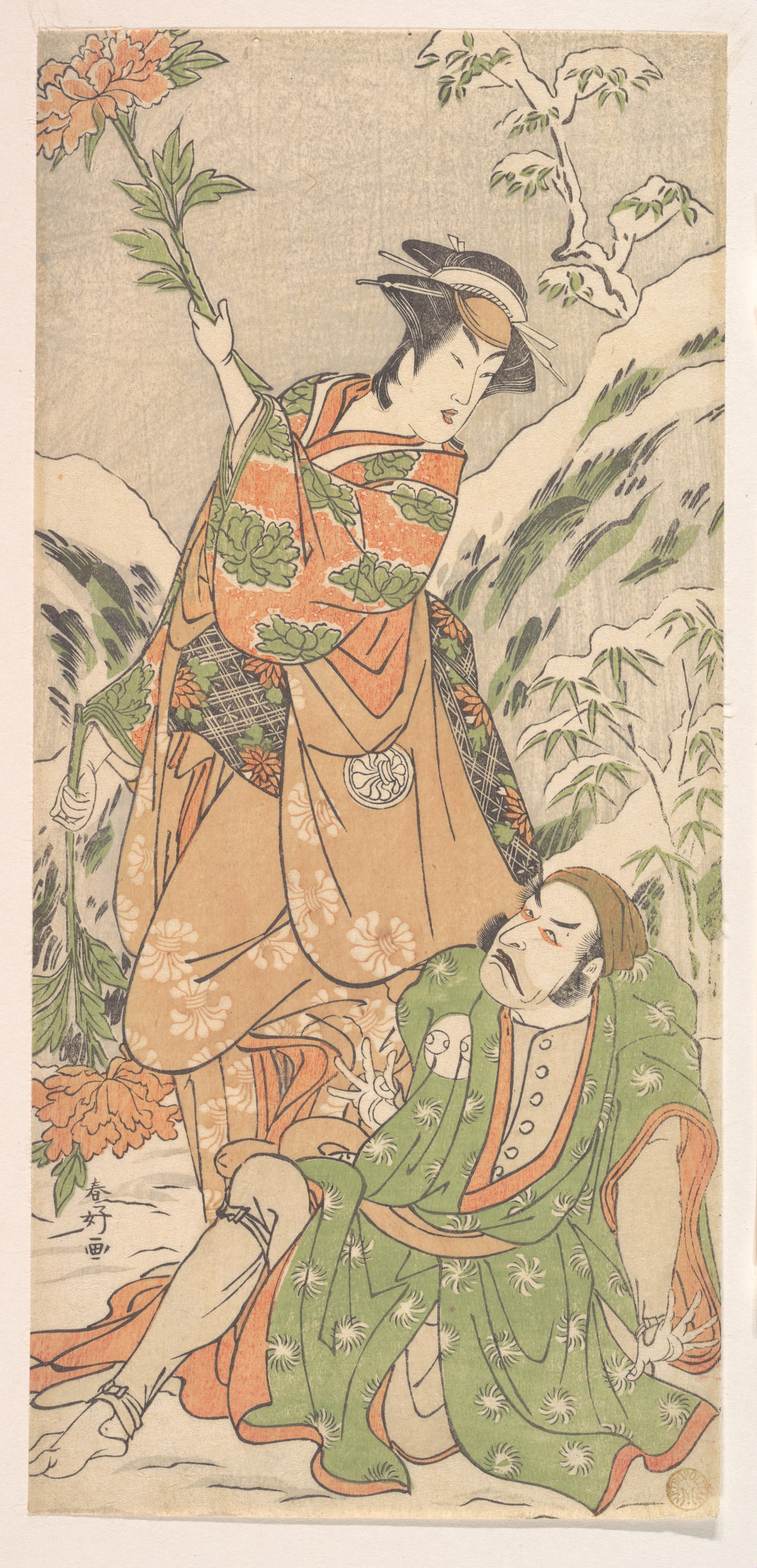
A color woodblock print of two men in traditional Japanese clothing. The man on the left is standing and wearing an orange robe with green leaves and a peach undergarment. The robe has a large silver medallion on the front. He holds a branch with green leaves and pink flowers in his right hand. The man on the right is kneeling on the ground, wearing a green robe with orange trim and white flowers. The green robe has a peach-colored undergarment visible. The background depicts green plants and a gray sky. The man on the left has black hair and the man on the right has brown hair.
Artwork details
- Date:
- ca. 1790
- Medium:
- Woodblock print; ink and color on paper
- Culture:
- Japan
- Dimensions:
- 301 × 624 px
- Museum record:
- View original
You May Also Like

Style of the Dancer

Mother Lifting a Child to a Plum Tree (from the series Chinese and Japanese Poems by Seven Year Old Girls of Recent Times)

Portrait of an Actor

The Fourth Matsumoto Koshiro as a Man Walking under an Umbrella

The Actor Matsumoto Koshiro IV on a Bullock in a Snowstorm

The Actor Segawa Kikunojo II as the Courtesan Maizuru in the Play Furisode Kisaragi Soga (Soga of the Long, Hanging Sleeves in the Second Month), Performed at the Ichimura Theater from the Twentieth Day of the Second Month, 1772

Famous Trees in the Eastern Capital: The Cherry Tree at Naruko (Toto meiboku Naruko no sakura)

Kabuki Actor

The Actor Ichikawa Komazo III as Katanaya Hanshichi in the Play Heike Hyobanki, Performed at the Nakamura Theater in the Ninth Month, 1789

Two Beauties Looking at Kimono

The Lion Dance

The Actor Ichikawa Monosuke (?) or Ichikawa Omezō in Female Role

The Actors Nakamura Nakazo I as Matsukaze (right), and Ichikawa Komazo I as Yukihira (left), in the Play Kuni no Hana Ono no Itsumoji, Performed at the Nakamura Theater in the Eleventh Month, 1771

The Actor Iwai Hanshiro IV as Lady Yaehata in the Play Sanga no Sho Haru no Hanayome, Performed at the Kiri Theater in the Eleventh Month, 1787

The Second Nakamura Juzo as a Samurai of High Rank

The Actor Iwai Hanshiro IV in an Unidentified Role

The Actors Ichimura Takenojo IV and Ogino Isaburo I as firewood peddlers in the play "Niwatori Oshu Genji," performed at the Ichimura Theater in the first month, 1726

The Actor Onoe Kikugoro I holding a puppet of the Actor Sanogawa Ichimatsu I

Young Lady with Parasol in the Yoshiwara District

A Young Lady in a Garden

Chrysanthemum Festival, from the series "Elegant Five-needled Pine (Furyu goyo matsu)"

The Third Princess and Her Kitten, from an untitled series of court ladies

Courtesan Likened to the Chinese Sage Zhang Guolao (Japanese: Chokaro)

The Actor Ichikawa Komazo I in the role of Utou Yarukata


