
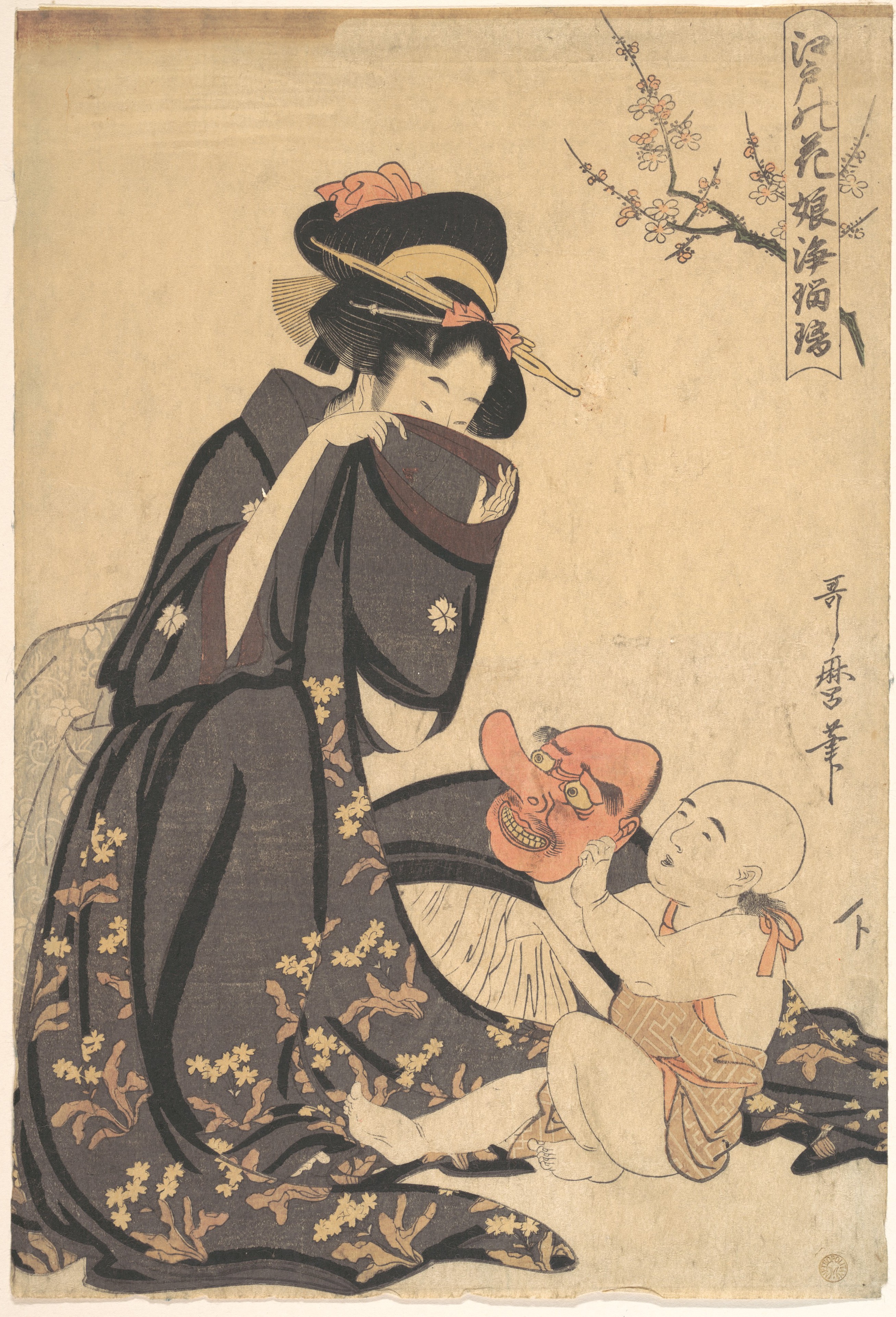
A woman wearing a black kimono with a gold floral pattern and a black hat with a pink flower sits on the floor. She covers her mouth with her right hand. A young boy, wearing a white kimono and an orange headband, sits on the floor to her right. He holds an orange-red mask in front of his face. A branch with blossoms is visible in the top right corner. Japanese characters are written vertically on the right side. The background is beige.
Artwork Details
- Date
- ca. 1804
- Medium
- Woodblock print; ink and color on paper
- Culture
- Japan
- Dimensions
- 425 × 625 px
- Public Domain
- Yes
- Museum Record
- View original
You May Also Like

Sashiye (name of a place in Edo)

Woman Seated Holding a Cat

Haze on a Clear Day at Stone Bridge (From the series Eight Elegant Views of Chanted Accompanimnets for Kabuki Plays)

A Woman Snatching a Bag of Sweetmeats from Her MotHer

Two Women with a Baby who is Playing on the Floor

Fond of Things from the series Eight Views of Favorite Things of Today's World

The Lovers Okiku and Kozuke (from the series An Elegant Comparison of Charming Features)

Mother and Child

The Hour of the Snake (from the series A Clock for Young Women)

Chinese Embroidery (from the series Instructive Patterns for Women's Handicraft)

The Courtesans Karagoto and Nishikido of Chojiya

Woman and Child

Mother Lifting a Child to a Plum Tree (from the series Chinese and Japanese Poems by Seven Year Old Girls of Recent Times)

The Second Yamashita Kinsaku in the Role of Shigenoi

Autumn Moon at the Temple Ishiyamadera from the series Fashionable Eight Views

Young MotHer Nursing Her Baby

Cleaning Combs

A Boat upon the Waters

Picture of the Eastern Beauties

“Hour of the Rat: Mistress,” from the series Women’s Daily Customs (Fuzoku bijin tokei)

A Courtesan Followed by a Girl Attendant Carrying a Doll

Making Ornaments for the Tanabata Festival

Chushingura: Act V of The Storehouse of Loyalty

The Courtesan Shiratama of the Tamaya Brothel, from the series “A Pat-tern Book of the Year’s First Designs, Fresh as Spring Herbs” (“Hinagata wakana hatsu moyō”)


