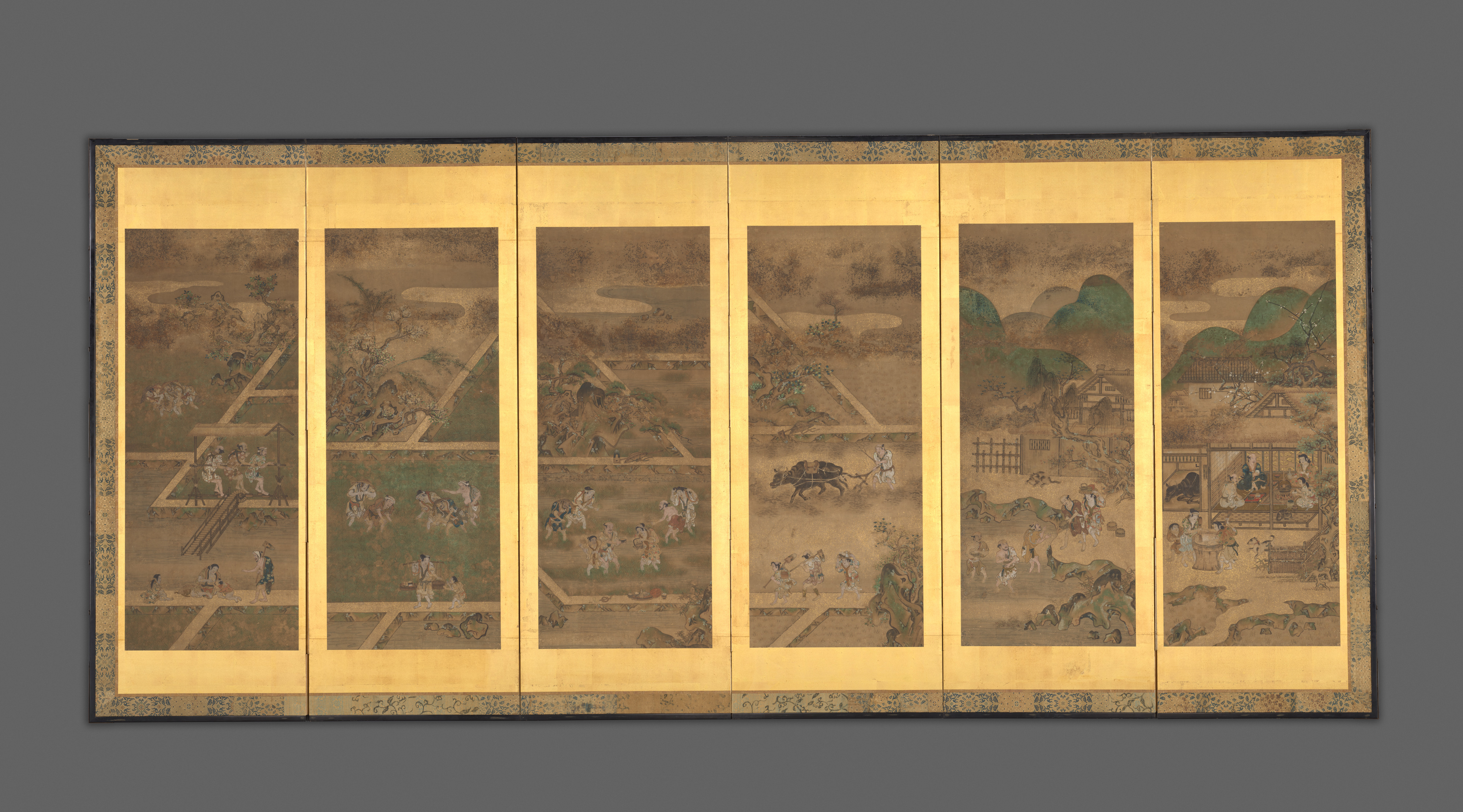
Farmers' Lives in the Twelve Months
The image depicts an artwork titled "Farmers' Lives in the Twelve Months" by an unknown artist. The artwork consists of a long, horizontal composition divided into six vertical panels. The panels are set against a gold background, which also forms a wide border around the perimeter of the artwork. The gold border features an intricate design along its inner edge. The central area of each panel shows scenes of rural life with people engaged in farming activities. The scenes are rendered in earth tones including shades of brown, green, and black. The composition within each panel includes depictions of people, animals, and landscapes. The artwork appears to be a traditional form of Japanese painting, likely from the Edo period. The image conveys a sense of the cycles of rural life and labor across different months of the year. The entire artwork is presented against a dark gray background.
Artwork details
- Date:
- late 17th–early 18th century
- Medium:
- Pair of six-panel folding screens; ink and color on paper
- Culture:
- Japan
- Dimensions:
- 600 × 333 px
- Museum record:
- View original
You May Also Like

One Hundred Chinese Boys

Birds and Flowers

Fishing Village

Taking Shelter from the Rain

Royal Visit to Ōhara, from The Tale of the Heike

View of West Lake

Landscapes of the Four Seasons

Landscape with Pavilion

Scenic Sites in the Qianlong Emperor’s Southern Inspection Tour

Mythical landscape with immortals

Scenes from the Tale of Genji

The Torii Gate of Gion Shrine

Tartars Hunting in a Mountain Landscape

Mountains and Rivers in Autumn

Landscapes of the Four Seasons

Famous Views of Ōmi

Flowers and Trees of the Four Seasons

The Battle of Yashima, from The Tale of the Heike (Heike monogatari)

Flowers and Trees of the Four Seasons (left screen)

Moonlit Landscape

Scenic Sites in the Qianlong Emperor’s Southern Inspection Tour

The Four Accomplishments

Landscape of the Four Seasons (Eight Views of the Xiao and Xiang Rivers)

"Kogō" and "The Imperial Procession to Ōhara", from The Tale of the Heike (Heike monogatari)


