
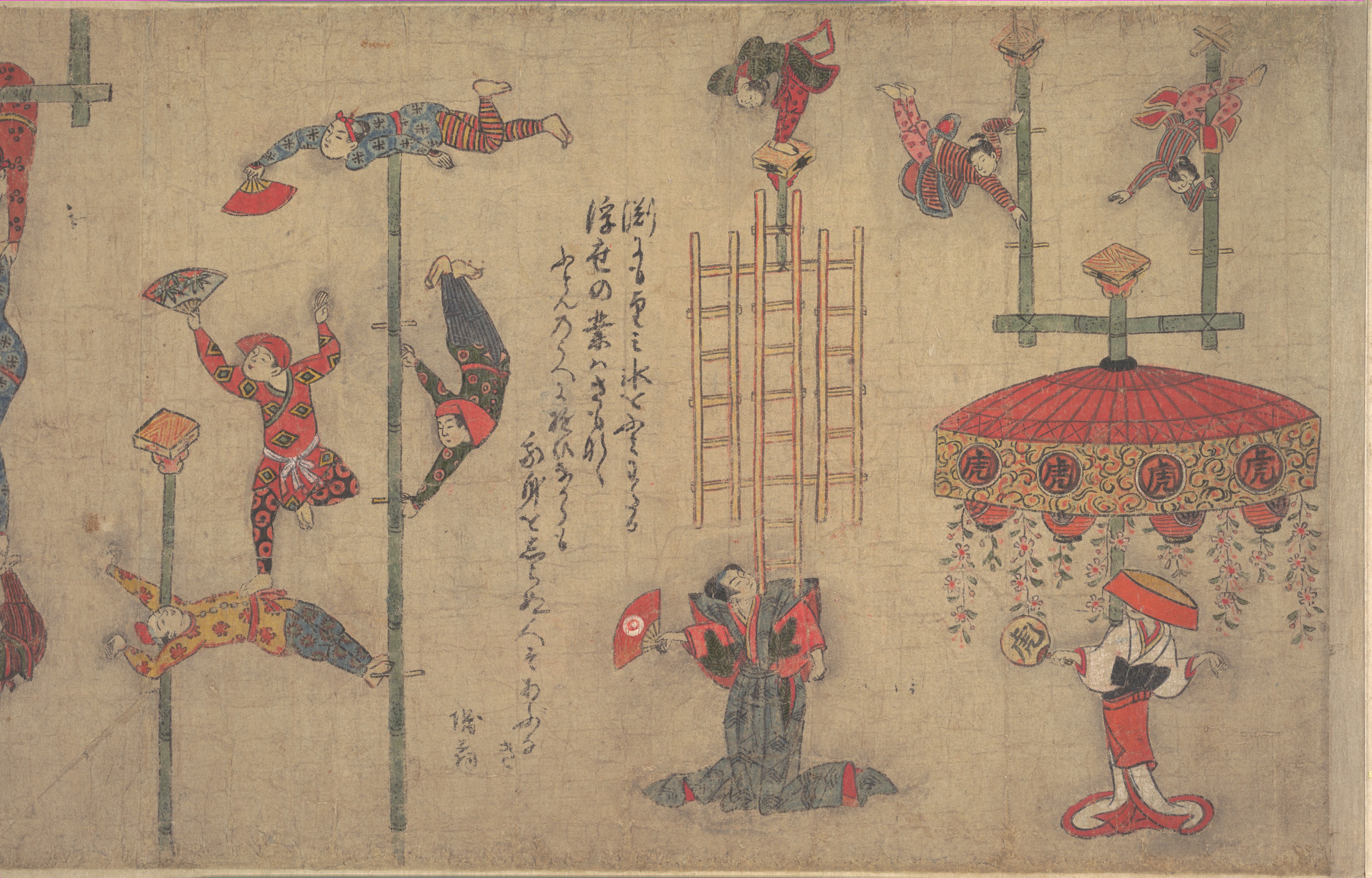
Acrobats
Colorful Japanese woodblock print of acrobats, titled "Acrobats" by the artist. The scene features eight acrobats wearing brightly colored traditional clothing with predominantly red, blue, and yellow hues. Three acrobats are on the left side of the image, each on a tall pole; one is lying on a pole with legs hanging down on the left; one is on the right with legs hanging down; and one on the bottom is on their head. On the right side, two acrobats are on tall T-shaped bars; one is standing on a ball on top and one is hanging from the T-bar. A large red and gold decorated umbrella is on the right edge; a man in white and red clothing holds a ball underneath. A man stands on the ground in the center of the image, holding a pole with a ladder on it, with two acrobats climbing; one on the left is on their head and one on the right is on their hands, both wearing red and black clothing. Japanese characters are written vertically down the center of the image. The background of the print appears aged with a light brown color.
Artwork details
- Date:
- ca. 1800s
- Medium:
- Handscroll; ink and color on paper
- Culture:
- Japan
- Dimensions:
- 600 × 384 px
- Museum record:
- View original
You May Also Like

Sanno Festival (Sanno matsuri), from vol. 1 of the illustrated book "Fine Views of the Eastern Capital at a Glance (Toto shokei ichiran)"

The Lady Ayame Being Brought to Minamoto no Yorimasa

Twenty-four Illustrations of Poems of the Thirty-six Poets

Two Women, from the series Spring Poems on Ushiwaka for the Year of the Ox (Ushiwaka haru)

Karaki Masaemon

Rustam meets the challenge of Ashkabus, from a Shah-nama (Book of Kings) of Firdausi (Persian, about 934–1020)

Kyōka: The Mist of Sandara (Kyōka Sandara-kasumi)

Spring Dance Scene

Ten Kings of Hell

Three Great Wise Men of the Han Dynasty

Hotei Opening His Bag which Is Full of Small Boys

Boys Play-acting a Daimyo Procession

Rustam meets the challenge of Ashkabus, from a Shah-nama (Book of Kings) of Firdausi (Persian, about 934–1020)

Attire

Scene in the Yoshiwara

Daoist Immortal on a Qilin and Two Attendants

The Young God Ebisu (Waka ebisu) 和歌夷

The Eleventh Month

Women Playing Music
![Narumi, from the series "Fifty-three Stations [of the Tokaido] (Gojusan tsugi)," also known as the Figure Tokaido (Jinbutsu Tokaido)](/api/image?url=https%3A%2F%2Fwww.artic.edu%2Fiiif%2F2%2F39479daa-959f-a29c-aae5-85f6198d104d%2Ffull%2F843%2C%2F0%2Fdefault.jpg&w=1536&q=75)
Narumi, from the series "Fifty-three Stations [of the Tokaido] (Gojusan tsugi)," also known as the Figure Tokaido (Jinbutsu Tokaido)

Hama-Yumi and Buriburi-Gitcho, Boy's Toys, for the New Year Celebration

Seven Gods of Good Fortune

Hama-yumi and Buriburi-gitcho; Both Ceremonial Toys of Boys for the New Year

Enjoying the Evening Cool near Ryogoku Bridge (Ryogoku bashi yusuzumi uki-e)


