
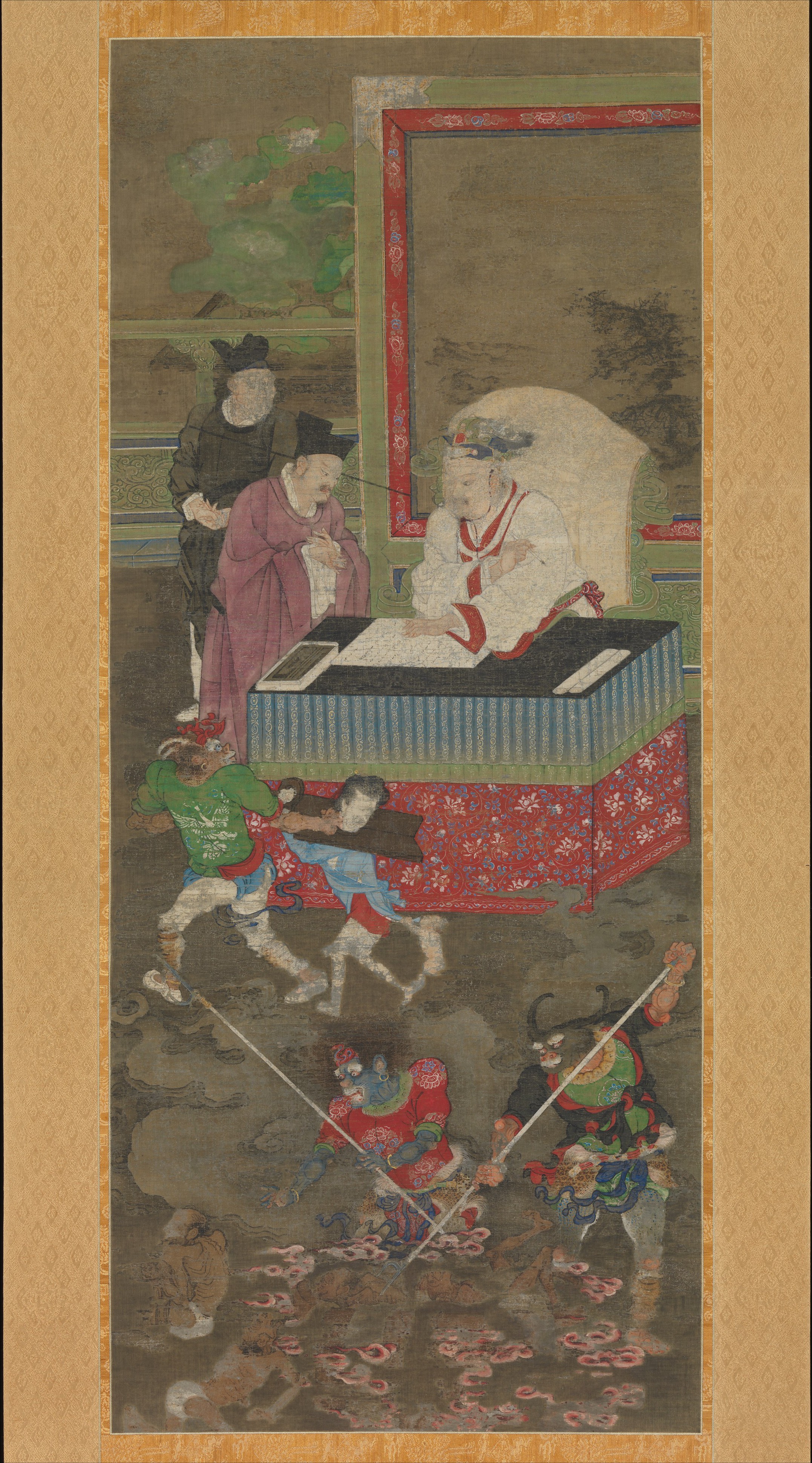
The painting depicts a scene with a man sitting on a platform at the top and several people below him. The man on the platform wears a white robe with red trim and a hat. He sits on a blue and white platform with a red base. Two men stand to his left, one in a pink robe and the other in a black robe and hat. Three figures below the platform have blue skin and wear colorful robes. They hold long spears. Red and white flowers or discs are scattered on the ground. A tree and a large empty frame with a red border are behind the seated man. The background is a mottled brown color. The entire image is surrounded by a tan border.
Artwork details
- Date:
- before 1195
- Medium:
- One of five of a set of ten hanging scrolls; ink and color on silk
- Culture:
- China
- Dimensions:
- 346 × 623 px
- Museum record:
- View original
You May Also Like

Ten Kings of Hell

Ten Kings of Hell

Ten Kings of Hell

An Episode from the Story of the Sasanian King Khusrau and His Beloved Shirin, from a Khamsa (Quintet) of Nizami (1141–1209) (verso)

A charioteer riding through a rocky landscape with an entourage of footmen and musicians, page from a Razm-nama (Book of Wars) adapted from the Sanskrit Mahabharata and translated into Persian by Mir Ghiyath al-Din Ali Qazvini, known as Naqib Khan (Persian, d. 1614)

Bashir confides his love for Habbaza to an Arab friend, and sends him to her with a message, from a Tuti-nama (Tales of a Parrot): Twenty-fourth Night

Preparation for the marriage of Mahmuda to the Young Vizier, from a Tuti-nama (Tales of a Parrot): Thirty-third Night

Rustam meets the challenge of Ashkabus, from a Shah-nama (Book of Kings) of Firdausi (Persian, about 934–1020)

Royal Reception in a Landscape, right folio from a double-page frontispiece of a Shahnama (Book of Kings) of Firdausi (940–1019 or 1025)

The deceitful wife assaults her erring husband, from a Tuti-nama (Tales of a Parrot): Eighth Night

Remonstrating with the emperor

Rustam meets the challenge of Ashkabus, from a Shah-nama (Book of Kings) of Firdausi (Persian, about 934–1020)

Timur distributes gifts from his grandson, the Prince of Multan, from a Zafar-nama (Book of Victories)

Mandala of the Four Deities of Mt. Kōya

Royal Reception in a Landscape, right folio from the double frontispiece of a Shahnama (Book of Kings) of Firdausi (Persian, about 940–1019 or 1025) (verso)

Bijan killing the wild boars of Irman, from a Shah-nama (Book of Kings) of Firdausi (Persian, about 934–1020) (verso)

The Flowering of Joseph’s Rod (folio 11 verso), from a Mirror of Holiness (Mir’at al-quds) of Father Jerome Xavier

Royal Reception in a Landscape, left folio from the double frontispiece of a Shahnama (Book of Kings) of Firdausi (Persian, about 940–1019 or 1025)

Royal Reception in a Landscape, left folio from the double frontispiece of a Shahnama (Book of Kings) of Firdausi (Persian, about 940–1019 or 1025)

A traveler persuades Lorik to return home (top); Chanda objects (bottom), from a Chandayana (Story of Chanda)

Habbaza meets Bashir under a tree, from a Tuti-nama (Tales of a Parrot): Twenty-fourth Night

The rejuvenated old man and the daughter of the king of the jinns take leave of the King of Kings, from a Tuti-nama (Tales of a Parrot): Seventh Night

The dervish brings the King of Kings before the king of Bahilistan, from a Tuti-nama (Tales of a Parrot): Seventh Night

Page from a Manuscript of Kulliyat (Complete Works) by Sa'di


