
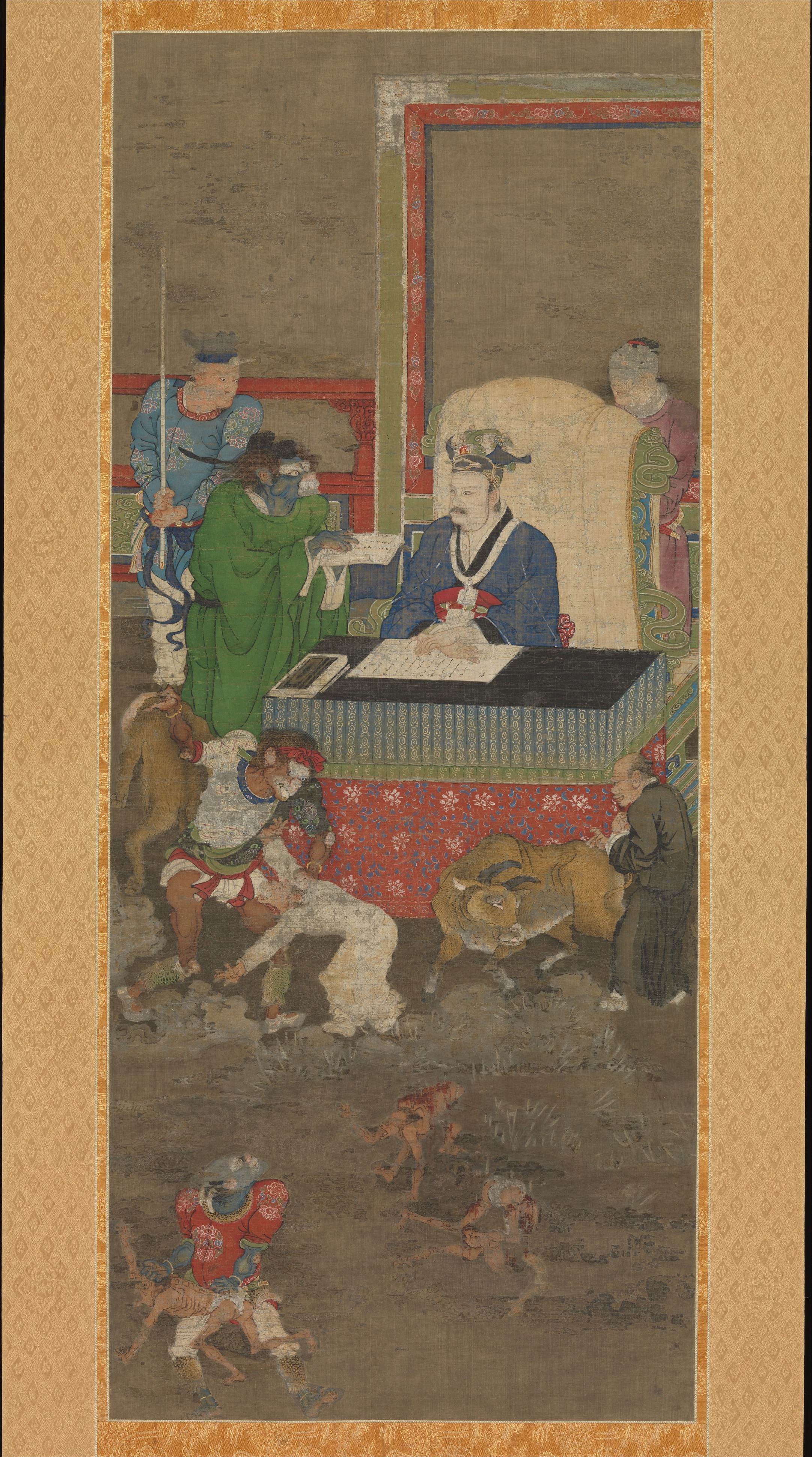
The image depicts a vertical rectangular painting with a gold border. The painting shows a man sitting on a white throne-like chair behind a low table. He wears a blue robe and a hat. The table has a blue and white striped cloth and a red cloth with a white pattern underneath. There are papers on the table. To the left, a man in a green robe holds a paper and looks at the seated man. Behind them, two men stand; one wears blue and holds a sword, the other wears green. In front of the table, several people in various colored robes are shown, some on horseback. The background includes a brown wall with a red and gold frame. The title of the painting is "Ten Kings of Hell" by artist Jin Chushi.
Artwork details
- Date:
- before 1195
- Medium:
- One of five of a set of ten hanging scrolls; ink and color on silk
- Culture:
- China
- Dimensions:
- 348 × 624 px
- Museum record:
- View original
You May Also Like

Ten Kings of Hell

Ten Kings of Hell

Ten Kings of Hell

Timur distributes gifts from his grandson, the Prince of Multan, from a Zafar-nama (Book of Victories)

An Episode from the Story of the Sasanian King Khusrau and His Beloved Shirin, from a Khamsa (Quintet) of Nizami (1141–1209) (verso)

Bahram Visits the White Domed Pavilion on Friday (recto)

Preparation for the marriage of Mahmuda to the Young Vizier, from a Tuti-nama (Tales of a Parrot): Thirty-third Night

Bahram Visits the White Domed Pavilion on Friday, illustrated with text in Khamsa of Nizami (verso), from a Haft Paykar (Seven Portraits) of Nizami

Royal Reception in a Landscape, left folio from the double frontispiece of a Shahnama (Book of Kings) of Firdausi (Persian, about 940–1019 or 1025)

Royal Reception in a Landscape, left folio from the double frontispiece of a Shahnama (Book of Kings) of Firdausi (Persian, about 940–1019 or 1025)

Remonstrating with the emperor
![Bahram Gur Visits the Princess of India in the Black Pavilion (recto): Illustration and Text, Persian Verses, from a manuscript of the Khamsa of Nizami, Haft Paykar [Seven Portraits]](/api/image?url=https%3A%2F%2Fopenaccess-cdn.clevelandart.org%2F1944.486.a%2F1944.486.a_web.jpg&w=1536&q=75)
Bahram Gur Visits the Princess of India in the Black Pavilion (recto): Illustration and Text, Persian Verses, from a manuscript of the Khamsa of Nizami, Haft Paykar [Seven Portraits]

Three Ladies in a Palace Interior: Page from a Dispersed Laur Chanda (Romance of Laurak and Chanda)

A charioteer riding through a rocky landscape with an entourage of footmen and musicians, page from a Razm-nama (Book of Wars) adapted from the Sanskrit Mahabharata and translated into Persian by Mir Ghiyath al-Din Ali Qazvini, known as Naqib Khan (Persian, d. 1614)

Yusuf and Zulaykha (recto); Illustration and Text (Persian Verses) in an Anthology with some verses from Haft Awrang (Seven Thrones) of Jami; The Fifth Throne

Royal Reception in a Landscape, right folio from the double frontispiece of a Shahnama (Book of Kings) of Firdausi (Persian, about 940–1019 or 1025) (verso)

Grotesque Dancers Performing

Royal Reception in a Landscape, right folio from a double-page frontispiece of a Shahnama (Book of Kings) of Firdausi (940–1019 or 1025)

The Flowering of Joseph’s Rod (folio 11 verso), from a Mirror of Holiness (Mir’at al-quds) of Father Jerome Xavier

Raja with his Beloved

Khosrow and Shirin in a Garden, a Scene from the Khamsa of Nizami

Circumcision ceremony for Akbar’s sons, painting 126 from an Akbar-nama (Book of Akbar) of Abu’l Fazl (Indian, 1551–1602)

Page from a Manuscript of Kulliyat (Complete Works) by Sa'di

The rejuvenated old man and the daughter of the king of the jinns take leave of the King of Kings, from a Tuti-nama (Tales of a Parrot): Seventh Night


