
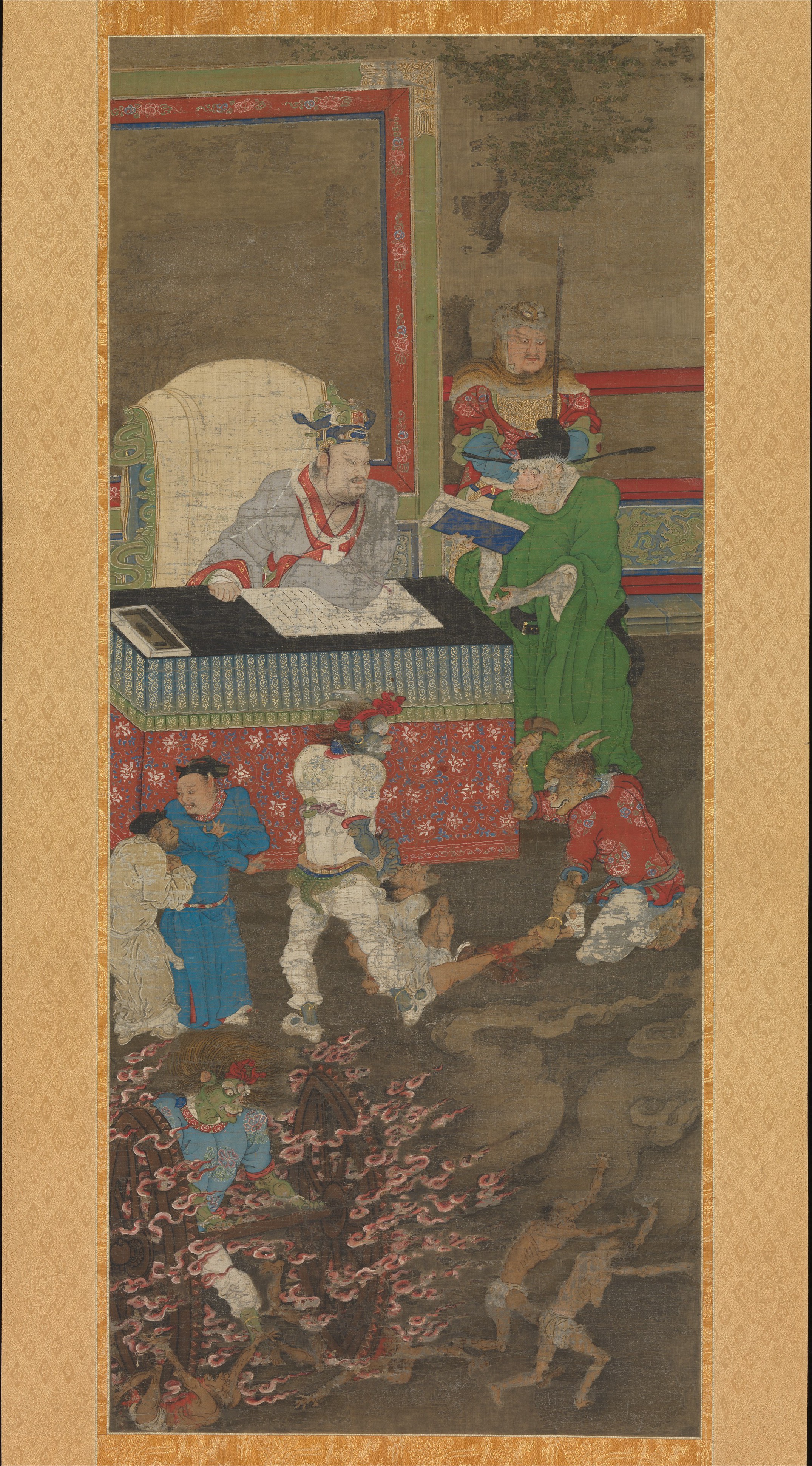
The image depicts a vertical painting titled "Ten Kings of Hell" by Jin Chushi. The painting shows a group of people in traditional Chinese clothing. In the top left, a man sits at a desk with a red and blue patterned cloth, wearing a gray robe with red trim and a hat with feathers. To his right, a woman in a green robe holds a blue book. Behind them, a person in a red and gold robe sits on a chair. Below them, several people are gathered around a large fire or pit, some wearing blue, red, or white robes. The background includes a brown wall with a red and gold frame, and a white archway. The border of the painting is a light-brown color with a diamond pattern. The scene appears to be a depiction of hell or a underworld setting.
Artwork details
- Date:
- before 1195
- Medium:
- One of five of a set of ten hanging scrolls; ink and color on silk
- Culture:
- China
- Dimensions:
- 346 × 624 px
- Museum record:
- View original
You May Also Like

Ten Kings of Hell

Ten Kings of Hell

Ten Kings of Hell

Remonstrating with the emperor

Preparation for the marriage of Mahmuda to the Young Vizier, from a Tuti-nama (Tales of a Parrot): Thirty-third Night

Royal Reception in a Landscape, right folio from a double-page frontispiece of a Shahnama (Book of Kings) of Firdausi (940–1019 or 1025)

Mandala of the Four Deities of Mt. Kōya

Page from a Manuscript of Kulliyat (Complete Works) by Sa'di

Seated Arhat with Two Attendants

Evening Cool on the Verandah (Ensaki no yusuzumi): Genre scenes with kyoka poems, in aiban format (Kyoka-iri aiban fuzoku zu)

Royal Reception in a Landscape, right folio from the double frontispiece of a Shahnama (Book of Kings) of Firdausi (Persian, about 940–1019 or 1025) (verso)

An Episode from the Story of the Sasanian King Khusrau and His Beloved Shirin, from a Khamsa (Quintet) of Nizami (1141–1209) (verso)

Yang Guifei Leaving the Bath

Three Great Wise Men of the Han Dynasty

Miracle of the Dragon

Ten Rakan Examining a Painting of White-Robed Kannon

Page from a Manuscript of Kulliyat (Complete Works) by Sa'di

Young Women Visiting a Shinto Shrine

Star deities of the northern and central dippers

The vizier dissuades the king of Bahilistan from executing the dervish who asks for his daughter’s hand in marriage, from a Tuti-nama (Tales of a Parrot): Seventh Night

The deceitful wife assaults her erring husband, from a Tuti-nama (Tales of a Parrot): Eighth Night

Bahram Visits the White Domed Pavilion on Friday (recto)

A Votive Picture to Be Donated to the Kannon of Asakusa (Asakusa Kannon hō kakegaku no zu), by Takigawa of the Ōgiya, Kamuro Menami and Onami, with Tomikawa, Kumegawa, Tamagawa, Tsugawa, Utagawa, and Kiyokawa

Two Women and a Girl Feeding a Crane at the Verandah


