
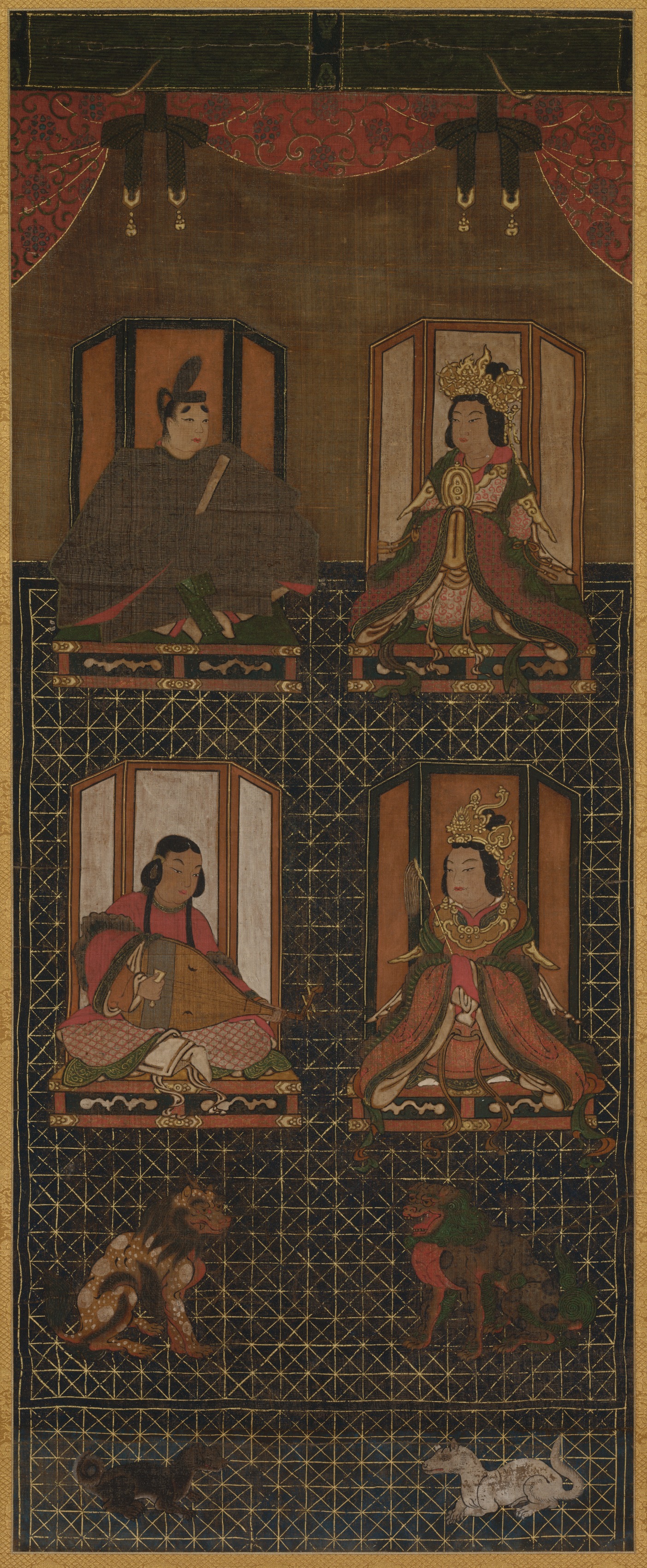
Mandala of the Four Deities of Mt. Kōya
The image depicts a vertical, rectangular artwork with a gold border. The artwork is divided into two main sections: a top section with a brown background and a bottom section with a black background featuring a gold geometric pattern. In the top section, two figures are seated behind screens, with the figure on the left wearing a brown robe and a black hat with a feather tucked into it, and the figure on the right wearing a red robe and a gold crown. In the bottom section, two more figures are seated behind screens, with the figure on the left wearing a red robe and playing a drum, and the figure on the right wearing a red robe and a gold crown. At the bottom of the artwork, three animals are depicted: a brown animal on the left, a brown and green animal in the center, and a white animal on the right. The top of the artwork features a red and gold patterned border with two black tassels hanging from it. The artwork appears to be a traditional Asian-style painting or tapestry, titled "Mandala of the Four Deities of Mt. Kōya" by an unknown artist.
Artwork details
- Dimensions:
- 372 × 900 px
- Museum record:
- View original
You May Also Like

Buddha Amitābha with Two Attending Bodhisattvas

Shōtoku Taishi at Sixteen

Preparation for the marriage of Mahmuda to the Young Vizier, from a Tuti-nama (Tales of a Parrot): Thirty-third Night

Ten Kings of Hell

Fujiwara no Kamatari as a Shinto Deity

Drama of Hikeyahike Kanhiki Dojoji

Shakyamuni with two attendants

Remonstrating with the emperor

Radha and Her Confidant Sit in an Open Room: Page from a Dispersed Rasikapriya

A traveler persuades Lorik to return home (top); Chanda objects (bottom), from a Chandayana (Story of Chanda)

Ten Rakan Examining a Painting of White-Robed Kannon

Seated Arhat with Two Attendants

Yang Guifei Leaving the Bath

A Heroine and Her Paramour: Malavi Ragini, from a Ragamala

Sacrificial Fire, from the "Tula Ram" Bhagavata Purana

The Actors Nakamura Nakazo I as Matsukaze (right), Ichikawa Komazo II as Ariwara no Yukihira (center), and Iwai Hanshiro IV as Murasame (left), in the Play Kuni no Hana Ono no Itsumoji, Performed at the Nakamura Theater in the Eleventh Month, 1771

Ten Kings of Hell

The merchant returns bringing a young slave who is really the son of the princess of Rum, now married to the king, from a Tuti-nama (Tales of a Parrot): Fiftieth Night

The deceitful wife assaults her erring husband, from a Tuti-nama (Tales of a Parrot): Eighth Night

Portrait of Shun'oku Myōha

Folios A and B from the "Five Treasures" (Panj Ganj) of Jami

Zulaykha in her palace and as an old woman with Joseph, from a Panj Ganj (Five Treasures) of Abd al-Rahman Jami (Persian, 1414–1492); verso from a Panj Ganj of Abd al-Rahman Jami (Persian, 1414–1492), with two masnavis: Yusuf va Zulaykha (Joseph and Zulaykha) and Khirad-nama-i Iskandari (Alexander’s Book of Wisdom)

Royal Reception in a Landscape, right folio from a double-page frontispiece of a Shahnama (Book of Kings) of Firdausi (940–1019 or 1025)

Kaiwan, Latif, and Sharif arrive at a house of worship, where they seek help from Khurshid who has become a mystical healer, from a Tuti-Nama (Tales of a Parrot): Thirty-second Night