
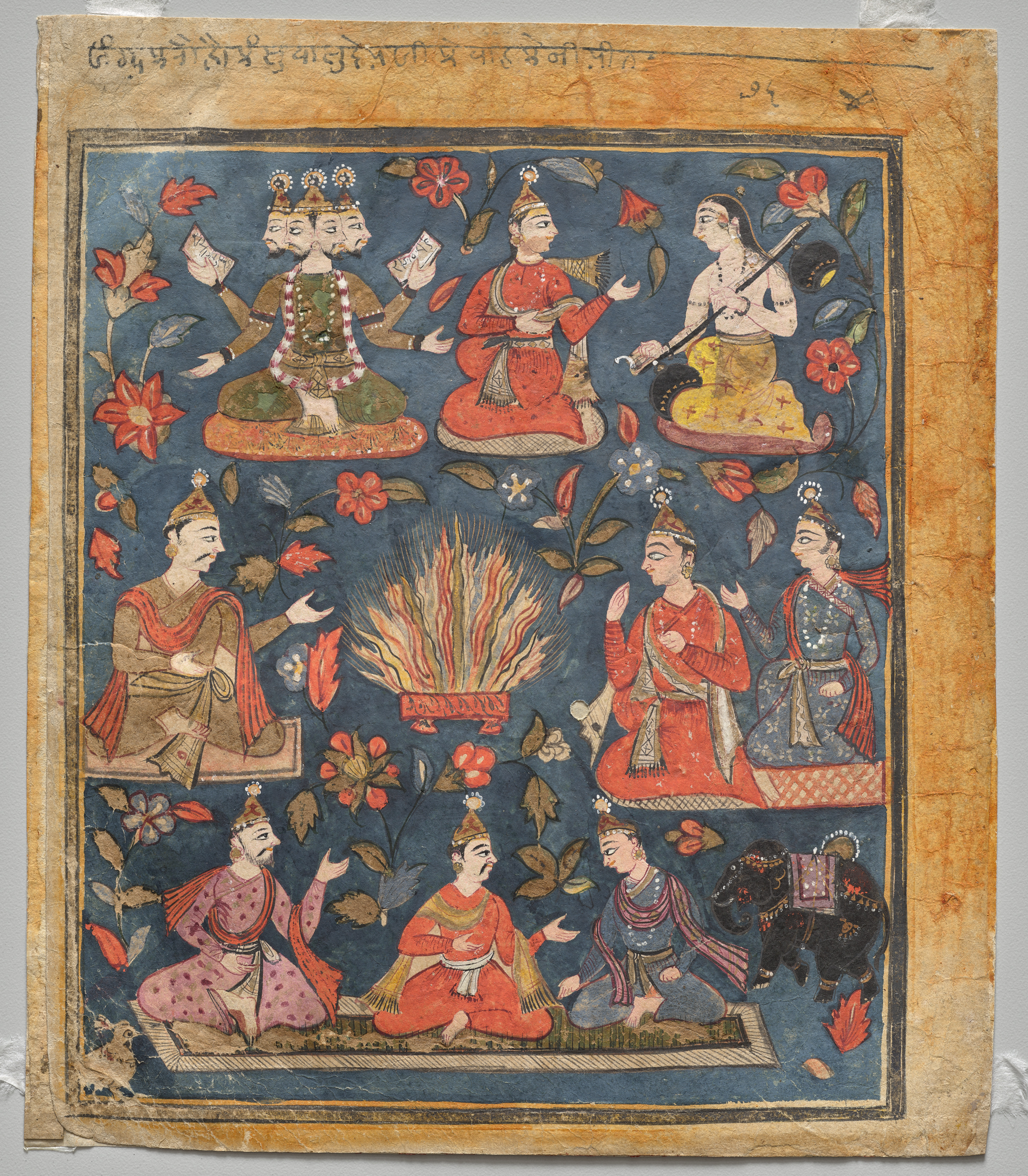
Sacrificial Fire, from the "Tula Ram" Bhagavata Purana
Colorful illustration on aged paper with a yellowed border, featuring a blue background. The scene depicts nine people sitting on mats or lotus flowers, wearing various colored traditional outfits, including red, orange, pink, blue, green, brown and yellow. Two individuals are positioned at the top center, one with four arms and three heads, and another with a flute; both have their legs crossed. The bottom row features three people on the left and two on the right, with the leftmost and center individuals on the same level. A central fire burns in a square container. Red, orange, and yellow flowers and leaves are scattered throughout. Black text written in a foreign language appears along the top edge. The image depicts a scene from the "Sacrificial Fire, from the 'Tula Ram' Bhagavata Purana" by an unknown artist.
Artwork details
- Dimensions:
- 786 × 900 px
- Museum record:
- View original
You May Also Like

The handmaiden appeals for justice and the prince is taken to the execution site for the fourth time, from a Tuti-nama (Tales of a Parrot): Eighth Night

The vizier dissuades the king of Bahilistan from executing the dervish who asks for his daughter’s hand in marriage, from a Tuti-nama (Tales of a Parrot): Seventh Night

Procession of Carriages Carrying Booty: Page from a Dispersed Bhagavata Purana Manuscript

Mandala of the Four Deities of Mt. Kōya

Krishna and Gopis

Folios A and B from the "Five Treasures" (Panj Ganj) of Jami

Zulaykha in her palace and as an old woman with Joseph, from a Panj Ganj (Five Treasures) of Abd al-Rahman Jami (Persian, 1414–1492); verso from a Panj Ganj of Abd al-Rahman Jami (Persian, 1414–1492), with two masnavis: Yusuf va Zulaykha (Joseph and Zulaykha) and Khirad-nama-i Iskandari (Alexander’s Book of Wisdom)

Preparation for the marriage of Mahmuda to the Young Vizier, from a Tuti-nama (Tales of a Parrot): Thirty-third Night

A dancing dervish and three musicians, from a Divan (Collected Poems) of Urfi (Persian, 1555–1591)

Left side of a double-page album folio: Outside a Royal Encampment (recto)

Royal Reception in a Landscape, right folio from a double-page frontispiece of a Shahnama (Book of Kings) of Firdausi (940–1019 or 1025)

A traveler persuades Lorik to return home (top); Chanda objects (bottom), from a Chandayana (Story of Chanda)

Kaiwan, Latif, and Sharif arrive at a house of worship, where they seek help from Khurshid who has become a mystical healer, from a Tuti-Nama (Tales of a Parrot): Thirty-second Night

Royal Reception in a Landscape, left folio from the double frontispiece of a Shahnama (Book of Kings) of Firdausi (Persian, about 940–1019 or 1025)

Royal Reception in a Landscape, left folio from the double frontispiece of a Shahnama (Book of Kings) of Firdausi (Persian, about 940–1019 or 1025)

The deceitful wife assaults her erring husband, from a Tuti-nama (Tales of a Parrot): Eighth Night

Bashir confides his love for Habbaza to an Arab friend, and sends him to her with a message, from a Tuti-nama (Tales of a Parrot): Twenty-fourth Night

Page from a Dispersed Rasikapriya (Lover's Breviary)

The court of the Raja of Ujjain, from a Tuti-nama (Tales of a Parrot): Forty-sixth Night

The Bodhisattvas of the Ten Stages in Attaining the Most Perfect Knowledge

The rejuvenated old man and the daughter of the king of the jinns take leave of the King of Kings, from a Tuti-nama (Tales of a Parrot): Seventh Night

The young prince is crowned and the wicked handmaiden is executed, from a Tuti-nama (Tales of a Parrot): Eighth Night

Luohan

Lovers on a Terrace: Ramakali Ragini of Hindol, from a Bundi Ragamala