
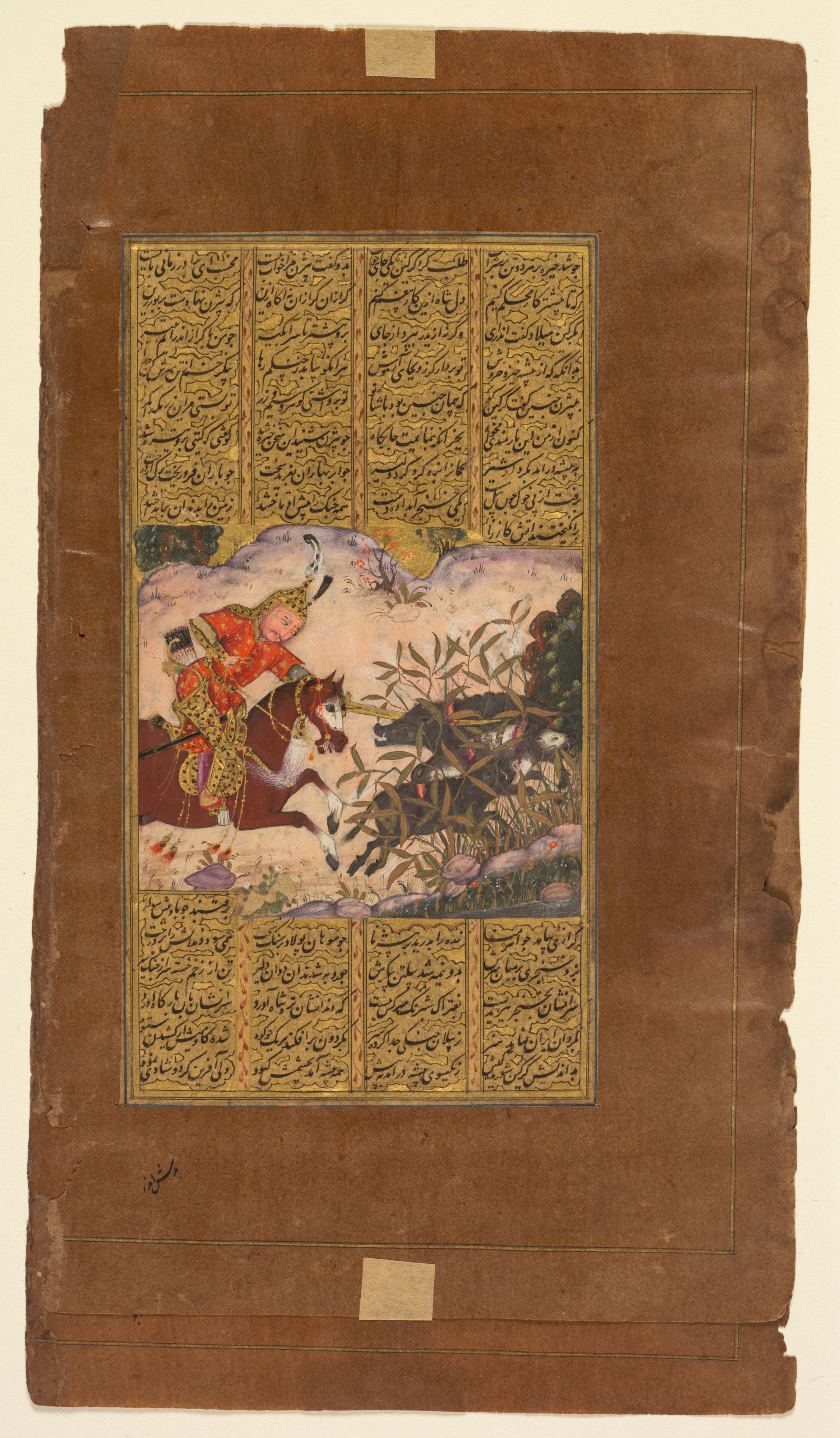
Bijan killing the wild boars of Irman, from a Shah-nama (Book of Kings) of Firdausi (Persian, about 934–1020) (verso)
This image depicts a man on horseback spearing a boar. The man wears a red tunic with gold accents and a patterned cloth wrapped around his waist. He rides a brown and white horse. The boar is black. The man and the animals are set within an illustration bordered by nine columns of black text on a gold background. The artwork sits on a brown background with darker edges. The brown background is rectangular and has a thin green border. Strips of tape hold the artwork in place on the brown background. The brown background sits on a beige background.
Artwork details
- Dimensions:
- 526 × 900 px
- Museum record:
- View original
You May Also Like

Bijan killing the wild boars of Irman, from a Shah-nama (Book of Kings) of Firdausi (Persian, about 934–1020)
![Nushirwan Listens to the Owls (recto): Illustration and Text, Persian Verses, from a Manuscript of the Khamsa of Nizami, Makhzan al-Asrar [Treasure of Secrets]](/api/image?url=https%3A%2F%2Fopenaccess-cdn.clevelandart.org%2F1944.487.a%2F1944.487.a_web.jpg&w=1536&q=75)
Nushirwan Listens to the Owls (recto): Illustration and Text, Persian Verses, from a Manuscript of the Khamsa of Nizami, Makhzan al-Asrar [Treasure of Secrets]

Rustam Takes Aim at Ashkabus, from a Shah-nama (Book of Kings)

Manuscript pages showing battle scenes

A prince riding a composite elephant

The Tale of the Twelve Faces. "The Warriors Engage in Combat": Illustration from the Firdausi Shahnama (verso)

The wounded monkey bites the hand of the prince, his chessmate, in the presence of guests, from a Tuti-nama (Tales of a Parrot): Fifth Night

Kamjuy, the wife of the Raja, averts her face from the fishes, from a Tuti-nama (Tales of a Parrot): Twenty-third Night

A charioteer riding through a rocky landscape with an entourage of footmen and musicians, page from a Razm-nama (Book of Wars) adapted from the Sanskrit Mahabharata and translated into Persian by Mir Ghiyath al-Din Ali Qazvini, known as Naqib Khan (Persian, d. 1614)

The prince rejects the amorous advances of the king’s handmaiden, from a Tuti-nama (Tales of a Parrot): Eighth Night

Grotesque Dancers Performing

The daughter-in-law of the king of Banaras, charmed by the music of a vagabond, comes down to meet him, from a Tuti-nama (Tales of a Parrot): Sixteenth Night

The king’s handmaiden takes the prince away to the harem, from a Tuti-nama (Tales of a Parrot): Eighth Night

The Parrot Addresses Khujasta at the Beginning of the Seventh Night, from a Tuti-nama (Tales of a Parrot)

Ghatotkacha and three demons in his company chase Bhagadatta, from Bhishma-parva (volume six) of a Razm-nama (Book of Wars) adapted from the Sanskrit Mahabharata and translated into Persian by Mir Ghiyath al-Din Ali Qazvini, known as Naqib Khan (Persian, d. 1614)

The young prince is crowned and the wicked handmaiden is executed, from a Tuti-nama (Tales of a Parrot): Eighth Night

The Parrot Addresses Khujasta at the Beginning of the Eighteenth Night, from a Tuti-nama (Tales of a Parrot)

The eldest brother explains the reason for his youthful appearance, from a Tuti-nama (Tales of a Parrot): Forty-ninth Night

Khusrau, the King of Kings, pays homage to the pious daughter of Khassa, from a Tuti-nama (Tales of a Parrot): Fifty-first Night

An Episode from the Story of the Sasanian King Khusrau and His Beloved Shirin, from a Khamsa (Quintet) of Nizami (1141–1209) (verso); Persian verses from a Haft Awrang (Seven Thrones) of Jami (d. 1492) (recto)

As punishment, the jester’s wife and the Zangi are thrown into fire and the emir’s wife and the mahout are trampled by an elephant, from a Tuti-nama (Tales of a Parrot), Twenty-second Night

Rustam meets the challenge of Ashkabus, from a Shah-nama (Book of Kings) of Firdausi (Persian, about 934–1020)

King Bahram, who has married Khassa’s daughter, has her tied to a camel to be abandoned in the desert as a result of false accusations made by Khulasa, from a Tuti-nama (Tales of a Parrot): Fifty-first Night

Siyavush on His Horse Hitting a Rolling Target, from a Shahnama (Book of Kings) of Firdausi (940–1019 or 1025) (recto)