
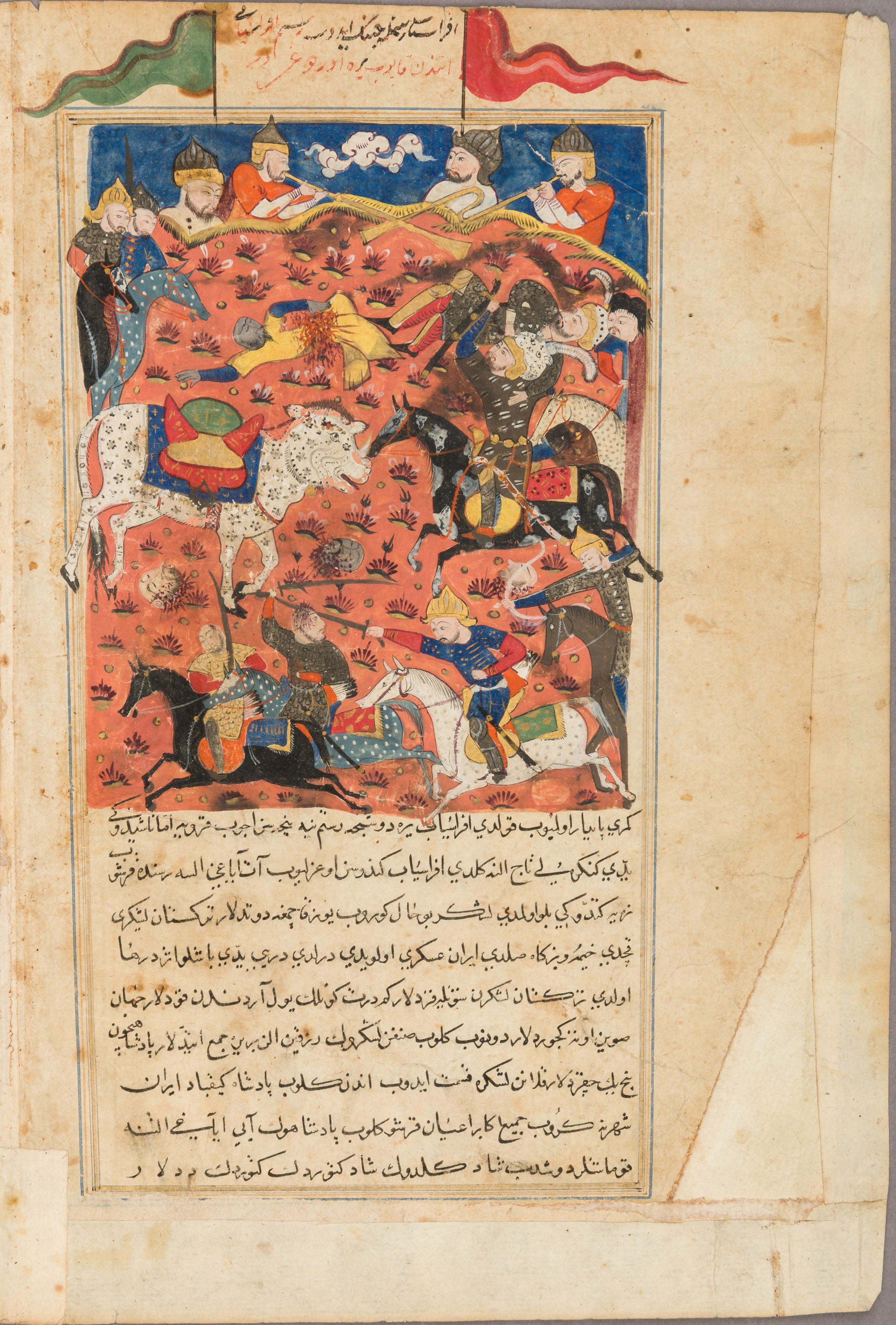
Manuscript pages showing battle scenes
Medieval manuscript page with elaborate miniature painting. The painting depicts a battle scene. The scene is set against a background with a blue sky and white clouds at the top, and a red ground with a repeating pattern of small black designs. Many figures are present, some on horseback and some on foot. The horses are various colors including black, brown, and white. The people wear colorful clothing including orange, blue, red, and green. Some people wear helmets or headgear that resembles a crown. A few people are holding weapons. The bottom half of the page contains black text written in a language that uses Arabic script. The page is yellowed with age and has some tears and discoloration. A small piece of paper with writing and a green and red streamer is at the top. The right edge of the page is rough and uneven.
Artwork details
- Date:
- early 17th century
- Medium:
- Ink and pigments on paper
- Culture:
- Turkish
- Dimensions:
- 422 × 624 px
- Museum record:
- View original
You May Also Like

The prince, once reprieved, is returned to the palace of execution a second time on the plea of the king’s handmaiden, from a Tuti-nama (Tales of a Parrot): Eighth Night

Rustam Takes Aim at Ashkabus, from a Shah-nama (Book of Kings)
![Nushirwan Listens to the Owls (recto): Illustration and Text, Persian Verses, from a Manuscript of the Khamsa of Nizami, Makhzan al-Asrar [Treasure of Secrets]](/api/image?url=https%3A%2F%2Fopenaccess-cdn.clevelandart.org%2F1944.487.a%2F1944.487.a_web.jpg&w=1536&q=75)
Nushirwan Listens to the Owls (recto): Illustration and Text, Persian Verses, from a Manuscript of the Khamsa of Nizami, Makhzan al-Asrar [Treasure of Secrets]

"Benefits of the Parts of Vultures" (From the Manafi' al-Haywan of Abu Sai'd Ubayd-Allay Ibn Bakhtishu) (verso)

The merchant’s daughter gives birth to a son as a result of eating out of the box. The clever child recognizes the false gems from true, from a Tuti-nama (Tales of a Parrot): Twenty-third Night

Bahram Gur Slays a Dragon (verso), from a Shahnama (Book of Kings) of Firdausi (940-1019 or 1025), known as the Great Mongol Shahnama

Episodes from the Reigns of Khusrau Parviz and Nushirwan from a Shahnama (Book of Kings) of Firdausi (940–1019 or 1025)

Khusrau Parviz Fleeing Bahram Chubineh and Being Saved by Angel Sarush (recto) from a Shahnama (Book of Kings) of Firdausi (940–1019 or 1025)

The king plucks fruit from the Tree of Life with his own hands and feeds it to a lady, from a Tuti-nama (Tales of a Parrot): Ninth Night

Yusuf and Zulaykha (recto); Illustration and Text (Persian Verses) in an Anthology with some verses from Haft Awrang (Seven Thrones) of Jami; The Fifth Throne

The Story of Hushang, from a Majma al-tavarikh (A Compendium of Histories) of Hafiz-i Abru (recto)

The Tale of the Twelve Faces. "The Warriors Engage in Combat": Illustration from the Firdausi Shahnama (verso)

The young prince is crowned and the wicked handmaiden is executed, from a Tuti-nama (Tales of a Parrot): Eighth Night

The parrot addresses Khujasta at the beginning of the forty-seventh night, from a Tuti-nama (Tales of a Parrot): Forty-seventh Night

The Parrot Addresses Khujasta at the Beginning of the Eighteenth Night, from a Tuti-nama (Tales of a Parrot)

Folio from a Persian Manafi‘ al-Hayawan (The Benefits of Animals) of Abu Said Ubaid-Allah ibn Jibrail ibn Bakhtishu (died 1058–68) (verso)

The wounded monkey bites the hand of the prince, his chessmate, in the presence of guests, from a Tuti-nama (Tales of a Parrot): Fifth Night

Yusuf and Zulaykha (recto); Text Page, Persian Verses (verso)

Page of disasters, from the Tarikh-i Alfi (History of a Thousand Years)

The prince rejects the amorous advances of the king’s handmaiden, from a Tuti-nama (Tales of a Parrot): Eighth Night

The eldest brother explains the reason for his youthful appearance, from a Tuti-nama (Tales of a Parrot): Forty-ninth Night

King Bahram, who has married Khassa’s daughter, has her tied to a camel to be abandoned in the desert as a result of false accusations made by Khulasa, from a Tuti-nama (Tales of a Parrot): Fifty-first Night

The hunter offers the mother parrot to the king of Kamarupa, from a Tuti-nama (Tales of a Parrot): Fifth Night

Bahram Gur meets Arzu, the Daughter of Mahiyar (verso); Illustration and Text, Persian Verses, from the Shahnama of Firdawsi


