
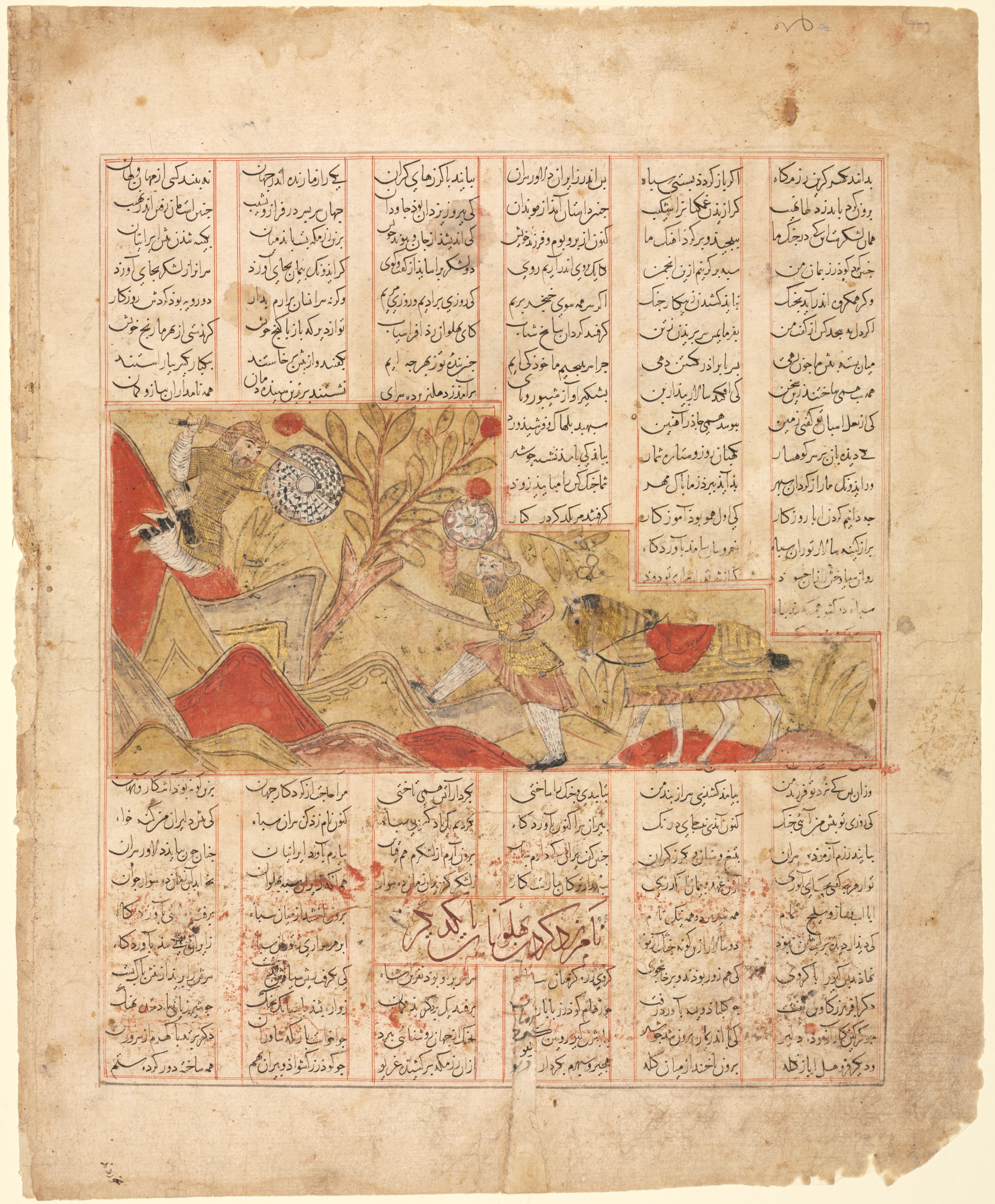
The Tale of the Twelve Faces. "The Warriors Engage in Combat": Illustration from the Firdausi Shahnama (verso)
A yellowed, aged piece of paper with an illustration in the middle. The illustration depicts two men on horseback. The man on the left wears a white helmet and a yellow tunic. The man on the right wears a gold helmet and gold tunic. Both men hold lances. The horses are brown with red saddle blankets. The background of the illustration includes a tree and red mountains. The paper has dark spots and torn edges. The illustration is surrounded by 12 blocks of black text in a foreign language, likely Arabic script, outlined in red. The blocks are arranged in three rows of four columns.
Artwork details
- Dimensions:
- 738 × 893 px
- Museum record:
- View original
You May Also Like

The Tale of the Twelve Faces. "Bizhan Addresses the Army": Illustration from the Firdausi Shahnama (recto); The Tale of the Twelve Faces. "The Warriors Engage in Combat": Illustration from the Firdausi Shahnama (verso)

Episodes from the Reigns of Khusrau Parviz and Nushirwan from a Shahnama (Book of Kings) of Firdausi (940–1019 or 1025)

Khusrau Parviz Fleeing Bahram Chubineh and Being Saved by Angel Sarush (recto) from a Shahnama (Book of Kings) of Firdausi (940–1019 or 1025)

Rustam Takes Aim at Ashkabus, from a Shah-nama (Book of Kings)

Text Page, Persian Verses (recto); Bahram Gur meets Arzu, the Daughter of Mahiyar (verso)

Nushirwan Listens to the Owls (recto); the Story of Nushirwan and his Minister, "The Third Discourse on Diverse Events and Disorder in Life" (verso) from a Khamsa (Quintet) of Nizami (1141-1209)
![Nushirwan Listens to the Owls (recto): Illustration and Text, Persian Verses, from a Manuscript of the Khamsa of Nizami, Makhzan al-Asrar [Treasure of Secrets]](/api/image?url=https%3A%2F%2Fopenaccess-cdn.clevelandart.org%2F1944.487.a%2F1944.487.a_web.jpg&w=1536&q=75)
Nushirwan Listens to the Owls (recto): Illustration and Text, Persian Verses, from a Manuscript of the Khamsa of Nizami, Makhzan al-Asrar [Treasure of Secrets]

Yusuf and Zulaykha (recto); Text Page, Persian Verses (verso)

The Story of Hushang, from a Majma al-tavarikh (A Compendium of Histories) of Hafiz-i Abru (recto)

Manuscript pages showing battle scenes

Bahram Gur Slays a Dragon (verso), from a Shahnama (Book of Kings) of Firdausi (940-1019 or 1025), known as the Great Mongol Shahnama

Bahram Gur meets Arzu, the Daughter of Mahiyar (verso); Illustration and Text, Persian Verses, from the Shahnama of Firdawsi

Folio from a Persian Manafi‘ al-Hayawan (The Benefits of Animals) of Abu Said Ubaid-Allah ibn Jibrail ibn Bakhtishu (died 1058–68) (verso)

Text Page, Persian Verses (verso) in an Anthology with some verses from Haft Awrang (Seven Thrones) of Jami; The Fifth Throne Yusuf and Zulaykha

Text in Khamsa of Nizami (verso), from a Haft Paykar (Seven Portraits) of Nizami

School Exercise Alphabet

"Benefits of the Parts of Vultures" (From the Manafi' al-Haywan of Abu Sai'd Ubayd-Allay Ibn Bakhtishu) (verso)

Qualities of Ringdoves (recto); On the Benefits of Quails (verso), from a Persian Manafi‘ al-Hayawan (The Benefits of Animals) of Abu Said Ubaid-Allah ibn Jibrail ibn Bakhtishu (died 1058–68)

An Episode from the Story of the Sasanian King Khusrau and His Beloved Shirin, from a Khamsa (Quintet) of Nizami (1141–1209) (verso); Persian verses from a Haft Awrang (Seven Thrones) of Jami (d. 1492) (recto)

Bijan killing the wild boars of Irman, from a Shah-nama (Book of Kings) of Firdausi (Persian, about 934–1020) (verso)

Folio from a Persian Manafi‘ al-Hayawan (The Benefits of Animals) of Abu Said Ubaid-Allah ibn Jibrail ibn Bakhtishu (died 1058–68) (recto)

Bahram Gur Visits the Princess of India in the Black Pavilion, Illustration and Text, Persian Verses (recto); Bahram Gur Visits the Princess of India, Text Page, Persian Verses (verso)

The Story of Hushang (recto), Illustration and text (Persian Prose) from Majmac al-Tavarikh (A Compendium of Histories) of Hafiz-i Abru; Text Page, Persian Prose, (verso), from Majmac al-Tavarikh (A Compendium of Histories) of Hafiz-i Abru

Calligraphy: A Page of Text from Sadi's Bustan (verso)