
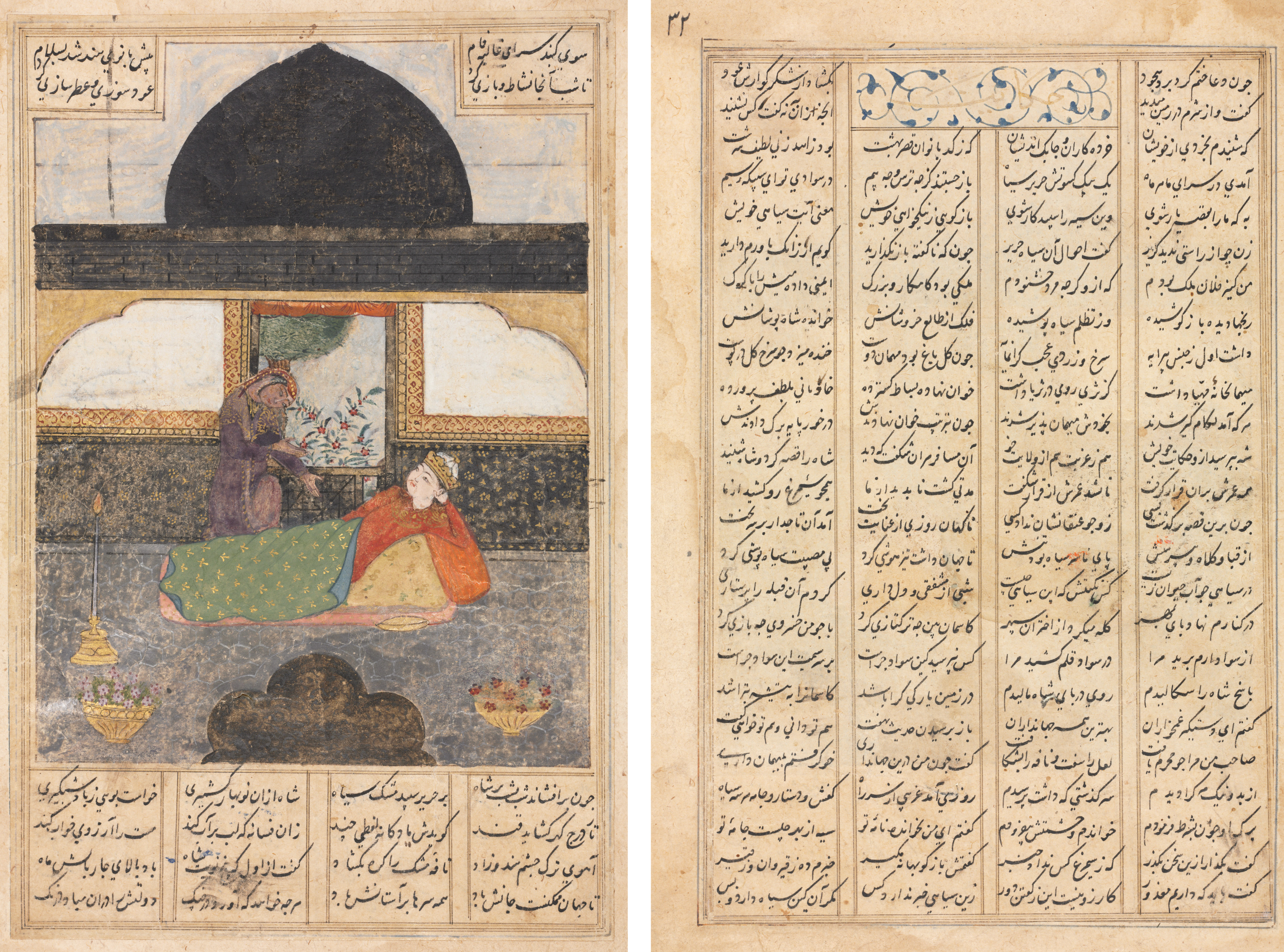
Bahram Gur Visits the Princess of India in the Black Pavilion, Illustration and Text, Persian Verses (recto); Bahram Gur Visits the Princess of India, Text Page, Persian Verses (verso)
Two-page spread from a book. Left page: A colorful illustration depicts a scene with two people. One person wearing a purple robe and a head covering stands behind a woman reclining on a low platform. The woman wears a green dress with gold stars and an orange shawl. The platform and background have a predominantly black, white and gold color scheme. Three lines of text in a foreign script are written in black ink at the top and bottom of the illustration. Right page: A page filled with writing in a foreign script, likely Persian, in black ink. The text is arranged in columns. A decorative blue and gold design element is at the top of the page. The pages have aged, yellowed paper.
Artwork details
- Dimensions:
- 900 × 668 px
- Museum record:
- View original
You May Also Like

Yusuf and Zulaykha (recto); Text Page, Persian Verses (verso)

Left side of a double-page album folio: Outside a Royal Encampment (recto) and Calligraphy, Persian Verses (verso)

An Episode from the Story of the Sasanian King Khusrau and His Beloved Shirin, from a Khamsa (Quintet) of Nizami (1141–1209) (verso); Persian verses from a Haft Awrang (Seven Thrones) of Jami (d. 1492) (recto)

Page of disasters, from the Tarikh-i Alfi (History of a Thousand Years)

A prince conversing with a woman while taking refreshments on a terrace (recto); Calligraphy (verso)

The Parrot Addresses Khujasta at the Beginning of the Eighteenth Night, from a Tuti-nama (Tales of a Parrot)

The prince rejects the amorous advances of the king’s handmaiden, from a Tuti-nama (Tales of a Parrot): Eighth Night

Kabir and Two Followers on a Terrace (recto); Calligraphy (verso)

Text in Khamsa of Nizami (verso), from a Haft Paykar (Seven Portraits) of Nizami

Tuti-Nama (Tales of a Parrot)

Nushirwan Listens to the Owls (recto); the Story of Nushirwan and his Minister, "The Third Discourse on Diverse Events and Disorder in Life" (verso) from a Khamsa (Quintet) of Nizami (1141-1209)

Latif, who has murdered his brother, falsely accuses Khurshid of the deed, from a Tuti-nama (Tales of a Parrot): Thirty-second Night

The merchant’s daughter gives birth to a son as a result of eating out of the box. The clever child recognizes the false gems from true, from a Tuti-nama (Tales of a Parrot): Twenty-third Night

The Story of Hushang, from a Majma al-tavarikh (A Compendium of Histories) of Hafiz-i Abru (recto)

Mirror of Holiness (Mir’at al-quds) of Father Jerome Xavier

Shahr-Arai and her husband adopt her lover as a brother in the family, from a Tuti-nama (Tales of a Parrot): Fortieth Night

The merchant has the hateful skull ground and put into a box, from a Tuti-nama (Tales of a Parrot): Twenty-third Night

The marriage of ‘Ubaid, son of a merchant of Tirmiz, from a Tuti-nama (Tales of a Parrot): Forty-second Night

A princess on a terrace with attendants at night (recto); Calligraphy (verso)

The parrot addresses Khujasta at the beginning of the forty-seventh night, from a Tuti-nama (Tales of a Parrot): Forty-seventh Night

In order to falsely implicate her husband, Hamnaz places a knife by his side and lets the blood dripping from her nose stain his clothes, from a Tuti-nama (Tales of a Parrot): Twenty-fifth Night

Calligraphy: A Page of Text from Sadi's Bustan (verso)

The unfaithful wife explaining away the presence of the dough elephant, from a Tuti-nama (Tales of a Parrot): Eighth Night
![Bahram Gur Visits the Princess of India in the Black Pavilion (recto): Illustration and Text, Persian Verses, from a manuscript of the Khamsa of Nizami, Haft Paykar [Seven Portraits]](/api/image?url=https%3A%2F%2Fopenaccess-cdn.clevelandart.org%2F1944.486.a%2F1944.486.a_web.jpg&w=1536&q=75)
Bahram Gur Visits the Princess of India in the Black Pavilion (recto): Illustration and Text, Persian Verses, from a manuscript of the Khamsa of Nizami, Haft Paykar [Seven Portraits]