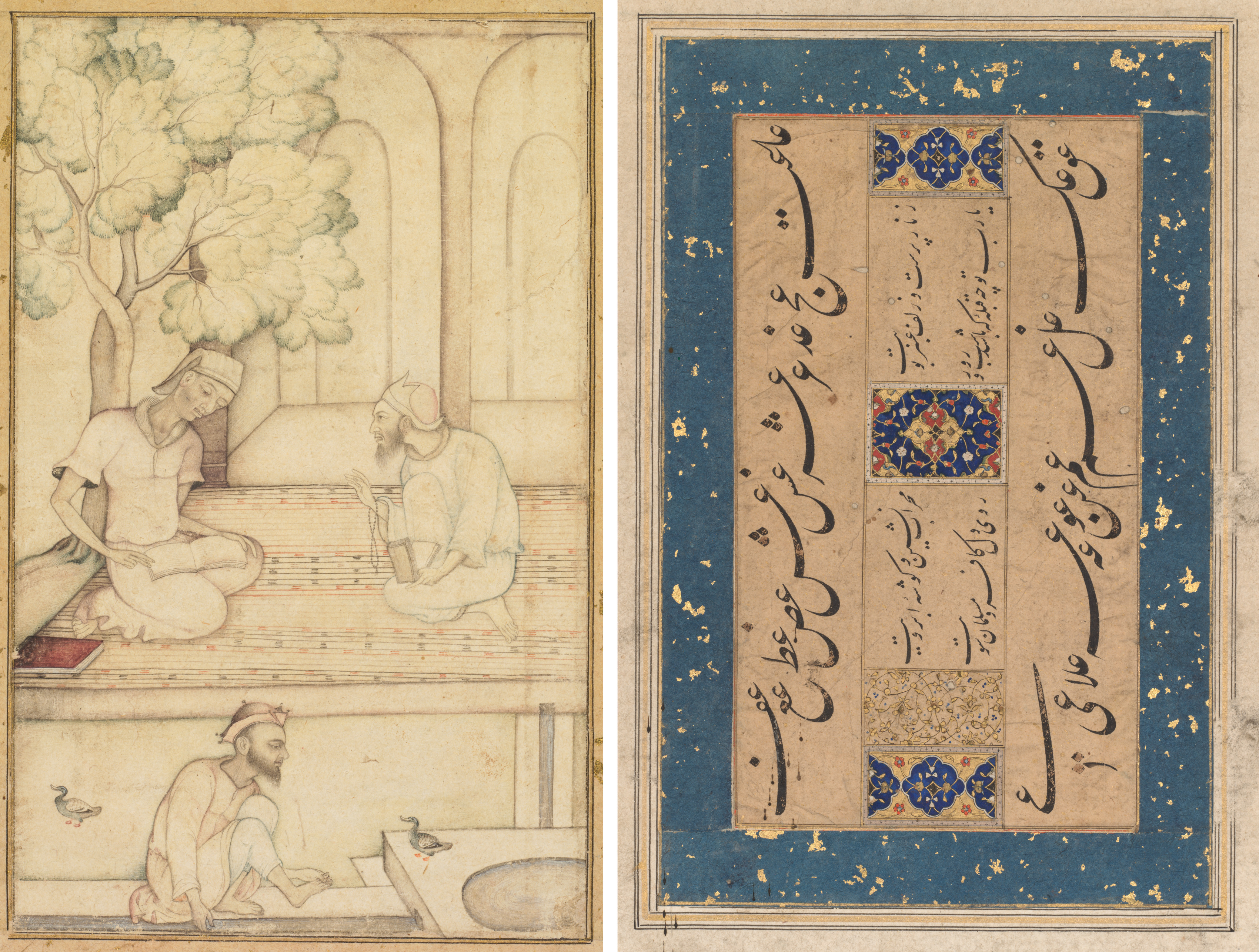
Kabir and Two Followers on a Terrace (recto); Calligraphy (verso)
Recto: A drawing of three men on a flat surface outdoors. Two of the men are on a higher platform, sitting cross-legged facing one another; both wear white hats. The man on the left sits with legs tucked under body; the man on the right sits with legs crossed. A tree to their left. The third man on lower platform on right, sitting on the floor with legs tucked under body. Verso: Calligraphy on beige background surrounded by blue border. Border has gold spots. Calligraphy written in black ink. Four decorative squares within border.
Artwork details
- Dimensions:
- 900 × 681 px
- Museum record:
- View original
You May Also Like

Yusuf and Zulaykha (recto); Text Page, Persian Verses (verso)

Bahram Gur Visits the Princess of India in the Black Pavilion, Illustration and Text, Persian Verses (recto); Bahram Gur Visits the Princess of India, Text Page, Persian Verses (verso)

A princess on a terrace with attendants at night (recto); Calligraphy (verso)

Left side of a double-page album folio: Outside a Royal Encampment (recto) and Calligraphy, Persian Verses (verso)

Hunting with falcons in a landscape; verso: Calligraphy of Chaghatai Turkish poems in praise of wine, Sultan Muhammad Nur (Persian, c. 1472–1536) and Mirza Muhammad (probably Persian, active c. 1520s)

A prince conversing with a woman while taking refreshments on a terrace (recto); Calligraphy (verso)
![Nushirwan Listens to the Owls (recto): Illustration and Text, Persian Verses, from a Manuscript of the Khamsa of Nizami, Makhzan al-Asrar [Treasure of Secrets]](/api/image?url=https%3A%2F%2Fopenaccess-cdn.clevelandart.org%2F1944.487.a%2F1944.487.a_web.jpg&w=1536&q=75)
Nushirwan Listens to the Owls (recto): Illustration and Text, Persian Verses, from a Manuscript of the Khamsa of Nizami, Makhzan al-Asrar [Treasure of Secrets]

The Parrot Addresses Khujasta at the Beginning of the Eighteenth Night, from a Tuti-nama (Tales of a Parrot)

Sketch of a Young Man and Persian Calligraphy

Persian Quatrains (Rubayi) and Calligraphic Exercises (recto); Persian Verse (khamriyya) (verso)

Princess with Wine Bottle and Cup (recto); Persian Verses (verso)

Tuti-Nama (Tales of a Parrot)

Leaf from the Late Shah Jahan Album: Harem Night-Bathing Scene (recto); Calligraphy Framed by an Ornamental Border of Flowers and Birds (verso)

The pious man’s wife offers the seven-colored bird as food to her lover, but not finding its head, he breaks the pot and bowl in anger, from a Tuti-nama (Tales of a Parrot): Fifty-second Night

Illuminated page (verso), from a Panj Ganj (Five Treasures) of Abd al- Rahman Jami (Persian, 1414–1492) with two Persian masnavis: Yusuf va Zulaykha (Joseph and Zulaykha) and Khirad-nama-i Iskandari (Alexander’s Book of Wisdom)

Nushirwan Listens to the Owls (recto); the Story of Nushirwan and his Minister, "The Third Discourse on Diverse Events and Disorder in Life" (verso) from a Khamsa (Quintet) of Nizami (1141-1209)

An Episode from the Story of the Sasanian King Khusrau and His Beloved Shirin, from a Khamsa (Quintet) of Nizami (1141–1209) (verso); Persian verses from a Haft Awrang (Seven Thrones) of Jami (d. 1492) (recto)

Persian ruba‘i (quatrain) by Maulana Muḥammad Murshidi Zawara’i (Persian, late 1500s–early 1600s) (verso)

Rustam Lassoing his Horse, Rakhsh, in a Landscape (recto); Calligraphy, Persian Verses (verso)

Calligraphy of a ghazal of Amir Khusrau Dihlavi (Indian, 1253–1325) (verso)

Persian Couplets (recto); Sleeping Youth (verso)

The parrot addresses Khujasta at the beginning of the thirty-seventh night, from a Tuti-nama (Tales of a Parrot)

Calligraphy, Persian Verses (verso)

The prince rejects the amorous advances of the king’s handmaiden, from a Tuti-nama (Tales of a Parrot): Eighth Night