
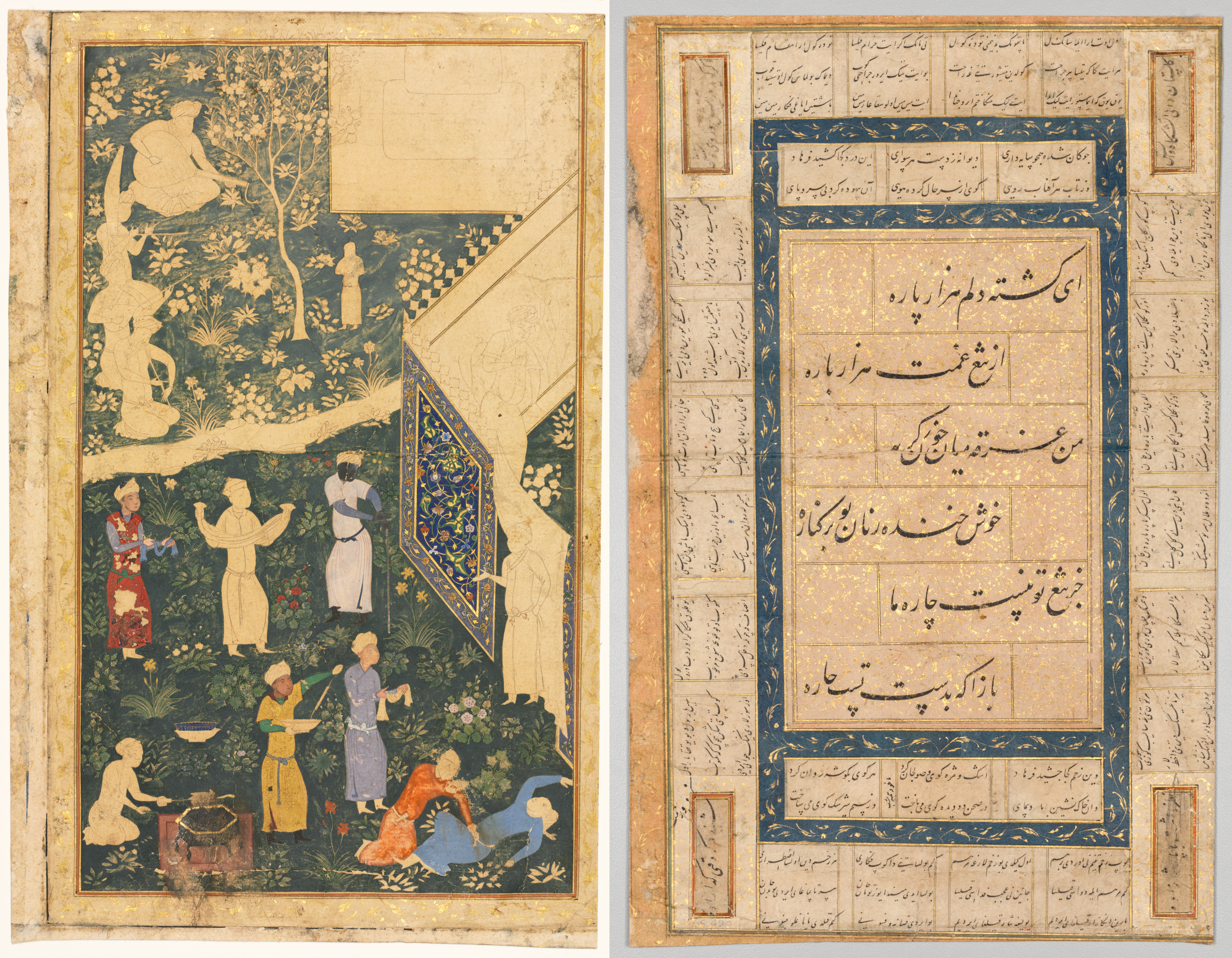
Left side of a double-page album folio: Outside a Royal Encampment (recto) and Calligraphy, Persian Verses (verso)
Double-page album folio, two pages side by side. Left page: A colorful illustration depicting people outside a royal encampment. The scene shows a group of people in a garden or courtyard with trees and plants. A staircase with blue and gold patterned steps leads up to a platform or building. The people are dressed in robes and tunics in shades of blue, orange, yellow, white, and red. Some are standing, others sitting or kneeling. Right page: A calligraphy page with Persian verses. The page has a beige background with a blue and gold border around a central rectangle containing black calligraphy. There are additional calligraphy and smaller rectangles with writing around the border. The pages have a yellowed, aged appearance with visible signs of wear.
Artwork details
- Dimensions:
- 900 × 700 px
- Museum record:
- View original
You May Also Like

Yusuf and Zulaykha (recto); Text Page, Persian Verses (verso)

Bahram Gur Visits the Princess of India in the Black Pavilion, Illustration and Text, Persian Verses (recto); Bahram Gur Visits the Princess of India, Text Page, Persian Verses (verso)

The young prince is crowned and the wicked handmaiden is executed, from a Tuti-nama (Tales of a Parrot): Eighth Night
![Nushirwan Listens to the Owls (recto): Illustration and Text, Persian Verses, from a Manuscript of the Khamsa of Nizami, Makhzan al-Asrar [Treasure of Secrets]](/api/image?url=https%3A%2F%2Fopenaccess-cdn.clevelandart.org%2F1944.487.a%2F1944.487.a_web.jpg&w=1536&q=75)
Nushirwan Listens to the Owls (recto): Illustration and Text, Persian Verses, from a Manuscript of the Khamsa of Nizami, Makhzan al-Asrar [Treasure of Secrets]

Kabir and Two Followers on a Terrace (recto); Calligraphy (verso)

An Episode from the Story of the Sasanian King Khusrau and His Beloved Shirin, from a Khamsa (Quintet) of Nizami (1141–1209) (verso); Persian verses from a Haft Awrang (Seven Thrones) of Jami (d. 1492) (recto)

The unfaithful wife explaining away the presence of the dough elephant, from a Tuti-nama (Tales of a Parrot): Eighth Night

The merchant has the hateful skull ground and put into a box, from a Tuti-nama (Tales of a Parrot): Twenty-third Night

The merchant’s daughter gives birth to a son as a result of eating out of the box. The clever child recognizes the false gems from true, from a Tuti-nama (Tales of a Parrot): Twenty-third Night

A prince conversing with a woman while taking refreshments on a terrace (recto); Calligraphy (verso)

Princess with Wine Bottle and Cup (recto); Persian Verses (verso)

The king plucks fruit from the Tree of Life with his own hands and feeds it to a lady, from a Tuti-nama (Tales of a Parrot): Ninth Night

Latif, who has murdered his brother, falsely accuses Khurshid of the deed, from a Tuti-nama (Tales of a Parrot): Thirty-second Night

The queen of Rum watches the peahen prefer to burn rather than abandon her eggs while the peacock flees the nest, from a Tuti-nama (Tales of a Parrot): Thirty-ninth Night

The Parrot Addresses Khujasta at the Beginning of the Eighteenth Night, from a Tuti-nama (Tales of a Parrot)

Leaf from the Late Shah Jahan Album: Harem Night-Bathing Scene (recto); Calligraphy Framed by an Ornamental Border of Flowers and Birds (verso)

Mirror of Holiness (Mir’at al-quds) of Father Jerome Xavier

The Parrot Addresses Khujasta at the Beginning of the Eleventh Night, from a Tuti-nama (Tales of a Parrot)

The young prince is presented to the king, his father, by his teacher, but refuses to speak, from a Tuti-nama (Tales of a Parrot): Eighth Night

Sketch of a Young Man and Persian Calligraphy

The false Mansur punished before the judge and expelled from the city, from a Tuti-nama (Tales of a Parrot): Seventeenth Night

The young man of Baghdad reunited with his slave-girl, from a Tuti-nama (Tales of a Parrot): Forty-eighth Night

The Parrot Addresses Khujasta at the Beginning of the Seventh Night, from a Tuti-nama (Tales of a Parrot)

The deceitful wife ejects the procuress after blackening her face, from a Tuti-nama (Tales of a Parrot): Eighth Night