
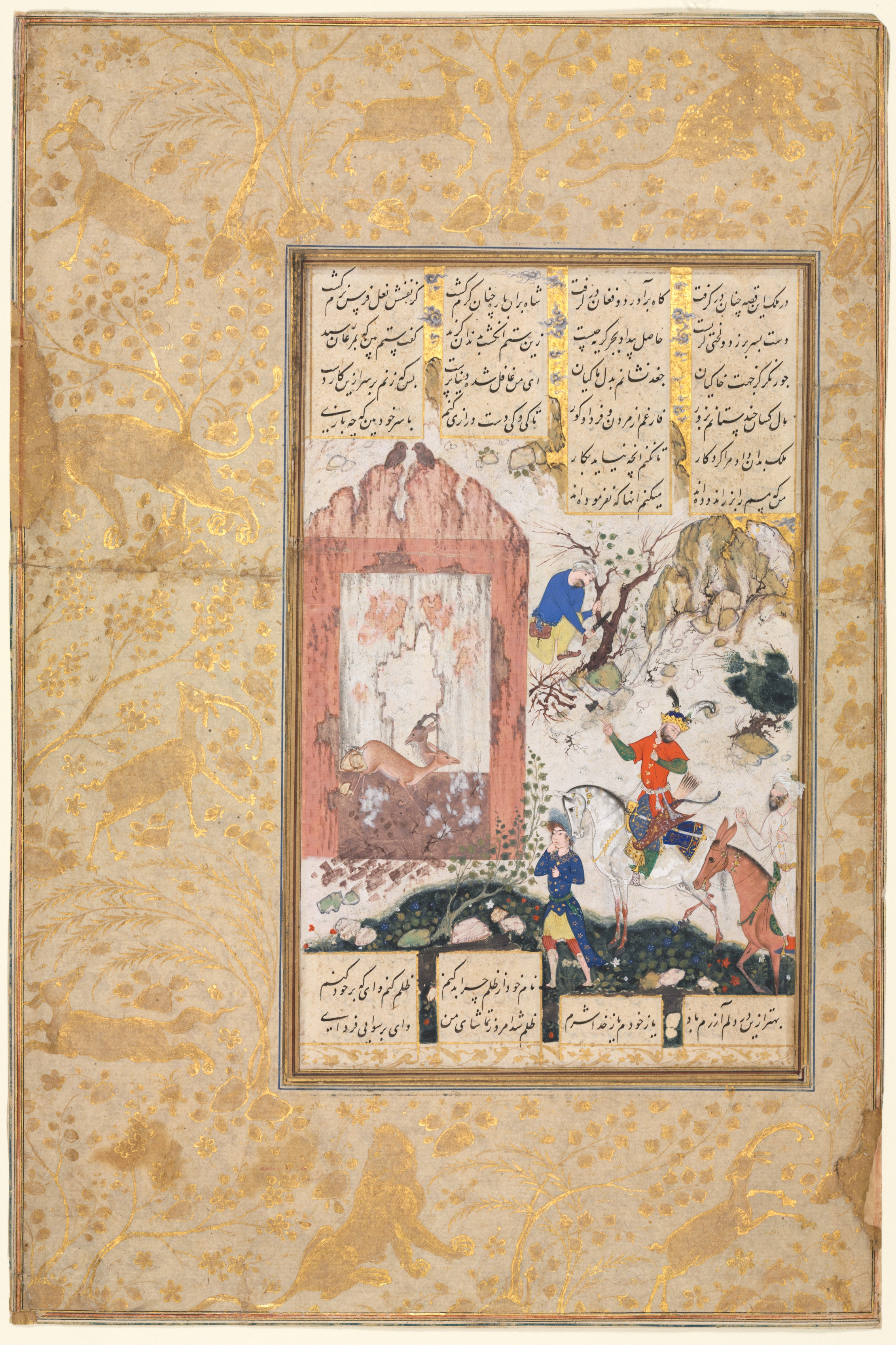
Nushirwan Listens to the Owls (recto): Illustration and Text, Persian Verses, from a Manuscript of the Khamsa of Nizami, Makhzan al-Asrar [Treasure of Secrets]
Recto illustration of a man on a white horse wearing an orange tunic with green accents and a yellow turban on his head gesturing with his right hand, accompanied by a man on foot wearing a blue tunic and a blue turban on his head with a yellow undergarment and a man on a brown horse wearing a white tunic; the scene is on a gold and white background with trees, mountains, an archway with a man and a lion; cursive black writing surrounds the illustration on a white background; beige and gold patterned border surrounds illustration; visible creases and stains throughout.
Artwork details
- Dimensions:
- 595 × 893 px
- Museum record:
- View original
You May Also Like

Yusuf and Zulaykha (recto); Text Page, Persian Verses (verso)

Nushirwan Listens to the Owls (recto); the Story of Nushirwan and his Minister, "The Third Discourse on Diverse Events and Disorder in Life" (verso) from a Khamsa (Quintet) of Nizami (1141-1209)

Left side of a double-page album folio: Outside a Royal Encampment (recto) and Calligraphy, Persian Verses (verso)

The Parrot Addresses Khujasta at the Beginning of the Eighteenth Night, from a Tuti-nama (Tales of a Parrot)

The queen of Rum watches the peahen prefer to burn rather than abandon her eggs while the peacock flees the nest, from a Tuti-nama (Tales of a Parrot): Thirty-ninth Night

Rustam's seventh course: He kills the White Div, folio 124 from a Shah-nama (Book of Kings) of Firdausi (Persian, about 934–1020)

The Tale of the Twelve Faces. "The Warriors Engage in Combat": Illustration from the Firdausi Shahnama (verso)

The young prince is crowned and the wicked handmaiden is executed, from a Tuti-nama (Tales of a Parrot): Eighth Night

A dancing dervish and three musicians, from a Divan (Collected Poems) of Urfi (Persian, 1555–1591)

Manuscript pages showing battle scenes

The Parrot Addresses Khujasta at the Beginning of the Seventh Night, from a Tuti-nama (Tales of a Parrot)

Illuminated page (verso), from a Panj Ganj (Five Treasures) of Abd al- Rahman Jami (Persian, 1414–1492) with two Persian masnavis: Yusuf va Zulaykha (Joseph and Zulaykha) and Khirad-nama-i Iskandari (Alexander’s Book of Wisdom)

Yusuf and Zulaykha (recto); Illustration and Text (Persian Verses) in an Anthology with some verses from Haft Awrang (Seven Thrones) of Jami; The Fifth Throne

Princess with Wine Bottle and Cup (recto); Persian Verses (verso)

Latif, who has murdered his brother, falsely accuses Khurshid of the deed, from a Tuti-nama (Tales of a Parrot): Thirty-second Night

The Parrot Addresses Khujasta at the Beginning of the Eleventh Night, from a Tuti-nama (Tales of a Parrot)

Sketch of a Young Man and Persian Calligraphy

Bijan killing the wild boars of Irman, from a Shah-nama (Book of Kings) of Firdausi (Persian, about 934–1020) (verso)

Persian Couplets (recto); Sleeping Youth (verso)

Three Ladies in a Palace Interior: Page from a Dispersed Laur Chanda (Romance of Laurak and Chanda)

The deceitful wife ejects the procuress after blackening her face, from a Tuti-nama (Tales of a Parrot): Eighth Night

Bahram Visits the White Domed Pavilion on Friday (recto)

The king plucks fruit from the Tree of Life with his own hands and feeds it to a lady, from a Tuti-nama (Tales of a Parrot): Ninth Night

Grotesque Dancers Performing