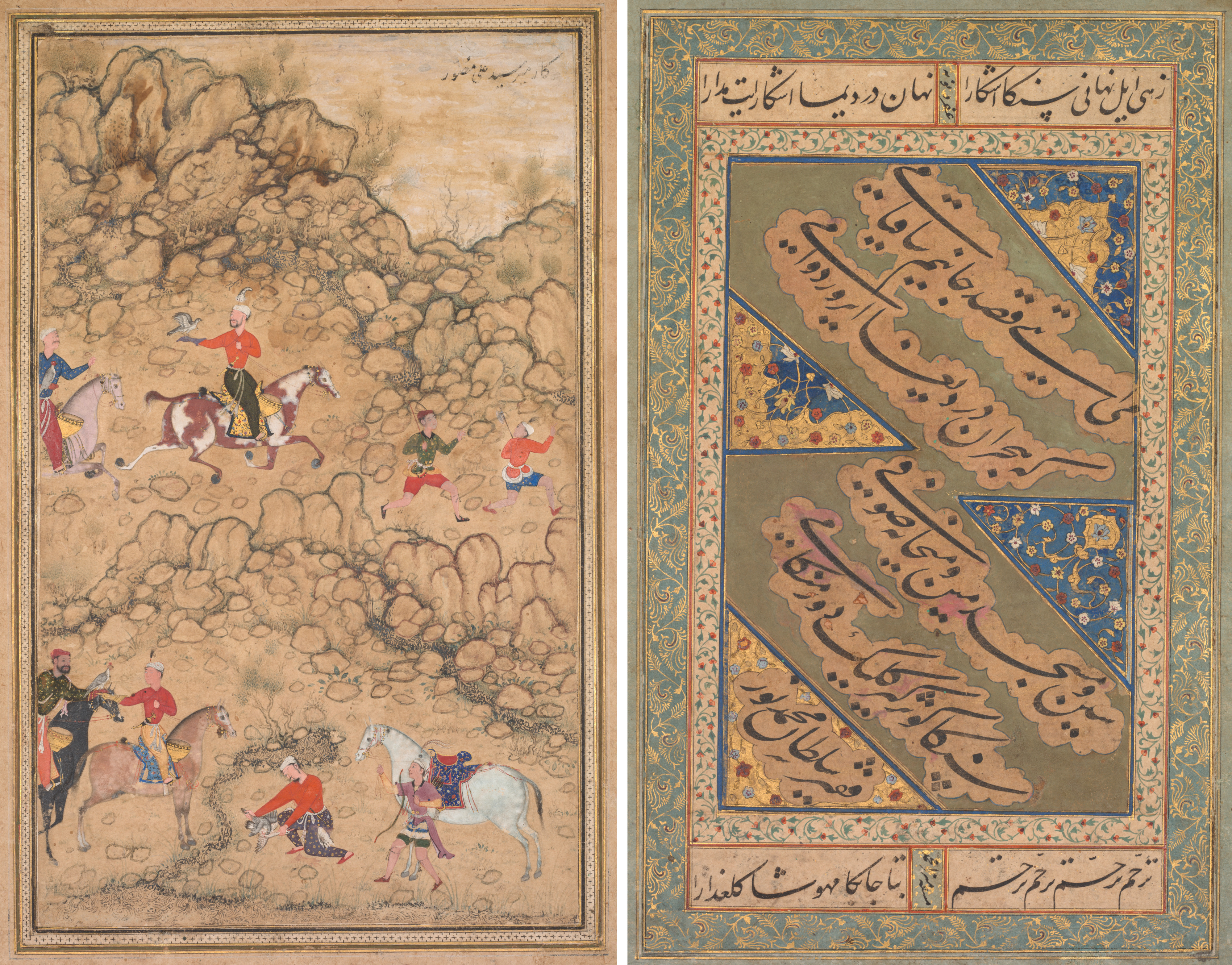
Hunting with falcons in a landscape; verso: Calligraphy of Chaghatai Turkish poems in praise of wine, Sultan Muhammad Nur (Persian, c. 1472–1536) and Mirza Muhammad (probably Persian, active c. 1520s)
The image depicts two artworks side by side. The left artwork shows a landscape with several people on horseback and one on foot. The people on horseback wear colorful clothing and hold birds, likely falcons. One person on horseback wears an orange shirt and black pants. A person on a white horse wears a purple and pink outfit. The background is a rocky hillside with brown and gray stones. The right artwork features calligraphy in a foreign language, possibly Arabic or Persian, on a green background with a blue and gold border. The calligraphy is written in black ink and arranged in a decorative pattern. The border consists of a repeating design of flowers and vines in shades of blue, red, and gold.
Artwork details
- Dimensions:
- 900 × 705 px
- Museum record:
- View original
You May Also Like

Yusuf and Zulaykha (recto); Text Page, Persian Verses (verso)

Kabir and Two Followers on a Terrace (recto); Calligraphy (verso)

Left side of a double-page album folio: Outside a Royal Encampment (recto) and Calligraphy, Persian Verses (verso)
![Nushirwan Listens to the Owls (recto): Illustration and Text, Persian Verses, from a Manuscript of the Khamsa of Nizami, Makhzan al-Asrar [Treasure of Secrets]](/api/image?url=https%3A%2F%2Fopenaccess-cdn.clevelandart.org%2F1944.487.a%2F1944.487.a_web.jpg&w=1536&q=75)
Nushirwan Listens to the Owls (recto): Illustration and Text, Persian Verses, from a Manuscript of the Khamsa of Nizami, Makhzan al-Asrar [Treasure of Secrets]

Babur meeting with Sultan Ali Mirza at the Kohik River, from a Babur-nama (Memoirs of Babur)

A princess on a terrace with attendants at night (recto); Calligraphy (verso)

Illuminated page (verso), from a Panj Ganj (Five Treasures) of Abd al- Rahman Jami (Persian, 1414–1492) with two Persian masnavis: Yusuf va Zulaykha (Joseph and Zulaykha) and Khirad-nama-i Iskandari (Alexander’s Book of Wisdom)

Calligraphy of Lyrical Quatrains (verso)

The wounded monkey bites the hand of the prince, his chessmate, in the presence of guests, from a Tuti-nama (Tales of a Parrot): Fifth Night

Bahram Gur Visits the Princess of India in the Black Pavilion, Illustration and Text, Persian Verses (recto); Bahram Gur Visits the Princess of India, Text Page, Persian Verses (verso)

Calligraphy of Chaghatai Turkish Poems in Praise of Wine (verso)

Portrait of Raja Ram Singh of Amber (r. 1667-1688) with a Deccan Sword (recto); Calligraphy (verso)

The merchant has the hateful skull ground and put into a box, from a Tuti-nama (Tales of a Parrot): Twenty-third Night

The deceitful wife ejects the procuress after blackening her face, from a Tuti-nama (Tales of a Parrot): Eighth Night

An African Lyre Player (recto); Calligraphy (verso)

Calligraphy of a ghazal of Amir Khusrau Dihlavi (Indian, 1253–1325) (verso)

The young prince is crowned and the wicked handmaiden is executed, from a Tuti-nama (Tales of a Parrot): Eighth Night

The Parrot Addresses Khujasta at the Beginning of the Eighteenth Night, from a Tuti-nama (Tales of a Parrot)

The queen of Rum watches the peahen prefer to burn rather than abandon her eggs while the peacock flees the nest, from a Tuti-nama (Tales of a Parrot): Thirty-ninth Night

The snake, hidden in a basket of flowers, reveals himself to the Raja who has just sent away his wife, from a Tuti-nama (Tales of a Parrot): Forty-third Night

A prince conversing with a woman while taking refreshments on a terrace (recto); Calligraphy (verso)

King Luhrasp Ascends the Throne: a Processon Arrives at Court (recto); the Story of King Luhrasp (verso) from a Shahnama (Book of Kings) of Firdausi (940-1019 or 1025)

The young prince recounts his experiences to his father, the king, from a Tuti-nama (Tales of a Parrot): Eighth Night

The merchant’s daughter gives birth to a son as a result of eating out of the box. The clever child recognizes the false gems from true, from a Tuti-nama (Tales of a Parrot): Twenty-third Night