
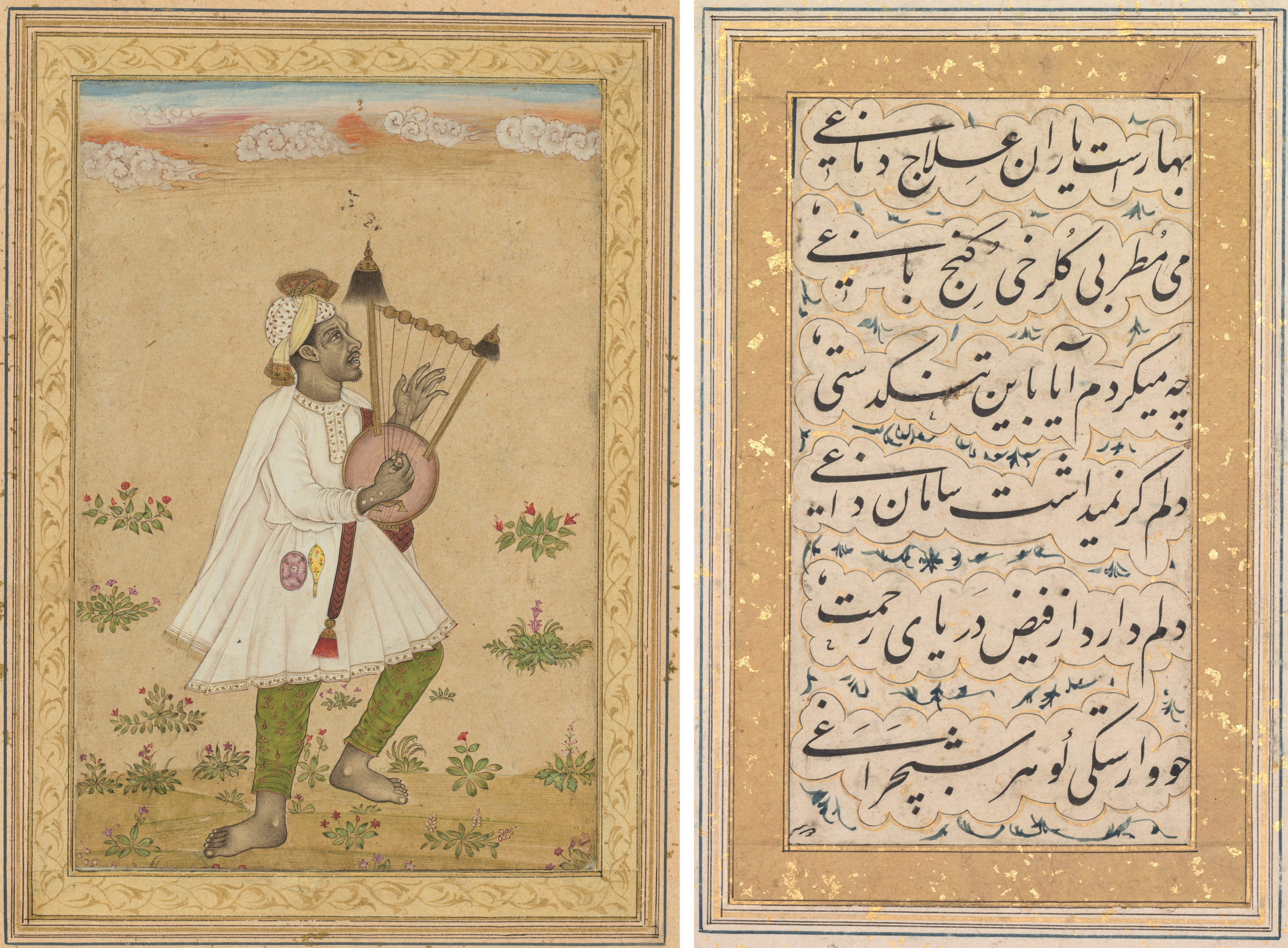
An African Lyre Player (recto); Calligraphy (verso)
The image shows two pages side by side. The left page depicts a man playing a lyre. He wears a white robe with gold trim and green pants. A red sash with a gold and purple ornament hangs from his waist. His head is covered with a white cloth with gold dots and a brown hat. He stands on a beige ground with pink and purple flowers. The sky above him has blue, pink, and white clouds. The right page shows black calligraphy on a beige background with a gold border. The text is written in a foreign language, possibly Arabic. The text is surrounded by a gold border with a thin blue line and small blue floral designs.
Artwork details
- Dimensions:
- 900 × 662 px
- Museum record:
- View original
You May Also Like

Portrait of Raja Ram Singh of Amber (r. 1667-1688) with a Deccan Sword (recto); Calligraphy (verso)

A Courtier, Possibly Khan Alam, Holding a Spinel and a Deccan Sword

An African Lyre Player (recto)

Portrait of Raja Bikramajit

A princess on a terrace with attendants at night (recto); Calligraphy (verso)

Princess Smoking a Hookah (as Salabhanjika)

The parrot addresses Khujasta at the beginning of the forty-first night, from a Tuti-nama (Tales of a Parrot): Forty-first Night

The Parrot Addresses Khujasta at the Beginning of the Eighteenth Night, from a Tuti-nama (Tales of a Parrot)

Portrait of an Unidentified Noble from Shah Jahan's Court

The rejuvenated old man and the daughter of the king of the jinns take leave of the King of Kings, from a Tuti-nama (Tales of a Parrot): Seventh Night

The Parrot Addresses Khujasta at the Beginning of the Twenty-sixth Night, from a Tuti-nama (Tales of a Parrot)

Shah Jahan holding a spinel and a long Deccan sword, from the Late Shah Jahan Album

A Mughal courtier

The prince rejects the amorous advances of the king’s handmaiden, from a Tuti-nama (Tales of a Parrot): Eighth Night

Posthumous portrait of the Mughal emperor Muhammad Shah (reigned 1719–1748) holding a falcon (recto); Calligraphy (verso)

Hunting with falcons in a landscape; verso: Calligraphy of Chaghatai Turkish poems in praise of wine, Sultan Muhammad Nur (Persian, c. 1472–1536) and Mirza Muhammad (probably Persian, active c. 1520s)

The eldest brother explains the reason for his youthful appearance, from a Tuti-nama (Tales of a Parrot): Forty-ninth Night

The Brahman’s wife who killed a peacock and ate its gallbladder on the physician’s advice, from a Tuti-nama (Tales of a Parrot): Nineteenth Night

A Courtier, Possibly Khan Alam, Holding a Spinel and a Deccan Sword

The origin of music from a fabulous bird of India which had seven holes in its beak, from a Tuti-nama (Tales of a Parrot): Fourteenth Night

Portrait of Raja Ram Singh of Amber (r. 1667-1688) with a Deccan Sword (recto)

The young prince is crowned and the wicked handmaiden is executed, from a Tuti-nama (Tales of a Parrot): Eighth Night

A European Couple

The prince, once reprieved, is returned to the palace of execution a second time on the plea of the king’s handmaiden, from a Tuti-nama (Tales of a Parrot): Eighth Night