
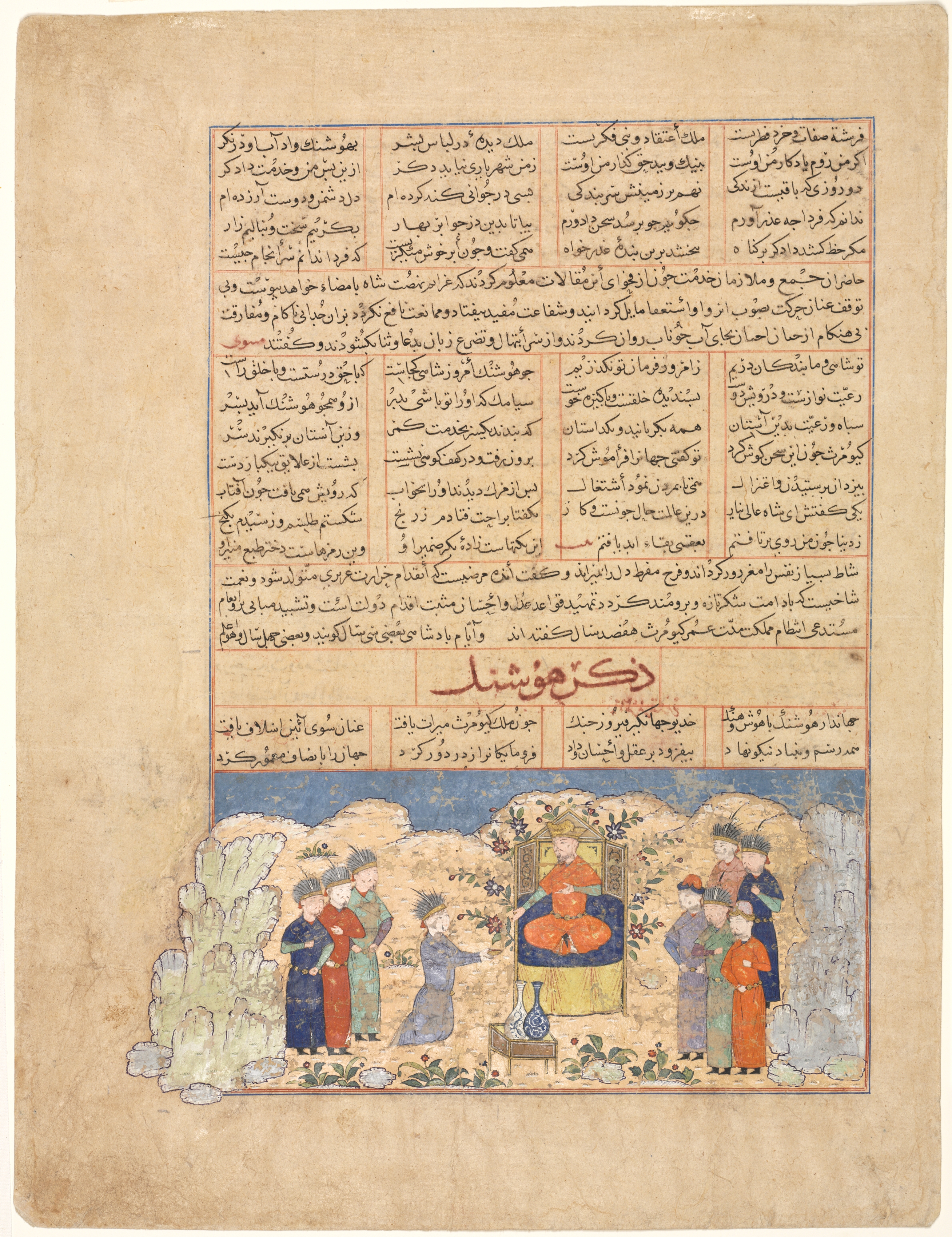
The Story of Hushang, from a Majma al-tavarikh (A Compendium of Histories) of Hafiz-i Abru (recto)
A page made of aged light brown paper, with rounded corners and right edge. The top 3/4 of the page contains written text in black ink in a foreign language, possibly Arabic. The text includes 4 columns on the top half. The bottom portion depicts a painted scene with a male figure on a throne. He wears a red hat and orange tunic over a yellow garment. The throne includes a blue and gold backrest. He sits among blue cloudy sky and surrounded by 7 other men. The standing men wear robes colored orange, blue, and green, and blue headwear. The bottom left contains green plants and grey stones. The bottom right contains grey stones and green plants. There is a blue vase with a white base on a table to the left of the throne. The throne and people are outlined by a red border. The background behind the page is white.
Artwork details
- Dimensions:
- 687 × 893 px
- Museum record:
- View original
You May Also Like

The Story of Hushang (recto), Illustration and text (Persian Prose) from Majmac al-Tavarikh (A Compendium of Histories) of Hafiz-i Abru; Text Page, Persian Prose, (verso), from Majmac al-Tavarikh (A Compendium of Histories) of Hafiz-i Abru

Nushirwan Sends Mihran Sitad to Fetch the Daughter of the King of China (recto) from a Shahnama (Book of Kings) of Firdausi (940–1019 or 1025)

Page of disasters, from the Tarikh-i Alfi (History of a Thousand Years)

Bahram Gur meets Arzu, the Daughter of Mahiyar (verso); Illustration and Text, Persian Verses, from the Shahnama of Firdawsi

Vabhruvahana Approaches Arjuna, page from the Khan Khanan's Razm-nama

An Episode from the Story of the Sasanian King Khusrau and His Beloved Shirin, from a Khamsa (Quintet) of Nizami (1141–1209) (verso); Persian verses from a Haft Awrang (Seven Thrones) of Jami (d. 1492) (recto)

The four destitute friends go to a wise man who gives each one of them a magic shell to be placed on top of the turban, from a Tuti-nama (Tales of a Parrot): Forty-seventh Night

Text in Khamsa of Nizami (verso), from a Haft Paykar (Seven Portraits) of Nizami

The king plucks fruit from the Tree of Life with his own hands and feeds it to a lady, from a Tuti-nama (Tales of a Parrot): Ninth Night

Yusuf and Zulaykha (recto); Illustration and Text (Persian Verses) in an Anthology with some verses from Haft Awrang (Seven Thrones) of Jami; The Fifth Throne

The merchant’s daughter gives birth to a son as a result of eating out of the box. The clever child recognizes the false gems from true, from a Tuti-nama (Tales of a Parrot): Twenty-third Night

Yusuf and Zulaykha (recto); Text Page, Persian Verses (verso)

The parrot brings a fruit from the Tree of Life to the king of Syria, from a Tuti-nama (Tales of a Parrot): Ninth Night

The pious man’s son, now a king, reveals himself to his father; his nurse upbraids his unfaithful mother, from a Tuti-nama (Tales of a Parrot): Fifty-second Night

Page from a Manuscript of Kulliyat (Complete Works) by Sa'di

The Story of Adam, peace upon him, his Sons and Progeny, from a Jami al-tavarikh (Compendium of Chronicles) of Rashid al-din (verso)

Bahram Gur Visits the Princess of India in the Black Pavilion, Illustration and Text, Persian Verses (recto); Bahram Gur Visits the Princess of India, Text Page, Persian Verses (verso)

Mahrusa’s marriage to the prefect of the city, from a Tuti-nama (Tales of a Parrot): Thirty-sixth Night

The eldest brother explains the reason for his youthful appearance, from a Tuti-nama (Tales of a Parrot): Forty-ninth Night

The marriage of ‘Ubaid, son of a merchant of Tirmiz, from a Tuti-nama (Tales of a Parrot): Forty-second Night

The prince and Nikfal are joined by Khalis and the Mukhlis who are the grateful snake and frog in human form, from a Tuti-nama (Tales of a Parrot): Eighteenth Night

The parrot addresses Khujasta at the beginning of the forty-seventh night, from a Tuti-nama (Tales of a Parrot): Forty-seventh Night

The lover’s son makes an elephant of the pastry dough carried by the unfaithful wife and puts it in her basket, from a Tuti-nama (Tales of a Parrot): Eighth Night

The king’s handmaiden takes the prince away to the harem, from a Tuti-nama (Tales of a Parrot): Eighth Night