
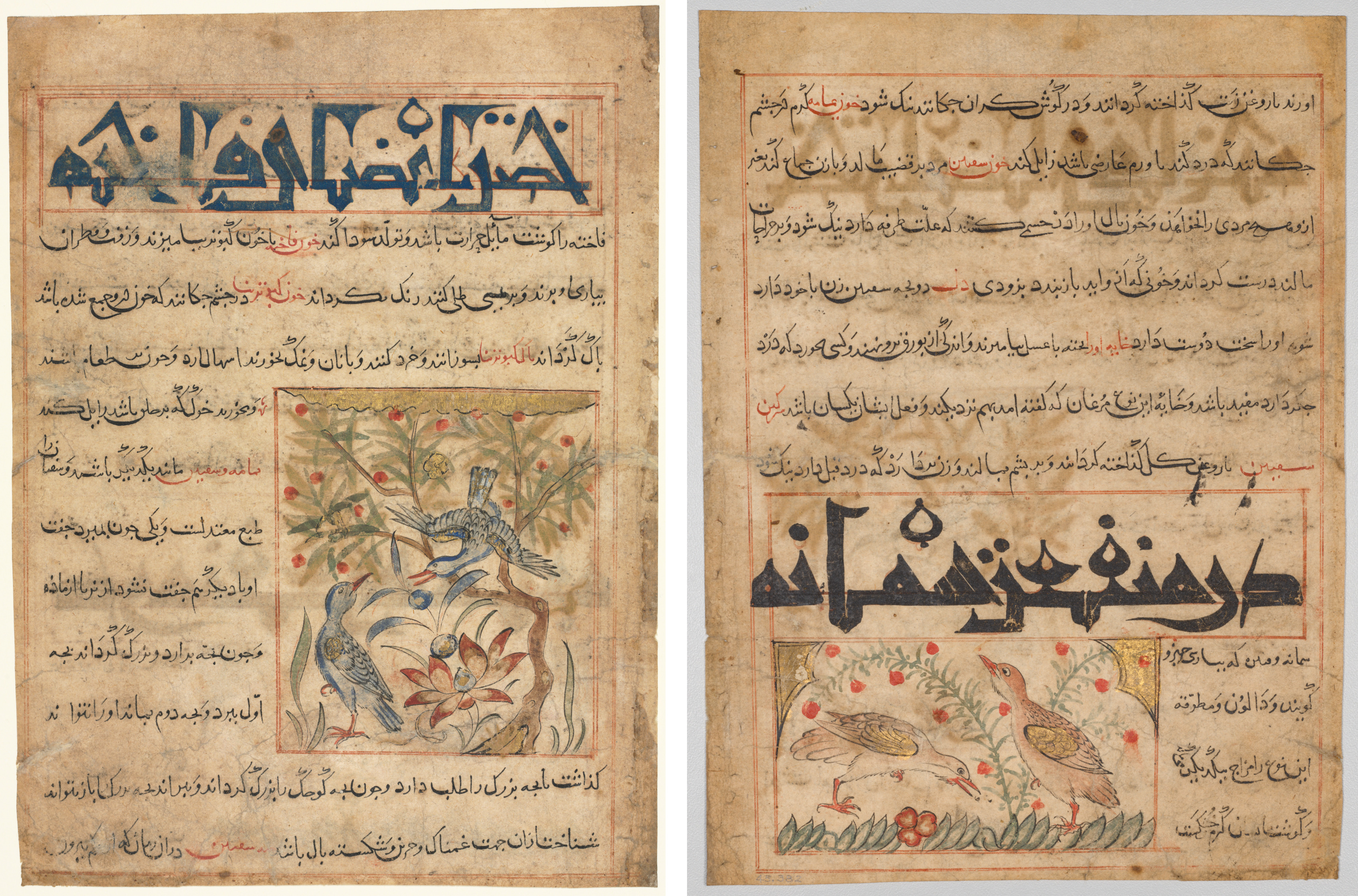
Qualities of Ringdoves (recto); On the Benefits of Quails (verso), from a Persian Manafi‘ al-Hayawan (The Benefits of Animals) of Abu Said Ubaid-Allah ibn Jibrail ibn Bakhtishu (died 1058–68)
The image contains two pages from a book. The pages are yellowed and aged. The left page has a blue title at the top and a red border around the text and an image. The image depicts a tree with green leaves and red berries. There are three birds in the image; one on a branch and two on the ground. The right page has a black title at the top and black text throughout. There is a red border around the text and an image. The image shows two brown birds standing on the ground near a flowering bush with red flowers. Both pages have Arabic writing in black, red, and blue ink.
Artwork details
- Dimensions:
- 900 × 594 px
- Museum record:
- View original
You May Also Like

Folio from a Persian Manafi‘ al-Hayawan (The Benefits of Animals) of Abu Said Ubaid-Allah ibn Jibrail ibn Bakhtishu (died 1058–68) (verso)

Folio from a Persian Manafi‘ al-Hayawan (The Benefits of Animals) of Abu Said Ubaid-Allah ibn Jibrail ibn Bakhtishu (died 1058–68) (recto)

"Benefits of the Parts of Vultures" (From the Manafi' al-Haywan of Abu Sai'd Ubayd-Allay Ibn Bakhtishu) (recto)

"Benefits of the Parts of Vultures" (From the Manafi' al-Haywan of Abu Sai'd Ubayd-Allay Ibn Bakhtishu)

Text Page, Persian Verses (recto); Bahram Gur meets Arzu, the Daughter of Mahiyar (verso)

"Benefits of the Parts of Vultures" (From the Manafi' al-Haywan of Abu Sai'd Ubayd-Allay Ibn Bakhtishu) (verso)

Text Page, Persian Verses (verso) in an Anthology with some verses from Haft Awrang (Seven Thrones) of Jami; The Fifth Throne Yusuf and Zulaykha

The Story of Hushang (recto), Illustration and text (Persian Prose) from Majmac al-Tavarikh (A Compendium of Histories) of Hafiz-i Abru; Text Page, Persian Prose, (verso), from Majmac al-Tavarikh (A Compendium of Histories) of Hafiz-i Abru

The Tale of the Twelve Faces. "Bizhan Addresses the Army": Illustration from the Firdausi Shahnama (recto); The Tale of the Twelve Faces. "The Warriors Engage in Combat": Illustration from the Firdausi Shahnama (verso)

Nushirwan Listens to the Owls (recto); the Story of Nushirwan and his Minister, "The Third Discourse on Diverse Events and Disorder in Life" (verso) from a Khamsa (Quintet) of Nizami (1141-1209)

Peacock-shaped Hand Washing Device (recto); Text Page, Arabic Prose (verso)

Persian Quatrains (Rubayi) and Calligraphic Exercises (recto); Persian Verse (khamriyya) (verso)

The Tale of the Twelve Faces. "The Warriors Engage in Combat": Illustration from the Firdausi Shahnama (verso)

Persian Couplets (recto), Calligraphy, Persian Verses; Single Page Manuscript

Text Page, Persian Prose (recto); The Story of Adam peace upon him, his Sons and Progeny (verso)

Manuscript pages showing battle scenes

Persian ruba‘i (quatrain) by Maulana Muḥammad Murshidi Zawara’i (Persian, late 1500s–early 1600s) (verso)

Persian Verses (verso)

Page from a Qur'an (recto)

Sketch of a Young Man and Persian Calligraphy

Yusuf and Zulaykha (recto); Text Page, Persian Verses (verso)

Page from a Qur'an (verso)

Bahram Gur Slays a Dragon (verso), from a Shahnama (Book of Kings) of Firdausi (940-1019 or 1025), known as the Great Mongol Shahnama

Illuminated opening page (folio 1 verso) and 131 folios with Persian text, from a Mirror of Holiness (Mir’at al-quds) of Father Jerome Xavier