
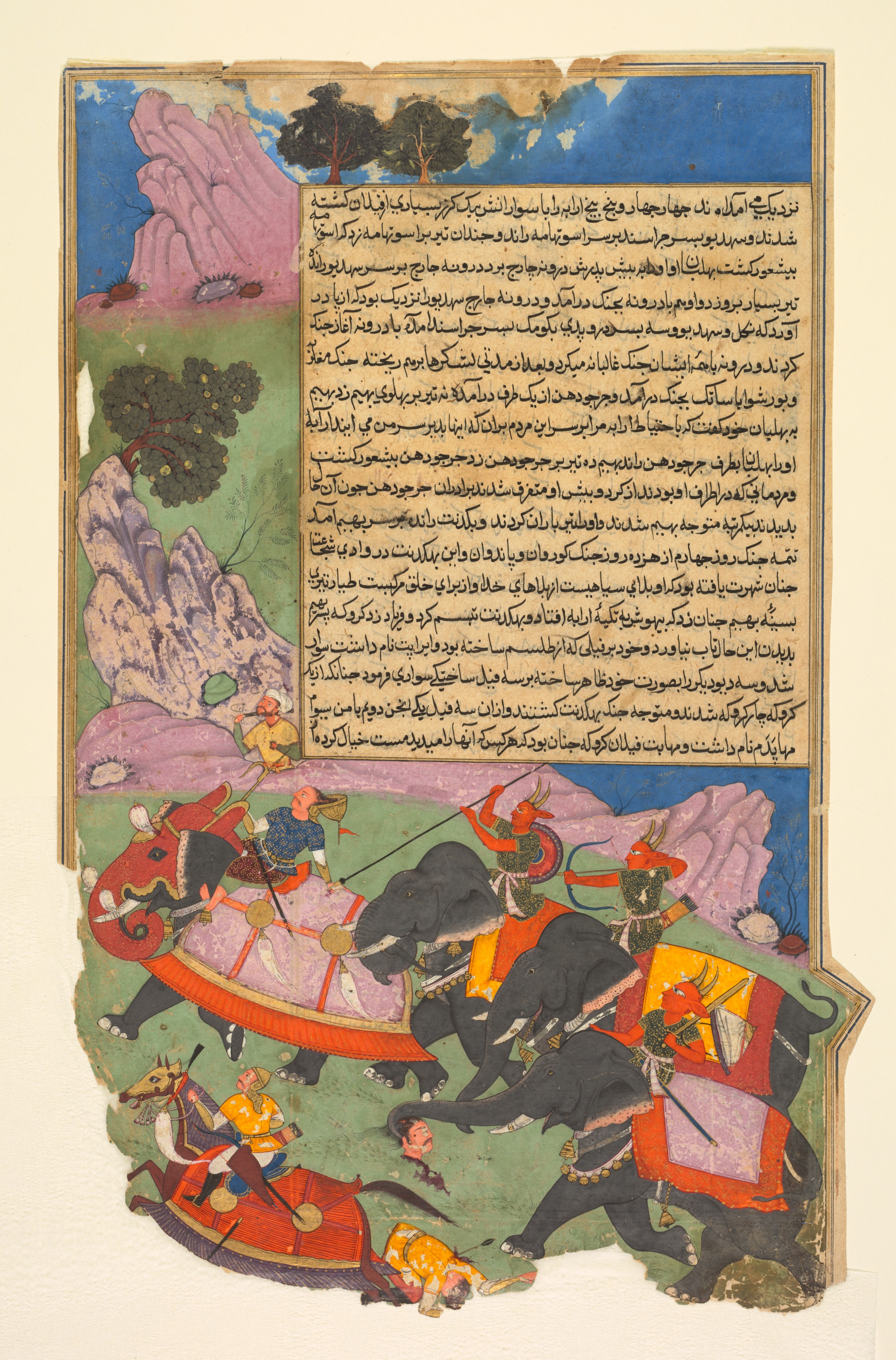
Ghatotkacha and three demons in his company chase Bhagadatta, from Bhishma-parva (volume six) of a Razm-nama (Book of Wars) adapted from the Sanskrit Mahabharata and translated into Persian by Mir Ghiyath al-Din Ali Qazvini, known as Naqib Khan (Persian, d. 1614)
A colorful illustration of a scene from a book with a battle between multiple figures on elephants and horses. The scene depicts a chaotic battle with several individuals on horseback and elephants. A person on a red and black horse is in the foreground, wearing a yellow shirt and blue pants, holding a sword. To the right, a person rides a black elephant adorned with red and gold decorations, holding a weapon. Another individual sits on a pink and red elephant. The background includes rocky terrain, trees, and a blue sky with clouds. The top half of the image features a block of text in a foreign script, possibly Arabic or Persian, written in black ink on a beige background. The illustration is framed by a gold border, with some areas of wear and tear visible along the edges.
Artwork details
- Dimensions:
- 593 × 900 px
- Museum record:
- View original
You May Also Like

A charioteer riding through a rocky landscape with an entourage of footmen and musicians, page from a Razm-nama (Book of Wars) adapted from the Sanskrit Mahabharata and translated into Persian by Mir Ghiyath al-Din Ali Qazvini, known as Naqib Khan (Persian, d. 1614)

Vabhruvahana Approaches Arjuna, page from the Khan Khanan's Razm-nama

The Story of Hushang (recto), Illustration and text (Persian Prose) from Majmac al-Tavarikh (A Compendium of Histories) of Hafiz-i Abru; Text Page, Persian Prose, (verso), from Majmac al-Tavarikh (A Compendium of Histories) of Hafiz-i Abru

The First Adventure of the White Horse, Page from the Khan Khanan's Razm Nama (Book of Wars)

Bijan killing the wild boars of Irman, from a Shah-nama (Book of Kings) of Firdausi (Persian, about 934–1020) (verso)

Manuscript pages showing battle scenes

The Parrot Addresses Khujasta at the Beginning of the Eighteenth Night, from a Tuti-nama (Tales of a Parrot)
![Nushirwan Listens to the Owls (recto): Illustration and Text, Persian Verses, from a Manuscript of the Khamsa of Nizami, Makhzan al-Asrar [Treasure of Secrets]](/api/image?url=https%3A%2F%2Fopenaccess-cdn.clevelandart.org%2F1944.487.a%2F1944.487.a_web.jpg&w=1536&q=75)
Nushirwan Listens to the Owls (recto): Illustration and Text, Persian Verses, from a Manuscript of the Khamsa of Nizami, Makhzan al-Asrar [Treasure of Secrets]

Tuti-Nama (Tales of a Parrot)

Rustam's seventh course: He kills the White Div, folio 124 from a Shah-nama (Book of Kings) of Firdausi (Persian, about 934–1020)

King Bahram, who has married Khassa’s daughter, has her tied to a camel to be abandoned in the desert as a result of false accusations made by Khulasa, from a Tuti-nama (Tales of a Parrot): Fifty-first Night

The Story of Hushang, from a Majma al-tavarikh (A Compendium of Histories) of Hafiz-i Abru (recto)

Siyavush on His Horse Hitting a Rolling Target, from a Shahnama (Book of Kings) of Firdausi (940–1019 or 1025) (recto)

The merchant Mansur departs on a sea voyage, leaving his wife behind, from a Tuti-nama (Tales of a Parrot): Seventeenth Night

Text Page, Persian Prose (recto); The Story of Adam peace upon him, his Sons and Progeny (verso)

The Tale of the Twelve Faces. "The Warriors Engage in Combat": Illustration from the Firdausi Shahnama (verso)

Page of disasters, from the Tarikh-i Alfi (History of a Thousand Years)

The Story of Adam, peace upon him, his Sons and Progeny, from a Jami al-tavarikh (Compendium of Chronicles) of Rashid al-din (verso)

The king plucks fruit from the Tree of Life with his own hands and feeds it to a lady, from a Tuti-nama (Tales of a Parrot): Ninth Night

The prince and Nikfal are joined by Khalis and the Mukhlis who are the grateful snake and frog in human form, from a Tuti-nama (Tales of a Parrot): Eighteenth Night

Mahrusa’s marriage to the prefect of the city, from a Tuti-nama (Tales of a Parrot): Thirty-sixth Night

The king of Zabul sees Mahrusa from his palace balcony, from a Tuti-nama (Tales of a Parrot): Thirty-sixth Night

The third suitor strikes the devotee’s daughter and thus restores her to life, from a Tuti-nama (Tales of a Parrot): Twentieth Night

The wounded monkey bites the hand of the prince, his chessmate, in the presence of guests, from a Tuti-nama (Tales of a Parrot): Fifth Night