
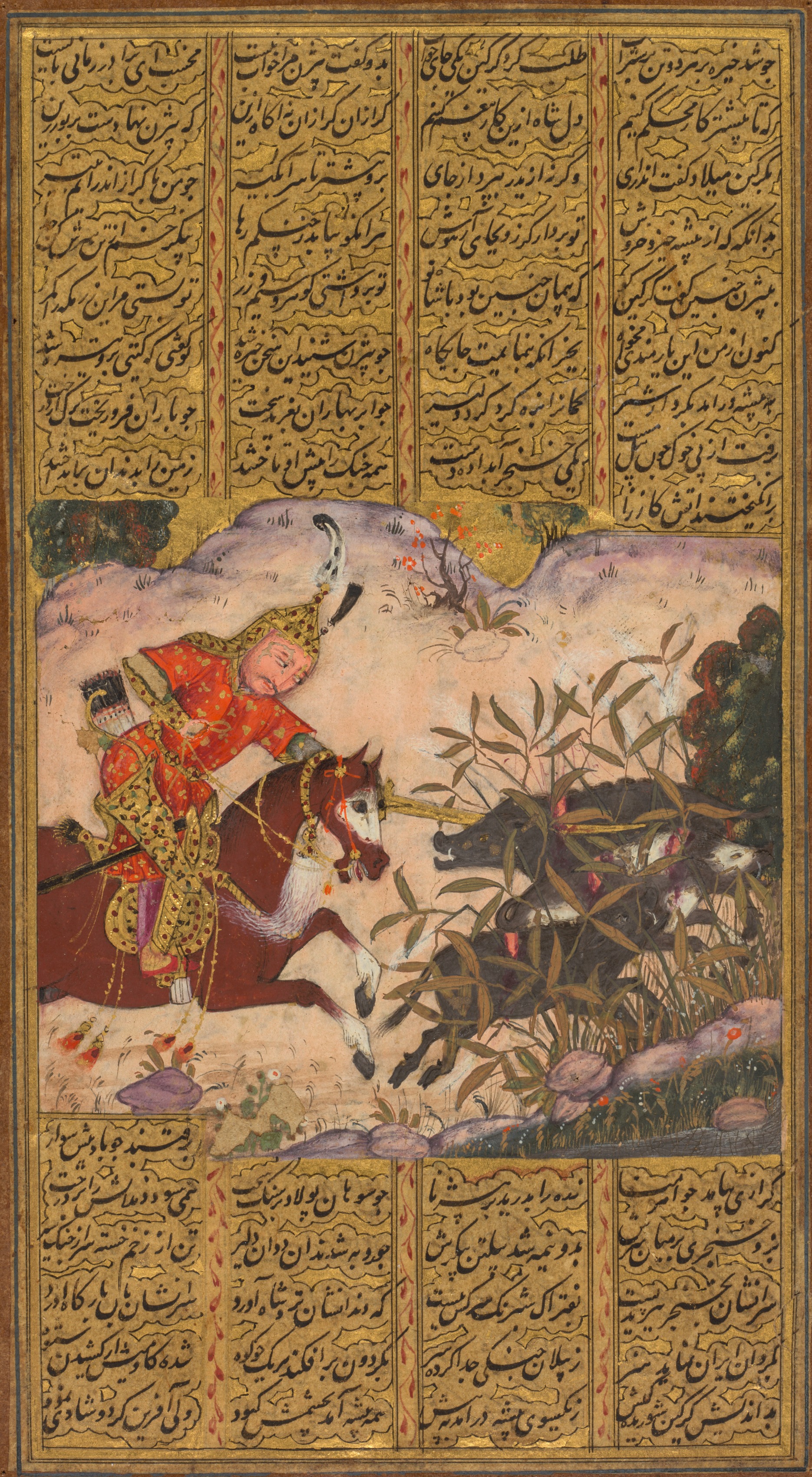
Bijan killing the wild boars of Irman, from a Shah-nama (Book of Kings) of Firdausi (Persian, about 934–1020)
Persian manuscript illustration depicting a man on horseback in a red and gold outfit and hat, holding a spear and stabbing a large black boar. The boar has a white patch on its forehead and its mouth is open. The horse is brown with a white blaze on its face and a long tail. The rider's horse and the boar are surrounded by green plants and flowers. The background of the illustration is a mottled pink and purple sky. The image is framed by a gold border with black Persian script written in eight panels. The top four panels are larger than the bottom four.
Artwork details
- Dimensions:
- 495 × 900 px
- Museum record:
- View original
You May Also Like

Bijan killing the wild boars of Irman, from a Shah-nama (Book of Kings) of Firdausi (Persian, about 934–1020) (verso)

The pious man’s son presents the slain dragon to the king, from a Tuti-nama (Tales of a Parrot): Fifty-second Night

A scene of the life of Alexander from the Sharaf-nameh

Mughal ruler Humayun defeating the Afghans before reconquering India, folio from an Akbar-nama (Book of Akbar) of Abu’l Fazl (Indian, 1551–1602)

The wounded monkey bites the hand of the prince, his chessmate, in the presence of guests, from a Tuti-nama (Tales of a Parrot): Fifth Night

Akbar Mounting his Horse; page from the Chester Beatty Akbar Nama (History of Akbar)

The monkey slain, his blood to be used as medicine for the ailing prince he has bitten, from a Tuti-nama (Tales of a Parrot): Fifth Night

Babur meeting with Sultan Ali Mirza at the Kohik River, from a Babur-nama (Memoirs of Babur)

Prince Mathu Singh of Jatoli on a Blue Horse Riding to Udaipur

The gardener seizes and beats a donkey who insisted on braying, while the deer, its companion flees to safety, from a Tuti-nama (Tales of a Parrot): Forty-first Night

Mary and Joseph Travel to Bethlehem (folio 24 verso), from a Mirror of Holiness (Mir’at al-quds) of Father Jerome Xavier

A charioteer riding through a rocky landscape with an entourage of footmen and musicians, page from a Razm-nama (Book of Wars) adapted from the Sanskrit Mahabharata and translated into Persian by Mir Ghiyath al-Din Ali Qazvini, known as Naqib Khan (Persian, d. 1614)

The fourth man digs at the spot where he dropped the shell, expecting jewels, but discovering mere iron, from a Tuti-nama (Tales of a Parrot): Forty-seventh Night

The Emperor Alamgir (reigned 1658–1707) on Horseback

Nata Ragina: Folio from a ragamala series (Garland of Musical Modes)

A prince riding a composite elephant

The snake, hidden in a basket of flowers, reveals himself to the Raja who has just sent away his wife, from a Tuti-nama (Tales of a Parrot): Forty-third Night

Siyavush on His Horse Hitting a Rolling Target, from a Shahnama (Book of Kings) of Firdausi (940–1019 or 1025) (recto)

Sultan Abdullah Qutb Shah (1614-74) on Horseback

Hunting with falcons in a landscape; verso: Calligraphy of Chaghatai Turkish poems in praise of wine, Sultan Muhammad Nur (Persian, c. 1472–1536) and Mirza Muhammad (probably Persian, active c. 1520s)

The farmer, father of the son with the deceitful wife, steals away with her anklet while she is in bed with her lover, from a Tuti-nama (Tales of a Parrot): Eighth Night

An Episode from the Story of the Sasanian King Khusrau and His Beloved Shirin, from a Khamsa (Quintet) of Nizami (1141–1209) (verso)

The Entry into Jerusalem (folio 156 recto), from a Mirror of Holiness (Mir’at al-quds) of Father Jerome Xavier

Seven men disputing possession of a woman bring her before the Tree of Justice into which she is absorbed, from a Tuti-nama (Tales of a Parrot): Sixth Night