
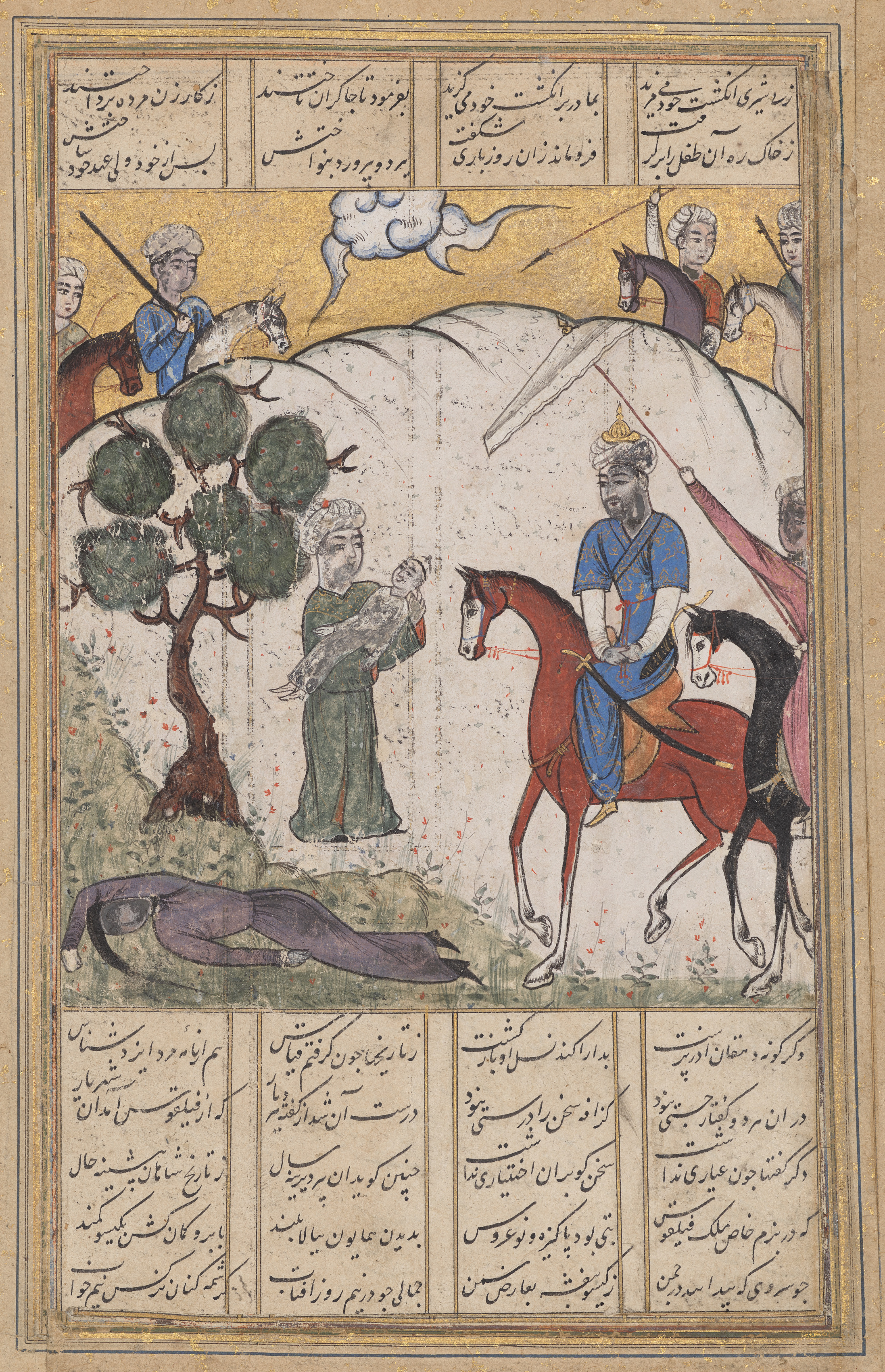
A scene of the life of Alexander from the Sharaf-nameh
The image depicts a scene with several people on horses and one standing by a tree. The scene has a man on a brown horse wearing a blue tunic and a gold crown-like object on his head. He faces right. A man on a black and white horse wearing pink faces him. A man on a white horse wearing blue faces right. A fourth man in green stands by a tree to the left. A man in purple lies on the ground. The background includes a tree with green leaves and a hill with a yellow sky and a white cloud. The image has a border with writing in a language that is not English. The scene appears to come from a book with the scene taking up most of the page and writing in the same language occupying the top and bottom. The scene is from the "Sharaf-nameh" and depicts a scene from the life of Alexander.
Artwork details
- Dimensions:
- 581 × 900 px
- Museum record:
- View original
You May Also Like

An Episode from the Story of the Sasanian King Khusrau and His Beloved Shirin, from a Khamsa (Quintet) of Nizami (1141–1209) (verso)

Habbaza meets Bashir under a tree, from a Tuti-nama (Tales of a Parrot): Twenty-fourth Night

Bijan killing the wild boars of Irman, from a Shah-nama (Book of Kings) of Firdausi (Persian, about 934–1020)

The pious man’s son presents the slain dragon to the king, from a Tuti-nama (Tales of a Parrot): Fifty-second Night

Saint George

The Entry into Jerusalem (folio 156 recto), from a Mirror of Holiness (Mir’at al-quds) of Father Jerome Xavier

Mary and Joseph Travel to Bethlehem (folio 24 verso), from a Mirror of Holiness (Mir’at al-quds) of Father Jerome Xavier

Page From a Dispersed Chandana Malayagiri Varta: (Roaming the Sandlewood Mountain) a (recto), Above, Caravan and Merchants; Below, Raja Presenting a String of Pearls to His Queen; b (verso) A Lady Gathering Wood Beside a Stream

The lover’s son makes an elephant of the pastry dough carried by the unfaithful wife and puts it in her basket, from a Tuti-nama (Tales of a Parrot): Eighth Night

An Ambassador before Humayun

A prince riding a composite elephant

Book of Hours (Use of Utrecht): fol. 221v, Adoration of the Magi

An Episode from the Story of the Sasanian King Khusrau and His Beloved Shirin, from a Khamsa (Quintet) of Nizami (1141–1209) (verso); Persian verses from a Haft Awrang (Seven Thrones) of Jami (d. 1492) (recto)

Leaf from a Book of Hours: Annunciation to the Shepherds (recto)

The place of Jesus’s birth (folio 25 recto), from a Mirror of Holiness (Mir’at al-quds) of Father Jerome Xavier

A charioteer riding through a rocky landscape with an entourage of footmen and musicians, page from a Razm-nama (Book of Wars) adapted from the Sanskrit Mahabharata and translated into Persian by Mir Ghiyath al-Din Ali Qazvini, known as Naqib Khan (Persian, d. 1614)

The rejuvenated old man and the daughter of the king of the jinns take leave of the King of Kings, from a Tuti-nama (Tales of a Parrot): Seventh Night

Christ's Entry into Jerusalem

Yusuf and Zulaykha (recto); Illustration and Text (Persian Verses) in an Anthology with some verses from Haft Awrang (Seven Thrones) of Jami; The Fifth Throne

The young man, who has magically taken on the appearance of Mansur the merchant, arrives at his home, from a Tuti-nama (Tales of a Parrot): Seventeenth Night

The vizier dissuades the king of Bahilistan from executing the dervish who asks for his daughter’s hand in marriage, from a Tuti-nama (Tales of a Parrot): Seventh Night

Book of Hours (Use of Paris): Fol. 118r, Angel and Devil Fighting over a Soul

The young prince is crowned and the wicked handmaiden is executed, from a Tuti-nama (Tales of a Parrot): Eighth Night

Zulaykha in her palace and as an elderly woman with Joseph (recto), from a Panj Ganj (Five Treasures) of Abd al- Rahman Jami (Persian, 1414–1492)