
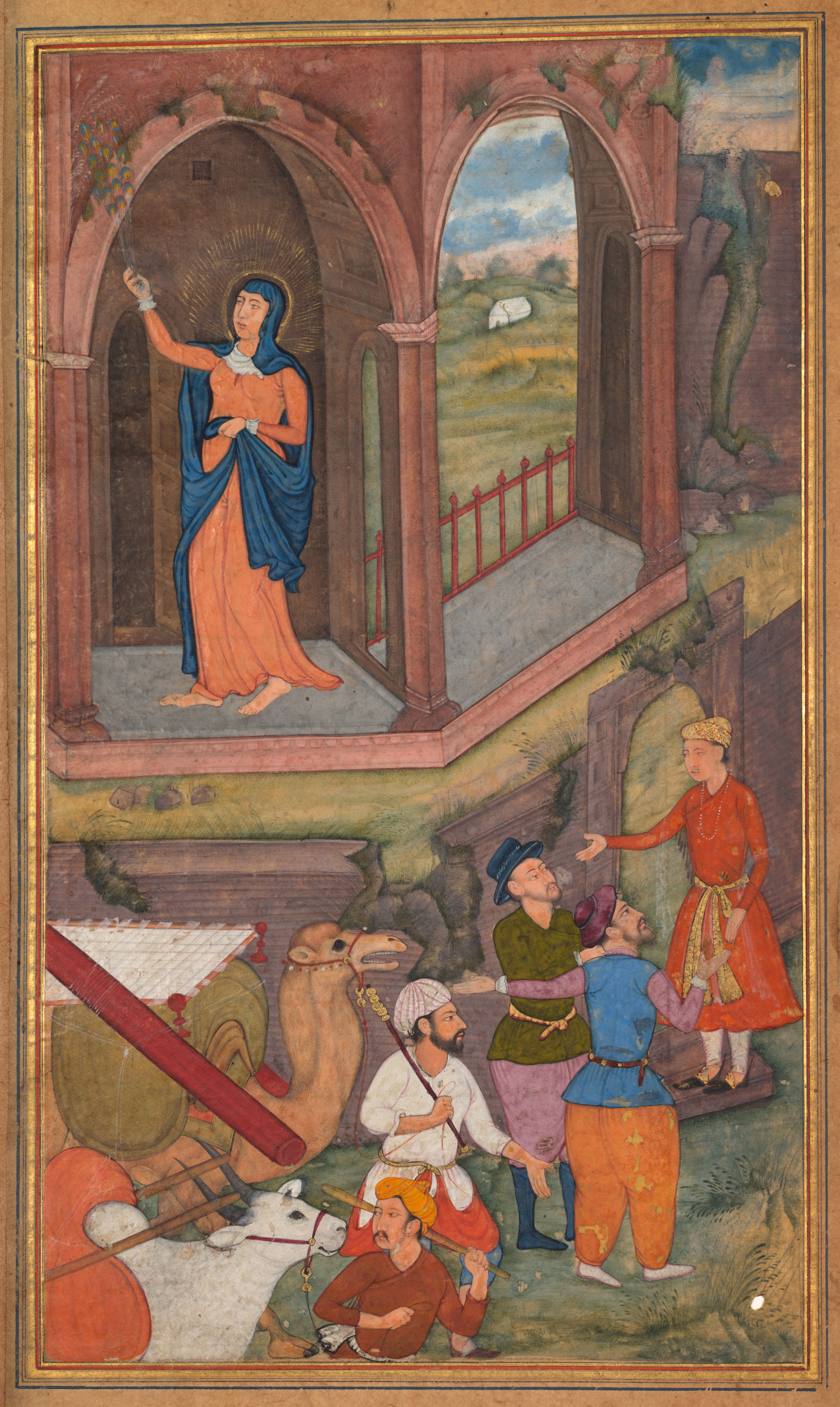
The place of Jesus’s birth (folio 25 recto), from a Mirror of Holiness (Mir’at al-quds) of Father Jerome Xavier
A painting depicting a scene from the life of Jesus Christ. A woman in an orange robe with a blue shawl stands in an arched alcove, pointing up with her right hand. She has a halo around her head. Below her, a group of six men dressed in colorful robes are gathered around a camel and a yoked white ox. One man gestures towards the woman. The background shows grass, a fence, arched structures, a green statue on a pedestal, and a field with a white sheep under a blue sky with clouds. The painting has a gold frame.
Artwork details
- Dimensions:
- 537 × 900 px
- Museum record:
- View original
You May Also Like

Simeon Kneels in Front of Mary and Jesus after Recognizing Them (folio 40 recto), from a Mirror of Holiness (Mir’at al-quds) of Father Jerome Xavier

Jesus Heals the Nobleman’s Son in Capernaum (folio 70 recto), from a Mirror of Holiness (Mir’at al-quds) of Father Jerome Xavier

The Marriage at Cana (folio 58 verso), from a Mirror of Holiness (Mir’at al-quds) of Father Jerome Xavier

The merchant returns bringing a young slave who is really the son of the princess of Rum, now married to the king, from a Tuti-nama (Tales of a Parrot): Fiftieth Night

Mary Magdalene Presents Ointment to Jesus (folio 102 verso), from a Mirror of Holiness (Mir’at al-quds) of Father Jerome Xavier

Kaiwan, Latif, and Sharif arrive at a house of worship, where they seek help from Khurshid who has become a mystical healer, from a Tuti-Nama (Tales of a Parrot): Thirty-second Night

The vizier dissuades the king of Bahilistan from executing the dervish who asks for his daughter’s hand in marriage, from a Tuti-nama (Tales of a Parrot): Seventh Night

Folios A and B from the "Five Treasures" (Panj Ganj) of Jami

Zulaykha in her palace and as an old woman with Joseph, from a Panj Ganj (Five Treasures) of Abd al-Rahman Jami (Persian, 1414–1492); verso from a Panj Ganj of Abd al-Rahman Jami (Persian, 1414–1492), with two masnavis: Yusuf va Zulaykha (Joseph and Zulaykha) and Khirad-nama-i Iskandari (Alexander’s Book of Wisdom)

Zulaykha in her palace and as an elderly woman with Joseph (recto), from a Panj Ganj (Five Treasures) of Abd al- Rahman Jami (Persian, 1414–1492)

The three young men present themselves as suitors for the hand of Zuhra, the daughter of the merchant of Kabul, from a Tuti-nama (Tales of a Parrot): Thirty-fourth Night

Mary ascends the stairs to the temple, from a Mirror of Holiness (Mir’at al-quds) of Father Jerome Xavier

Babur receives booty and Humayun’s salute after the victory over Sultan Ibrahim in 1526, from an Akbar-nama (Book of Akbar) of Abu’l Fazl (Indian, 1551–1602)

Preparation for the marriage of Mahmuda to the Young Vizier, from a Tuti-nama (Tales of a Parrot): Thirty-third Night

The magician disguised as a Brahman returns to claim his “daughter-in-law,” from a Tuti-nama (Tales of a Parrot): Thirty-fifth Night

The rejuvenated old man and the daughter of the king of the jinns take leave of the King of Kings, from a Tuti-nama (Tales of a Parrot): Seventh Night

The two couples reach a foreign city where they make their home, from a Tuti-nama (Tales of a Parrot): Thirty-third Night

The son of the king of Babylon sees the Brahman transformed into a woman bathing and falls in love with her, from a Tuti-nama (Tales of a Parrot): Thirty-fifth Night

Jesus writes on the ground (folio 130 verso), from a Mirror of Holiness (Mir’at al-quds) of Father Jerome Xavier

The old procuress conveys the young man’s message of love to Mansur’s wife, from a Tuti-nama (Tales of a Parrot: Seventeenth Night

Mary and Joseph Travel to Bethlehem (folio 24 verso), from a Mirror of Holiness (Mir’at al-quds) of Father Jerome Xavier

The deceitful wife assaults her erring husband, from a Tuti-nama (Tales of a Parrot): Eighth Night

The magician, disguised as a Brahman, visits the king of Babylon, from a Tuti-nama (Tales of a Parrot): Thirty-fifth Night

Timur distributes gifts from his grandson, the Prince of Multan, from a Zafar-nama (Book of Victories)