
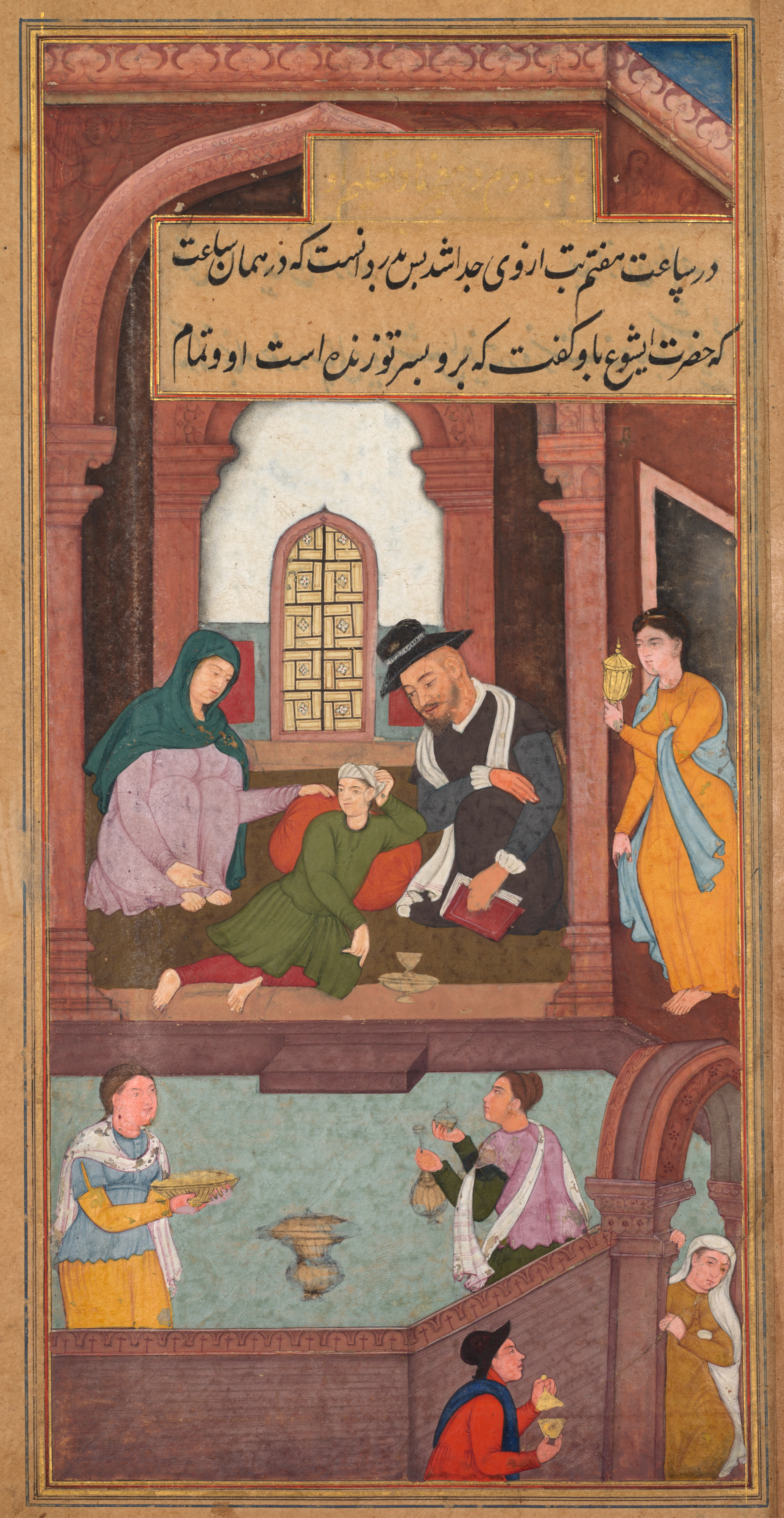
Jesus Heals the Nobleman’s Son in Capernaum (folio 70 recto), from a Mirror of Holiness (Mir’at al-quds) of Father Jerome Xavier
Rectangular painting with a thin gold border. Inside the border, top portion: a man sits on a platform with a woman on his left and a man on his right; woman to the right stands. The seated man wears green and is reclining. The man on his right wears a black hat and dark clothing; he holds a book. The woman on the left wears a green head covering and a pink dress. The woman on the right wears yellow and blue. Behind them is a window with a brown frame, divided into small, square panes; some are open. Above them is a tan rectangle with black text written in a foreign language. Inside the border, bottom portion: a man and three women. The man crouches at the bottom right and holds a cup. To his left, a woman wearing blue and yellow holds a tray. To her left, a woman wearing purple stands; she holds flowers. To her left, an older woman with a white head covering looks over a ledge. The background in the top portion is red and brown; the background in the bottom portion is green.
Artwork details
- Dimensions:
- 465 × 900 px
- Museum record:
- View original
You May Also Like

Simeon Kneels in Front of Mary and Jesus after Recognizing Them (folio 40 recto), from a Mirror of Holiness (Mir’at al-quds) of Father Jerome Xavier

Jesus writes on the ground (folio 130 verso), from a Mirror of Holiness (Mir’at al-quds) of Father Jerome Xavier

The Marriage at Cana (folio 58 verso), from a Mirror of Holiness (Mir’at al-quds) of Father Jerome Xavier

Timur distributes gifts from his grandson, the Prince of Multan, from a Zafar-nama (Book of Victories)

Jesus Raises Jairus’s Daughter from the Dead (folio 82 verso), from a Mirror of Holiness (Mir’at al-quds) of Father Jerome Xavier

Mary Magdalene Presents Ointment to Jesus (folio 102 verso), from a Mirror of Holiness (Mir’at al-quds) of Father Jerome Xavier

Salome Receiving John the Baptist’s Head on a Platter (folio 112 verso), from a Mirror of Holiness (Mir’at al-quds) of Father Jerome Xavier

Jesus being portrayed by King Abgar’s painter (folio 143 recto), from a Mirror of Holiness (Mir’at al-quds) of Father Jerome Xavier

Repenting his conduct, ‘Ubaid falls at the feet of his parents, from a Tuti-nama (Tales of a Parrot): Forty-second Night

John the Baptist recognizes Christ by the appearance of a dove (folio 50 verso), from a Mirror of Holiness (Mir’at al-quds) of Father Jerome Xavier

Preparation for the marriage of Mahmuda to the Young Vizier, from a Tuti-nama (Tales of a Parrot): Thirty-third Night

The three young men present themselves as suitors for the hand of Zuhra, the daughter of the merchant of Kabul, from a Tuti-nama (Tales of a Parrot): Thirty-fourth Night

The place of Jesus’s birth (folio 25 recto), from a Mirror of Holiness (Mir’at al-quds) of Father Jerome Xavier

The Flowering of Joseph’s Rod (folio 11 verso), from a Mirror of Holiness (Mir’at al-quds) of Father Jerome Xavier

European Costume Scene

The four destitute friends go to a wise man who gives each one of them a magic shell to be placed on top of the turban, from a Tuti-nama (Tales of a Parrot): Forty-seventh Night

Babur receives booty and Humayun’s salute after the victory over Sultan Ibrahim in 1526, from an Akbar-nama (Book of Akbar) of Abu’l Fazl (Indian, 1551–1602)

A feast for Babur hosted by his half-brother Jahangir Mirza in Ghazni in May 1505, from a Babur-nama (Memoirs of Babur)

Zulaykha in her palace and as an elderly woman with Joseph (recto), from a Panj Ganj (Five Treasures) of Abd al- Rahman Jami (Persian, 1414–1492)

Yusuf and Zulaykha (recto); Illustration and Text (Persian Verses) in an Anthology with some verses from Haft Awrang (Seven Thrones) of Jami; The Fifth Throne

Folios A and B from the "Five Treasures" (Panj Ganj) of Jami

Zulaykha in her palace and as an old woman with Joseph, from a Panj Ganj (Five Treasures) of Abd al-Rahman Jami (Persian, 1414–1492); verso from a Panj Ganj of Abd al-Rahman Jami (Persian, 1414–1492), with two masnavis: Yusuf va Zulaykha (Joseph and Zulaykha) and Khirad-nama-i Iskandari (Alexander’s Book of Wisdom)

The old procuress conveys the young man’s message of love to Mansur’s wife, from a Tuti-nama (Tales of a Parrot: Seventeenth Night

Bahram Visits the White Domed Pavilion on Friday, illustrated with text in Khamsa of Nizami (verso), from a Haft Paykar (Seven Portraits) of Nizami