
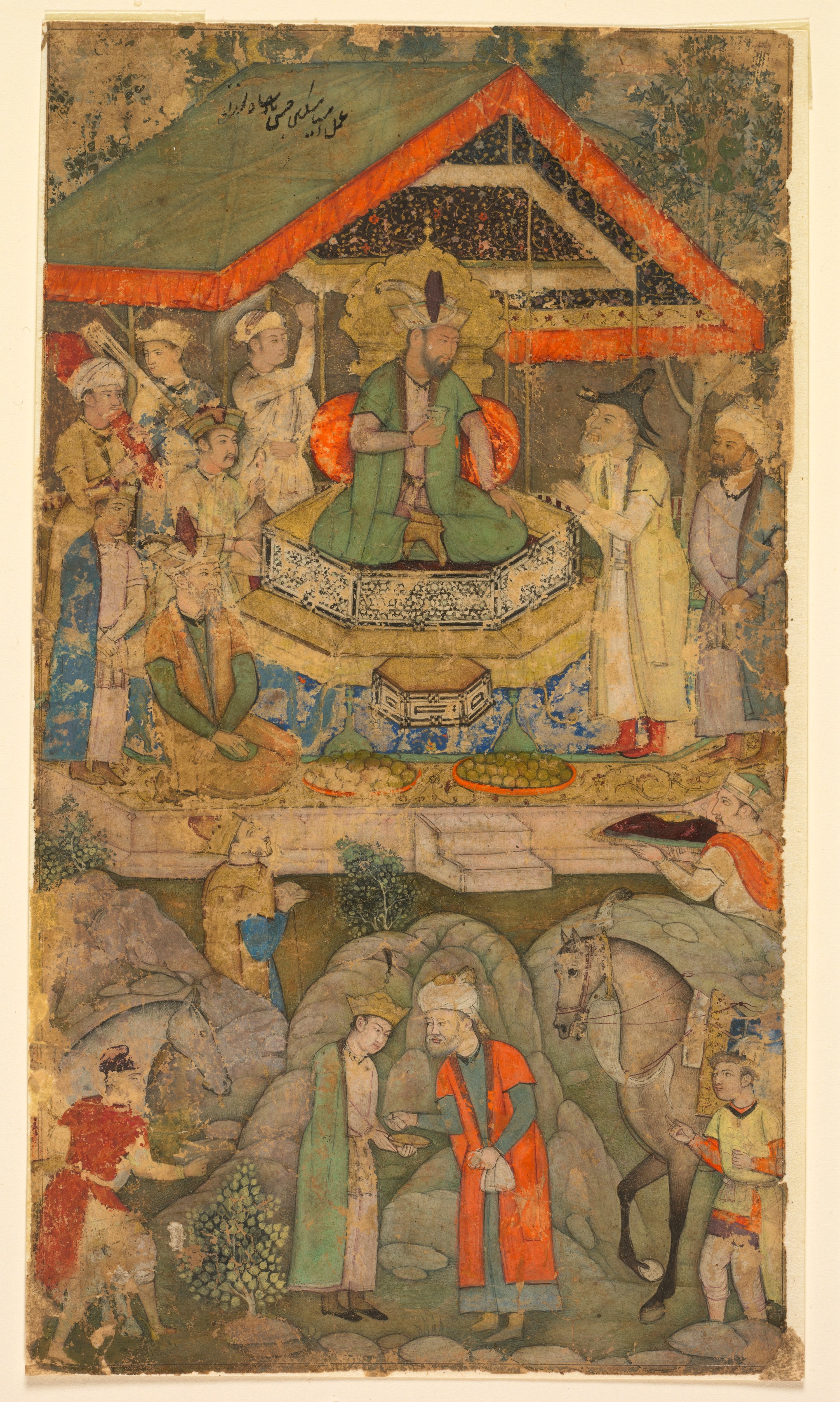
The image depicts a two-scene composition. The top scene shows a man seated on an octagonal platform under a green and orange canopy. He wears a green robe and a white turban with a feather. Several people stand around him. The bottom scene shows people interacting; one man in an orange robe stands facing another in a green robe. A gray horse is present. The artwork is titled "An Ambassador before Humayun" by Miskin. The scene shows Humayun, the second Mughal emperor, seated on a platform, wearing green. He has a white beard and mustache, and a tall white turban. His right hand rests on his chest. He sits on a gold throne-like object decorated with blue. A canopy above is green with an orange border. Several attendants stand around. In the bottom scene, people in robes and turbans interact. A man holds a horse by the bridle. The background includes trees and rocks. The color palette includes shades of green, orange, blue, and beige. The style appears to be Mughal or Persian miniature painting.
Artwork details
- Dimensions:
- 539 × 900 px
- Museum record:
- View original
You May Also Like

Royal Reception in a Landscape, left folio from the double frontispiece of a Shahnama (Book of Kings) of Firdausi (Persian, about 940–1019 or 1025)

Royal Reception in a Landscape, left folio from the double frontispiece of a Shahnama (Book of Kings) of Firdausi (Persian, about 940–1019 or 1025)

Preparation for the marriage of Mahmuda to the Young Vizier, from a Tuti-nama (Tales of a Parrot): Thirty-third Night

Yusuf and Zulaykha (recto); Illustration and Text (Persian Verses) in an Anthology with some verses from Haft Awrang (Seven Thrones) of Jami; The Fifth Throne

Babur receives booty and Humayun’s salute after the victory over Sultan Ibrahim in 1526, from an Akbar-nama (Book of Akbar) of Abu’l Fazl (Indian, 1551–1602)

Royal Reception in a Landscape, right folio from a double-page frontispiece of a Shahnama (Book of Kings) of Firdausi (940–1019 or 1025)

An Episode from the Story of the Sasanian King Khusrau and His Beloved Shirin, from a Khamsa (Quintet) of Nizami (1141–1209) (verso)

The vizier dissuades the king of Bahilistan from executing the dervish who asks for his daughter’s hand in marriage, from a Tuti-nama (Tales of a Parrot): Seventh Night

Page from a Manuscript of Kulliyat (Complete Works) by Sa'di

The merchant hears of his wife’s unfaithfulness (above); the unfaithful wife performs penance by plucking her hair (below), from a Tuti-nama (Tales of a Parrot): First Night

A traveler persuades Lorik to return home (top); Chanda objects (bottom), from a Chandayana (Story of Chanda)

Simeon Kneels in Front of Mary and Jesus after Recognizing Them (folio 40 recto), from a Mirror of Holiness (Mir’at al-quds) of Father Jerome Xavier

Royal Reception in a Landscape, right folio from the double frontispiece of a Shahnama (Book of Kings) of Firdausi (Persian, about 940–1019 or 1025) (verso)

A feast for Babur hosted by his half-brother Jahangir Mirza in Ghazni in May 1505, from a Babur-nama (Memoirs of Babur)

Left side of a double-page album folio: Outside a Royal Encampment (recto)

The rejuvenated old man and the daughter of the king of the jinns take leave of the King of Kings, from a Tuti-nama (Tales of a Parrot): Seventh Night

The court of the Raja of Ujjain, from a Tuti-nama (Tales of a Parrot): Forty-sixth Night

The merchant returns bringing a young slave who is really the son of the princess of Rum, now married to the king, from a Tuti-nama (Tales of a Parrot): Fiftieth Night

Bashir confides his love for Habbaza to an Arab friend, and sends him to her with a message, from a Tuti-nama (Tales of a Parrot): Twenty-fourth Night

Khurshid reunited with her husband Utarid, from a Tuti-nama (Tales of a Parrot): Thirty-second Night

Circumcision ceremony for Akbar’s sons, painting 126 from an Akbar-nama (Book of Akbar) of Abu’l Fazl (Indian, 1551–1602)

The young prince is crowned and the wicked handmaiden is executed, from a Tuti-nama (Tales of a Parrot): Eighth Night

Mary ascends the stairs to the temple, from a Mirror of Holiness (Mir’at al-quds) of Father Jerome Xavier

The Story of Hushang, from a Majma al-tavarikh (A Compendium of Histories) of Hafiz-i Abru (recto)