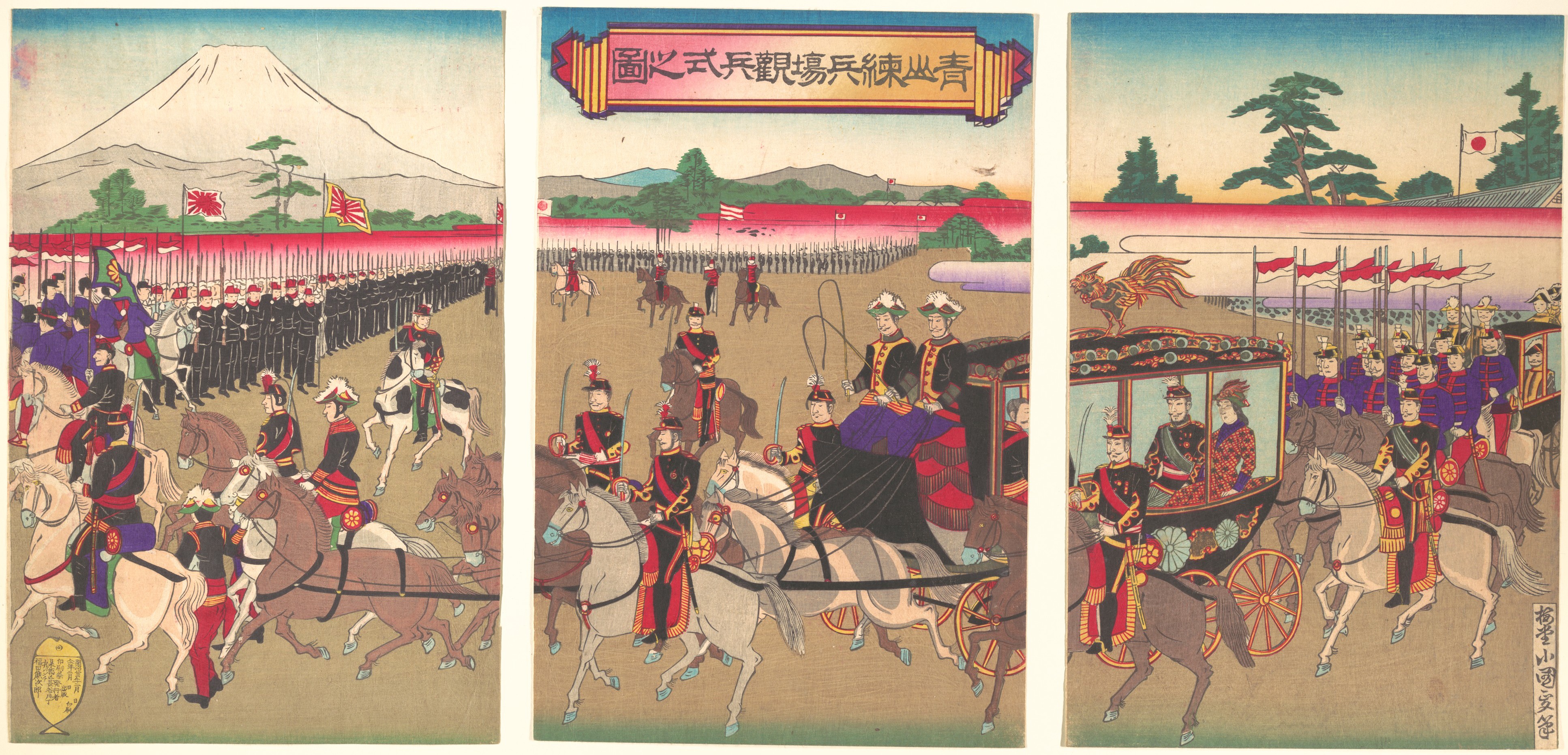
Review of Troops at the Aoyama Training Grounds
Three-panel artwork, color woodblock print. The scene depicts a military review. In the left panel, a mountain, possibly a volcano with snow on top, is in the background; a line of soldiers in dark uniforms stand at attention; some on horseback in traditional Japanese military uniforms ride towards them. In the center panel, a man on a white horse wearing a purple and red uniform rides towards the right; another man on a white horse wearing the same uniform rides behind him; a yellow and red banner in the top center reads "Aoyama Jinenjo", a training ground; Japanese characters are written in black ink; mountains are in the background. The right panel shows a horse-drawn carriage with two people wearing traditional Japanese military uniforms; two white horses pull the carriage; another group of men on horseback wearing traditional Japanese military uniforms ride in the same direction; a line of soldiers stand at attention with flags behind them; green trees are in the background.
Artwork details
- Date:
- February 1889
- Medium:
- One sheet of a triptych of woodblock prints (nishiki-e); ink and color on paper
- Culture:
- Japan
- Dimensions:
- 598 × 288 px
- Museum record:
- View original
You May Also Like

Review of Troops at the Aoyama Training Grounds
Review of Troops at the Aoyama Training Grounds

View of the Imperial Carriage
Illustration of the Imperial Carriage (Gohōren no zu)
View of the Imperial Carriage

Parade of the Emperor's Troops

Maharao Ram Singh II of Kota (r. 1828–66) Hunting Buffalo

King Dasaratha and His Retinue Proceed to Rama's Wedding: Folio from the Shangri Ramayana Series (Style II)

Maharaja Balwant Singh of Ratlam (r. 1825–57) in Procession with His Relatives and Courtiers

Picture of a Procession of Foreigners at Yokohama

Parody of Ariwara no Narihira's journey to the east

Englishman Walking for Pleasure

Poem by Kanke (Sugawara Michizane), from the series One Hundred Poems Explained by the Nurse (Hyakunin isshu uba ga etoki)

Chronicle of the Imperial Restoration (Kōkoku isshin kenbunshi)

A charioteer riding through a rocky landscape with an entourage of footmen and musicians, page from a Razm-nama (Book of Wars) adapted from the Sanskrit Mahabharata and translated into Persian by Mir Ghiyath al-Din Ali Qazvini, known as Naqib Khan (Persian, d. 1614)

Foreigners Visiting the Famous Site of Mt. Gongen in Kanagawa

Poem by Kanke, from the series "One Hundred Poems Explained by the Nurse (Hyakunin isshu uba ga etoki)"

Illustration of the Commanders who Pacified Western Japan, Receiving the Emperor's Gift Cups (Saigoku chinbu shoshō tenpai o tamau no zu)

Kamsa deploys Akrura and Keshi to Braj, from a Bhagavata Purana

Chiyoda Castle (Album of Men)

Equestrian Portrait of Maharana Raj Singh II of Mewar (r. 1755–62)

The Port of London England

The Actors Segawa Kikunojo III as Koito, Sawamura Sojuro III as the monk Sainenbo, and Ichikawa Monnosuke II as the monk Renseibo, in the shosa "Mata Saku Hana Museume Dojoji," performed at the Nakamura Theater in the fourth month, 1783

Civil and Military Officers


